
China through the lens
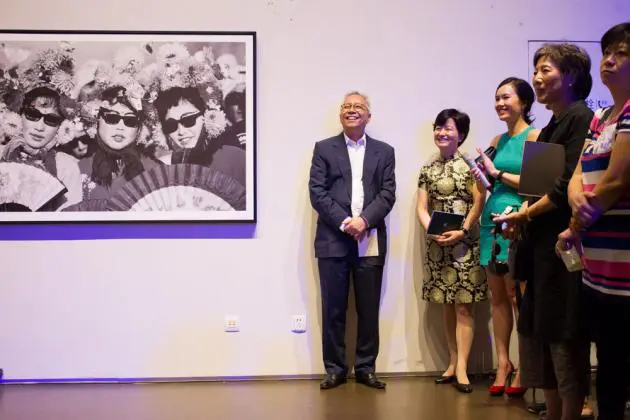


Liu Heung Shing looks back over his 35-year photo journalism career.
THREE DECADES have passed since Liu Heung Shing published his photography book “China after Mao”. Now the Pulitzer Prize winner is presenting, for the first time in China, 115 of his pictures at China Art Museum in Shanghai. The exhibition “China Dream, Thirty Years” spans a 35-year period of observing the country through his camera lens.
China has experienced 30 years of drastic changes and development, the photographer notes, and for many people, this has been a period of dreams coming true.
The country has been like a giant ship moving in a new direction since 1978, when China started to focus on economic development and open up to the world. Liu has witnessed and captured the country’s transformation from collectivism to individualism.
Liu’s pictures take up two exhibition halls on the ground floor of the museum. The curator has arranged the exhibits in a way that, in one of the halls, images focus on collective life of China, while the other features diverse personalities and individuals.
Liu was born in 1951 and spent most of his childhood in Fujian province before moving to Hong Kong. When studying at the City University of New York, he read extensively about China, comparing what he read with his impressions from childhood.
Upon graduation, his enthusiasm about China led him back to the country as a journalist. His first assignment as a photographer was in 1976. He was denied permission to photograph the mourning in Beijing over Chairman Mao’s death, so he stayed in Guangzhou, but he was sensitive enough to find traces of a society ready to change. “People practised tai chi in the park as usual, but their shoulders looked somehow relaxed, slightly different,” Liu recalls.
In 1978 he became the founder of Time magazine’s Beijing office, while continuing to serve as a reporter. He was impressed with the prevalence of political intervention in everyday life. One of his most famous works showed workers taking Mao’s portrait off the facade of the National Museum of Chinese History on the east side of Tiananmen Square, illustrating the end of an era.
He went on to photograph people trying on sunglasses at a commodities fair, aspiring artists presenting their creations along a public wall, and young lovers managing to have a moment of intimacy without the luxury of privacy.
“I keep my eyes and ears open,” the photographer told the media at the opening of “China Dream, Thirty Years” in Shanghai. “I hope I can feel China’s pulse in every period and show its highest height and lowest low with my pictures when words fail to do so.”
In recent years Liu has devoted lots of time and effort to compiling photo documentaries about China. His book “China, Portrait of a Country” has been translated into six languages since 2008 and sold more than 250,000 copies.
In 2010 Liu collaborated with Briton Karen Smith, a critic and curator of contemporary art, to publish “Shanghai: A History in Photographs, 1842-Today”. Smith is also curator of Liu’s exhibition at China Art Museum in Shanghai.
Photography is greatly different nowadays compared with the 1970s when Liu started his career in China, Smith says. One could take no more than 36 pictures with a roll of film and the photographer had to keep his wits about him whenever he was shooting.
Sometimes one might capture a great shot by luck, but most of the time, it is achieved through keen perception and understanding of the time and place he is working, Smith says. Nowadays everybody takes pictures with digital cameras and mobile phones. Photography is no longer as reliable, since it can be digitally altered using computer software.
Liu says he belonged to the last generation of photojournalists. Now agencies and publications will dispatch staff members wherever news happens. Journalists rarely have the luxury of living for years in a country, submerging in the local culture and lifestyle.
“I got to see China and digest what I saw through photography,” Liu said. “I hope to present our common memories for the past 30 years, when China’s drastic changes and development has the whole world impressed. It’s impossible to present it with dry statistics of GDP, and that’s not my job.”
His photography of details of daily life – how people live, leisure and love – filled the giant gaps between the dry numbers of historic narration, Smith says. It is the details and personal feelings that connects to all human beings, and makes his pictures special.
