
To the continent of ice
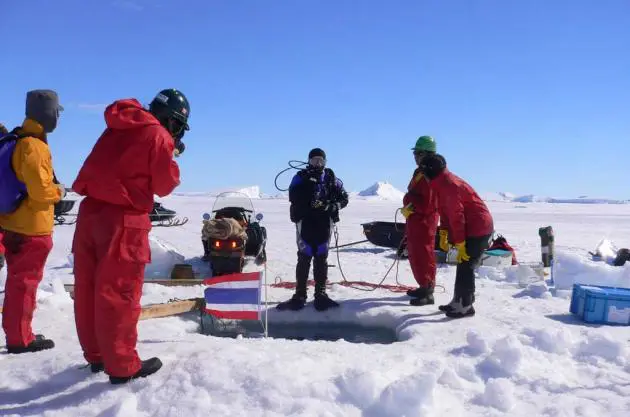


Two Thai researchers arrive in Antarctica tomorrow seeking the answers it holds to climate change
Chulalongkorn University researchers Suchana Chavanich and Onruthai Pinyakong are off to freezing Antarctica to peer at microbes and calculate the impact that climate change has on marine animals.
Dr Suchana, 41, with the Department of Marine Science, and Dr Onruthai, 37, in the Department of Microbiology, have joined a Chinese expedition heading to the Great Wall Research Station.
They’ve been in Chile since the year dawned and will be transported by helicopter to Antarctica tomorrow.
It’s not the first visit to the southernmost continent for Suchana. A veteran, American-trained diver and a “hands-on” scientist, she travelled to the South Pole with the Japanese Antarctic Research Expedition, which extended from November 2009 to March 2010. She and Dr Voranop Viyakarn, 50, who was in Antarctica with the same expedition in 2004, share their experience in the new book “Polar Harmony”.
On this trip Suchana will for the first time dive into the icy sea, getting a better perspective of marine animals in their natural habitat. “I’ll be the only capable Arctic diver on this expedition and I’ll be diving alone – without a buddy,” she says.
It will be rather risky, she admits, recalling a leopard seal’s attack on an Australian diver, but she’s confident of avoiding danger if the animals don’t feel threatened.
This is part of the Expedition to the North and South Poles in the Footsteps of HRH Princess Maha Chakri Sirindhorn, a project announced during a press conference held by the National Science and Technology Development Agency (NSTDA) on November 19. The researchers are expected to return home on February 15.
The Thai scientists are travelling with the 30th Chinese Antarctic Research Expedition, which has arranged the fast helicopter in place of the boats used for the Japanese expeditions to reach Antarctica, which took at least a month.
Onruthai, making the excursion for the first time, acknowledges that she has little training or field experience. She says she never dreamed of participating in such an adventure, having always conducted lab studies of microbes.
On previous outings she mainly surveyed the creatures in the Gulf of Thailand and the Chao Phraya River, through she did test some of the soil samples that Suchana brought back from Antarctica. The biting cold and icy plains that loom ahead for her thus present a huge challenge, but she says she’s ready for it.
“I’m excited and honoured to have the opportunity, especially in the footsteps of Her Royal Highness Princess Maha Chakri Sirindhorn,” Onruthai says. “I’ll try my best. This will be a great experience!”
Princess Sirindhorn visited Antarctica in 1993, the first Thai to do so, according to NSTDA senior adviser Dr Pairash Thajchayapong. Impressed with the research she saw underway at Scott Base and McMurdo Station, she suggested that Thai researchers should regularly visit the continent as well to further their knowledge.
The studies planned for the 2014 trip have interesting implications. “I’ll be examining the effects of climate change, both global warming and cooling, on marine animals,” Suchana says. “I’ve done this before in Antarctica, but this time I’ll be
looking at an area where climate change has had a greater impact.”
On her previous expedition Suchana found that animals are more prone to disease and parasites as a result of climate change. The rising sea temperature affects their habitat as well, inevitably altering the marine ecosystem.
Asked why the impact of climate change on Antarctic life specifically is important, she explains that the North and South Poles accumulate pollution from all around the planet as a result of the earth’s rotation.
The South Pole, despite having no permanent human inhabitants, is thus one of the world’s most polluted places, so it can serve as an indicator of global climate change. Suchana calls it “the first frontier to observe the impact”. Changes occurring there forecast what will eventually happen everywhere.
That same intensive pollution draws Onruthai to examine the indigent microbes and their ability to break down pollutants accumulating in the soil. They appear able to handle the problem without the help of other species that man could introduce but which could harm the ecosystem.
Both women are bracing for severe weather, saying it will pose the most daunting challenge on their journey.
Suchana points out that Antarctica has the world’s most unpredictable weather, with snowstorms striking so suddenly and fiercely that they can cripple research. Every scientist going there, she says, must understand and accept that they might get only half of their planned studies done.
DEEPEST SOUTH
“Polar Harmony” is available at the National Science Museum and Chulalongkorn Book Centre for Bt600 this month and Bt750 thereafter.
