
Purity shrouded in darkness


Play
The Preljocaj Ballet offers a spellbingly black take on the tale of Snow White
FOR MANY OF us, the story of “Snow White” conjures up images of a daydreaming princess singing “Someday My Prince Will Come” to her wide-eyed dwarf pals or whistling a happy tune while doing housework with cute woodland animals.
Artistic director of the Preljocaj Ballet Angelin Preljocaj, however, ditched Disney in favour of the Grimm brothers’ original story as his inspiration for the timeless tale staged on Wednesday night as part of Bangkok’s 16th International Festival of Dance and Music.
The renowned French choreographer instead took his audience into a strange world of dark beauty, base desires and death. The contemporary ballet opened with a loud bang, the stage filling with smoke, as an elegant woman dressed in black collapsed to the ground. Writhing in excruciating pain, she died alone in childbirth. This striking first scene was a far cry from the romantic image of a queen sewing by an open window during a winter snowfall stuck in my mind from childhood cartoons.
The sullen atmosphere was sustained throughout the performance with murky yet beguiling lighting in most scenes. The music score, combining Mahler and electronic sounds by 79D, added an entrancing, otherworldly air to the production. Visceral sexuality was heightened with Jean Paul Gaultier’s racy costumes that exposed much of the group dancers’ bare legs and turned the seductive Stepmother (Cecilia Torres Morillo) into a dominatrix, complete with a black leather corset and thigh-high boots.
Even Snow White (Emilie Lalande) herself was not as pure as her name suggests. Wearing Gaultier’s white diaper-dress with a plunging neckline and figure-revealing slits up the side, the heroine seemed eager to leave her virginal childhood for the adult world of pleasures. Snow White didn’t wait for love, choosing her Prince (Jean-Charles Jousni) at her coming-of-age ball earlier in the show. The pair even ran off to a lovers’ lane in the woods and got to know each other better in a passionate, fluid pas de deux amidst four other scantily clad couples.
The overall choreography though, seemed a little hit-and-miss. Despite all the dancers being barefoot, many sequences felt like a less impressive pastiche of well-known classical and dramatic ballets. The palace ball reminded me of Princess Aurora’s coming-of-age party in “Sleeping Beauty”, with the same classical format of a corps de ballet showcase interspersed with smaller group dances. The courtship in the woods was reminiscent of the balcony scene pas de deux in “Romeo and Juliet” while the Prince’s solo in response to the discovery of Snow White’s “corpse” brought to mind the heartbroken Duke Albrecht’s dance in “Giselle”.
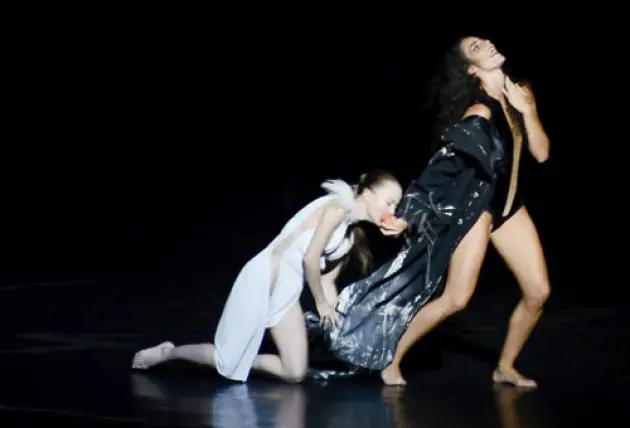
The contemporary ballet nevertheless had its moments of ingenuity. Instead of following the fairy tale and giving Snow White a poisonous apple for her to take a bite from, the Stepmother in Preljocaj’s production violently shoved the fruit into the poor girl’s mouth. She continued dragging Snow White by her head, her mouth still glued to the apple, and created an enthralling, hair-raising duet out of the movements. The Prince’s subsequent pas de deux with the “dead” Snow White was also morbidly mesmerising as he manoeuvred her limp body in his arms and over his body like a skilled puppeteer in a frenzy of love and grief.
Another memorable moment in the show was the entrance of the seven miners – Preljocaj’s answer to the dwarves – who abseiled down the spectacular mountain set by Thierry Leproust and started an energetic aerial ballet of flips and leaps against the shimmery brown surface. Creative aerial work wasn’t used only for the acrobatics but to also enhance the emotions in the more vulnerable side of the story, when Snow White’s late mother flew down to weep over and embrace her seemingly lifeless daughter for the first time.
The chilling image of Snow White’s Stepmother dancing and jerking to her death in burning iron shoes at the end summed up the dark take on the popular fairy tale perfectly.
However, even with this striking presentation, the production wasn’t much more than another story ballet. Preljocaj said himself that he wanted to more deeply examine the dramatic content and symbols of the story but, to me, relevant issues like coming-of-age and loss, also could also have been explored more extensively and eloquently.
DANCING QUEEN
Bangkok’s 16th International Festival of Music and Dance continues tomorrow and on Wednesday with “The World's Greatest ABBA Show” by the Arrival from Sweden. Shows are at 7:30 at the Thailand Cultural Centre.
For tickets, visit www.ThaiTicketMajor.com. For more details, visit www.BangkokFestivals.com.
