
A timely discussion


Play
Ornanong Thaisriwong's new solo performance is crisper and more poignant than ever in our unique political climate
The front of the programme leaflet of B-Floor Theatre’s “Bang la Merd”, a solo work by Ornanong “Golf” Thaisriwong, shows a section of Paris map as well as where last month’s Charlie Hebdo incidents took place. A video excerpt from a demonstration in Paris screened briefly during the performance shows the way the French spell out the title “Bang la Merd” and thus a connection is made from the word go.
And despite Golf enjoying her high tea while the video shows a wall on to which the words “Fight on, Pancake” have been sprayed, we are reminded that freedom of expression is a global issue, something we tend to forget in a climate where everything is calm and clean and happiness is, supposedly, returning.
Theatre is the least censored medium in this country, thanks perhaps to the least exposure to, and impact on, the public. Thai theatre artists’ freedom of expression was tested, though, when a representative from the army made a call to Thong Lor Art Space the morning of the press preview performance. Golf, cheekingly and jovially, re-enacted the scene when her producer Dujdao “Dao” Vadhanapakorn Boonyai made a call back and asked whether a theatre company needed to seek permission, and from whom, before staging a performance. Dao’s implication was probably, “Excuse me, is this Singapore?”
The company then invited army personnel to watch the performance that day. They’ve been coming every night ever since, and Golf also points them out to the audience, while the show goes on as scheduled. This news of the government’s interest in contemporary Thai theatre has now gone global and an internationally renowned theatre director texted me from Hong Kong to ask, “Is it serious?”
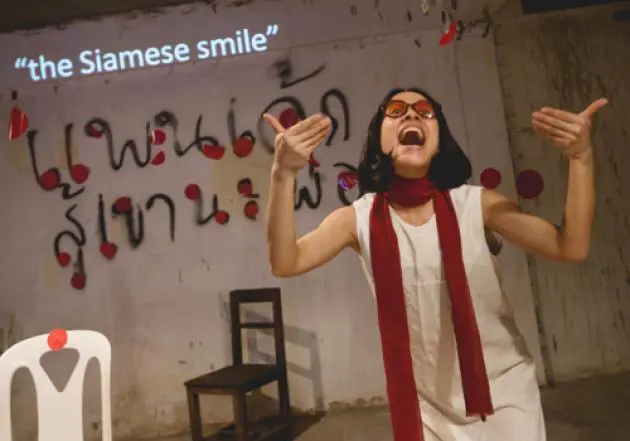
“Bang la Merd” is deftly staged as a site-responsive performance. In the fourth floor room, an out-of-bounds space for this venue, which has seen most works staged on either the first or third floors, razor blades are hung from the ceiling and audience seats are scattered sporadically. Golf performs in almost every corner. She grabs the attention with a few scenes in which we can actively participate, especially at her spot-on portrayal of a teacher who instructs us how to give three signature Siamese smiles.
One of the smiles reminded me of a senior colleague who suggested I teach film criticism by showing a scene from a movie and then telling my students what I thought – in other words, think for them – instead of watching the whole movie and sharing their thoughts with professional critics, other students and the public. On a larger perspective, our democracy is the way it currently is, partly because of the way we teach our children.
When Golf moves outside onto the balcony, her spoken words are fewer but her physical movements are greater, and while we don’t get to hear the whole conversation with the people whose freedom of speech was deemed illegal, we know who they are. The skyline of the neighbourhood also adds more messages to the scene and makes the surtitle “The Land I Do Not Own” much clearer: “Bang la Merd” is not merely theatre. After 10-minute break, Golf returns for post-show discussion, and by which time the military personnel have returned to their camp.
In the end, another revival of “Bang la Merd” means our definition of “freedom of speech” remains different from others – as does that of “democracy”. And one wonders how many more revivals of “Bang la Merd” will move, touch, engage and ignite us into the political discussions and debates that are an integral part of any democratic society. Unity is not harmony and this rebuilding time needs many more different opinions than before.
TONIGHT ONLY
The last performance of “Bang la Merd: The Land I Do Not Own” is at 8 tonight at Thong Lor Art Space. It’s in Thai with English surtitles.
Tickets are Bt500 at (095) 542 4555 or (095) 924-4555.
B-Floor’s co-artistic director Jarunun Phantachat also invites looks at her “art project”, “The Test of Endurance”.
For more details, e-mail [email protected].
