
A walk in the Buddha's footsteps


Play
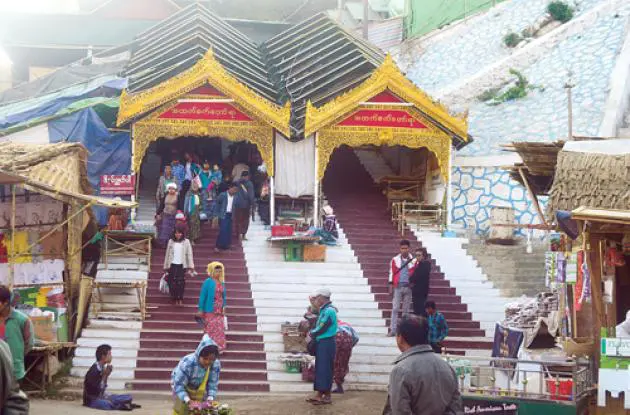
Pilgrims from across Myanmar are gathered for the Shwe Settaw Pagoda Festival
MYANMAR IS NOT just “the land of pagodas” – it’s also the land of pagoda festivals. The Shwe Settaw (“The Golden Footprints”) Pagoda |Festival is one of the biggest such gatherings in Upper Myanmar. Buddhists from all over the country annually make a pilgrimage to the two pagodas housing the Lord Buddha’s footprints: Auk Settawyar (Lower Footprint) and A Htet Settawyar (Upper Footprint).
Located in Minbu Township, Magway Region, the lower footprint can be found near Mann Creek at the foot of beautiful Thitsadepaka Hill. The upper footprint is high above and can be reached via a road or a stairway.
The Shwesettaw Pagoda Festival is held every year from the month of Tabothwe (February) to the end of Myanmar New Year’s Day (April).
This year’s festival kicked off recently with a scattering of pilgrims.
The place had an air of solemnity at nighttime after the hubbub had quieted down. As dawn broke, the shouting of food vendors wafted through the air, shattering the fragile morning calm.
“Do you want to eat hot kaukhnyin?” boomed a seller of glutinous rice. “You want hot green tea? Hot green tea, fritters, fried fish here!”
The bustle of hawkers and the swarming crowd cajoled the Shwe Settaw Pagoda Festival back to life. I made my way to Auk Settawyar first and was thrilled by the religious and commercial frenzy on the ground.
There were pilgrims offering fruit and flowers to images of the Buddha while others paid homage to the Auk Settawyar footprint.
Pilgrims had a wide range of choices for gifts to take home: dried dates, dried bamboo shoots and dried venison.
I next went up the hill on a pilgrimage to A Htet Settawyar. “We’ll leave once it’s full,” a taxi tout hollered. “Come on – we’ll leave immediately,” shouted another.
“I went there with my own car once,” said Aung Hla, a pilgrim from Meiktila, “but this time I want to hire a car because it’s much easier. The fee is 300 kyat per person [less than Bt10] and it’s safer than driving up on my own.
“Afterward I’ll take a bath in Mann Creek and have lunch somewhere before going home.”
After a few minutes’ drive, we reached A Htet Settawyar, whose upper platform was crammed with worshippers.
After paying respects to the sacred footprint, I walked to the platform for a good view of the lush green landscape and the market below, now bustling with people.
The sight of Mann Creek, the monasteries and the festival scene along the rivulet was fascinating. Far away in the distance, the gloomy hills were thick with clouds of white smoke billowing from the ground, probably from farmers burning off brush on their land.
“I come to the Mann Shwesettaw Pagoda Festival every year,” Aung Hla said. “It’s like the festivals my grandparents used to attend. I got here early this year to avoid the crowds.
“You won’t get sick taking a bath in Mann Creek,” he assured me. “We always jump in the water as soon as we arrive. Nothing bad has ever happened to us.
“I like the vendors here in particular. I recognise some of them from previous visits. One sad thing, though, is that too much bamboo is cut down for their makeshift tents ever year. And there are more beggars every year. I feel bad whenever I see little children begging.”
A villager from Thanhmogyi near Magway told me he’d arrived days early to get a job as a carpenter, helping erect the tents. “After that I worked as a masseur for the pilgrims!
“I’m here with my family. My wife earns money cooking food for the pilgrims and she’s a masseuse too. One of my two children sells hot green tea and the other sells raw fish. The whole family has to work. Altogether we can make 500,000 kyat during the festival. At this time of year there’s no work in the village, so everyone comes looking for work here.”
