
Waxing lyrical over medicine


Play
Once consigned to museums, plaster and wax figures make a comeback as teaching tools
Hands and feet, chests and heads are lying on the autopsy table. Some are pale and white, others strongly red. But these life-like body parts are actually made out of plaster and wax.
They are moulages, models of injuries and illness symptoms that for centuries were important tools in teaching medicine. Today most of the remaining moulages are in museums but as a teaching tool they’re making a comeback.
Navena Widulin is a medical taxidermist. Her job is to dissect bodies and she had nothing to do with moulages until the director of the medical history museum at Berlin’s Charite hospital told her about the wax figures, sparking an enthusiasm that has continued to grow.
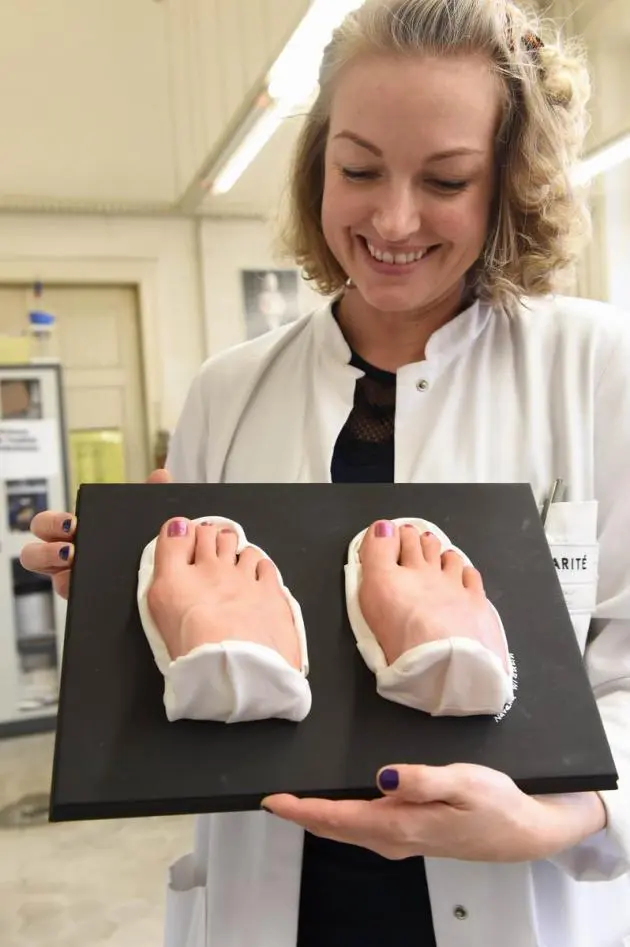
“This is the foot of a friend,” says the 42-year-old, holding up a moulage of a foot. “She likes to wear high-heeled shoes and has a distinct Hallux valgus,” a bunion on the big toe.
The toenails of the moulage are painted pink, as Widulin’s friend likes to do. This particular moulage was shown in an exhibition about the history of the shoe.
Widulin also creates moulages for forensic cases. The wax models had their heyday between around 1850 and 1950 but fell out of favour with the arrival of colour photography. Due to the risk of infection from real patients, the moulages were typically used to demonstrate the appearance of skin diseases to trainee doctors.
There are around 17 moulage collections in Germany illustrating a range of skin problems from smallpox to weeping eczema.
These historical objects are actually highly relevant today as they show the characteristics of infectious diseases that were believed conquered but are now on the rise again, such as syphilis.
The collection at the Bonn University Dermatology Clinic includes many plaster casts that show the lesions caused by syphilis. “Today, there aren’t such blatant manifestations of syphilis,” says the curator of the collection,
Beatrice Bieber, but it’s still extremely important to know what the disease looks like in its most severe stage.
Using moulages meant that diseases could be explained without the presence of patients, Bieber says.
“People understand what was behind that. Skin diseases stigmatise, even today.”
Unlike the Berlin collection, the Bonn collection includes patient records for many of its 1,000 moulages. “A patient’s story always touches one,” Bieber says. “But if there’s 100 years in between it has extra appeal.”
The wax figures are not only of interest to medical practitioners. Cultural researchers and art students are also keen to see them.
Widulin exchanges her work with makeup artists. “They ask me what death marks or a bog body looks like. I ask them about their techniques. That’s how I found the special silicone I use for forming the skin.”
She stabilises the silicone impression with plaster, then fills the mould with hot wax. Depending on the skin tone, she mixes oil paint into the wax. “Many say: ‘You are an artist!’ I feel more like a craftsperson,” she says.
When the model is complete, it needs to be lightly painted so as to be as realistic as possible. “Moulages are in between. |They look real but they’re not,” Widulin says.
