
Reading with mother
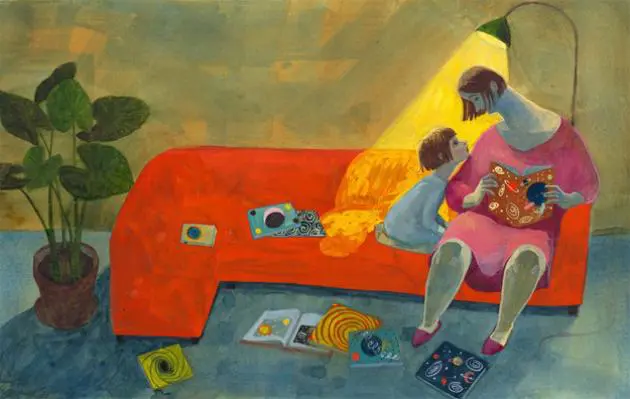


Swedish author Majken Pollack empathises with her young readers by tackling the problems they face in easy, well-illustrated stories
“It’s late and Embla is about to go to bed. ‘Please, just one more story’, Embla asks.”
Most parents will be able to identity with this short passage from the Swedish children’s book “Embla’s Cosmos” (“Embla mitt I kosmos”) by well-known author Majken Pollack. And more often than not, just as Embla’s mother does in the book, they will oblige, turning the page to the next story as their little one snuggles up close.
“Each child has a unique language that opens the door to their imagination and so a writer of children’s books has to be able to find and accept her own inner child,” says Pollack, who was in town last week to take part in a seminar organised as part of the 43th Bangkok International Book Fair.
Hosted by the Swedish Embassy and Nanmeebooks, “Illustrations – the Art of Children Books” saw Pollack, who is also an actress and theatre director, and Associate Professor Krirk Yoonpun of the Children’s Literature Department at Srinakharinwirot University’s humanities faculty, discussing the role of books in teaching youngsters about the real world.
“Children receive the world with their emotions and they try to communicate their experiences in their own way. My young character Embla enjoys playing by herself and is addicted to visual images. She likes asking questions and learns a great deal from nature, from the changing of the seasons.”
The Embla books, richly illustrated by Sara Lundberg, are not just popular bedtime reads but are also used as reading material as schools throughout the country. There are two books in the series and they focus around such real-world themes as feeling alone, relationships between siblings and the mother as a source of both comfort and conflict.
“I use my own experiences – my dad died when I was 13 and my mother sunk into a deep depression – for my stories. I had to grow up very quickly and used writing and theatre as a healing process. I’m using these experiences to encourage others to express their feelings. We have a lot of young adults in Sweden and they are often under a lot of pressure. The result is that they feel unhappy and disconnected and so they tend to close in on themselves. Expressing how you feel is very important for healing. In the theatre I favour the collaborative process and bringing together as many perspectives as possible because people with different characters relate to things according to their experiences. The answer is not about ‘what’ we do but ‘how’ we do it,” she says.
In the first book “Embla’s Universe”, which Pollack says was inspired by her own children and their relationships with each other, Embla is building a space rocket and does not want her sister Anna to be part of the game. The mother tries to intervene by telling Embla Anna should be allowed to play but Embla refuses.
“The explanation that Embla gives is interesting,” says the author. “For example when her mother asks if Anna can be a star, Embla says no because she is the star and the whole universe. Anna doesn’t fit in the game. The questions continue along the same lines but with different pictures. ‘In the forest, I am the whole tree, the root, the trunk, the air that makes the tree grow. I’m the book with all you need. Anna doesn’t fit’,” Embla says.
“But when her mother and Anna finally leave her be, Embla becomes afraid of being alone. Even though she is striving to become her own person and feels that she needs space to grow and play by herself, she misses her sister. In the end Embla invites Anna back in and lets her become the undetected star in the universe.”
Lundberg’s illustrations add to the themes. She uses grey for the borders to represent reality while the children are colourful, demonstrating their unlimited imagination. The mother is very big but she does not fit properly on the page because it is a children’s world.
“Mother hugs and comforts her children but doesn’t always understand them. And when the children hug their mother, they come up just to her waist. It’s only on the last page that Embla is seen with her sister. Otherwise, she’s the only one on the page. For the cover, Embla’s big black eyes look straight at the reader. She represents children’s perspectives and integrity,” Pollack says.
The second book, “Embla’s Cosmos” focuses on loneliness and connectedness and the illustrations are much darker, representing how trapped the little girl feels. Embla cannot sleep. She no longer feels connected to her mother and has the sensation of being alone.
“The idea is to say that it is every child’s right to be taken care of. It’s very important that we pay more attention to our children. They are our future,” Pollack says.
Krirk,a renowned author and illustrator of such Thai children books as “Balloon”, “Kradook Kradick Kradok Kradeak”, “Thai Farmer” and “Kratai noi nee mae” as also the owner of the Million Toy Museum, says children’s books will last forever no matter how fast other media develop.
“A children’s book is something tangible. It’s heart-warming and comforting and children want to possess it. It helps fulfil the imagination and develops the personality. We wouldn’t need to campaign for Thai children to read more if our authors, illustrators and publishers could come up with books specific to age development.”
He also encourages parents to design their own children’s books. “If the child has an unpleasant personality trait that the parent wants to fix, the story should be based on that. For example, if the child is never ready on time, create a story using a character that he or she likes, such as a rabbit, and have him wake up late. Then devise a story related to the rabbit’s behaviour that causes so many problems that the rabbit finally has to change. If it’s a well-crafted story they can tell it time and time again. And when children want to choose their own books, parents should be able to guide them to buy ones that suit their age and development.”
