
An art as old as mankind


Play
Jewellery making is a long and often arduous process
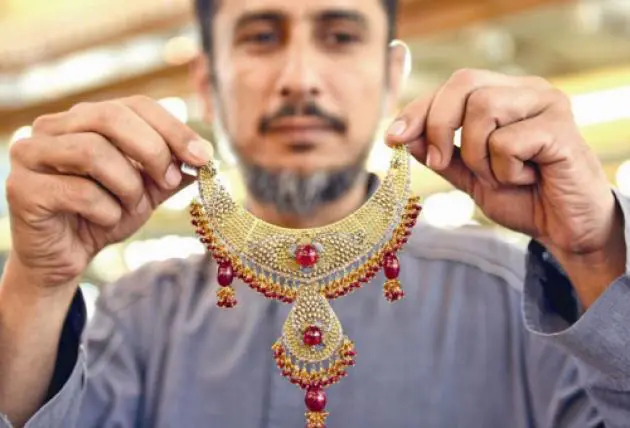
The use of gold in jewellery is a practice as old as time itself, but few know the labour that goes into turning a piece of metal into the intricately designed rings, bracelets, earrings and necklaces found in jewellery stores.
Jewellery making is an extensive process, with six or more experts involved. The industry continues to provide employment for many despite the existence of machinery to accelerate the process.
In smaller markets, most goldsmiths still prefer to employ the traditional methods of melting gold and silver and grind the diamonds as well as other precious stones. These processes involve significant risk but allow the goldsmith to produce original, handmade designs.
Though gold ornaments are accepted as a part of fashion, gold jewellery is also seen as a mark of status in South Asian families, and women of the family often wear heavy jewellery.
The popularity of gold ornaments has led to the setting up in every urban area of a special market, known as a Sarafa bazaar, which specialises in the making of gold jewellery. After gold is extracted from mines in various parts of the world, it is brought to a local Sarafa bazaar in the shape of gold “biscuits”, and the process of moulding it into different shapes begins.
At the Sarafa bazaar on Murree Road and Purana Qila, jewellers were brought both gold biscuits and old jewellery. A goldsmith handed the gold over to experts for melting. In the case of the old jewellery, the process also allows for the separation of brass and silver from the gold.
“We place the gold in earthenware pots and melt it in an oven at high temperatures. After the metal cools, we clean it with various types of acid and hand it over to the jewellery makers,” Abdul Islam, who is an expert in melting gold and runs a workshop, explains
Waseem Ali, a goldsmith and Jeweller Association vice president, added that after this the biscuits are handed over to workmen who shape the metal. “At this workshop, workers make designs using machines, but at a local level, this work is done using traditional techniques. Often designs are copied from pictures as well,” Ali says.
Once the ornament has been designed, it is sent to a workshop to be polished. We grind the joints of various designs and remove any imperfections. A lot of gold is wasted in the process,” a worker adds.
After polishing, the gold is sent to another workshop, where workers emboss colours and stones into the design. In the fifth step, the ornament is finished and any unnecessary knots are removed. Finally, the finished piece of jewellery enters jewellery showrooms.
Murree Road Jewellers Association president Abdul Qadoos says that the piece of gold jewellery is high particularly because the process of working metal into an ornament is very artistic. Six workers are involved in the production of jewellery, but it is up to the skills of shopkeepers to sell the finished product of jewellery, but it is up to the skills of shopkeepers to sell the finished product. He added that the demand for gold jewellery in the subcontinent would never fall because it is worn by both men and women.
