
Babes in Tokyo's toyland


Play
Infant-formula maker Mead Johnson treats 20 Thai families to a tour of brain-nourishing attractions in Japan
TRAVELLING WITH kids can be massive headache, but, as I learned on a recent trip to Japan with 25 toddlers in tow, it can also be quite rewarding.
I tagged along on the outing arranged by baby-food maker Mead Johnson Nutrition (Thailand) for 20 lucky families. The little ones ranged in age from one to five.
Yes, there certainly were challenges during the flight, but babies are bound to scream when the air pressure squeezes their ears, and when we arrived, some of the kids refused to try Japanese food. But the parents and I soon learned that, with proper planning, travelling abroad with children doesn’t have to be a nightmare. On the contrary, it offers a world of benefits for their development.
The itinerary, designed specifically for the youngsters, was a huge improvement on what they encounter at clock-watching schools.
First we took a two-hour drive from Tokyo to the Hakone Open Air Museum, where more than 120 giant sculptures are scattered around a sweeping hillside. The kids needed no coaxing to take off and play among the touch-me-climb-on-me exhibits.
British sculptor Henry Moore once called the form “an art of the open air”, and at the museum his words are taken to heart. The beautiful garden is populated by his work along with pieces by Rodin, Joan Miro, Niki de St Phalle and Arnaldo Pomodoro.
“Art can stimulate the interconnectivity between the brain cells responsible for imagination, emotions and appreciation, so it promotes emotional intelligence,” explained Patcha Nimmannit, marketing manager at Mead Johnson, which makes Enfagrow A+ formulas for toddlers. “Too many Thai parents focus only on academic results and competitiveness.”
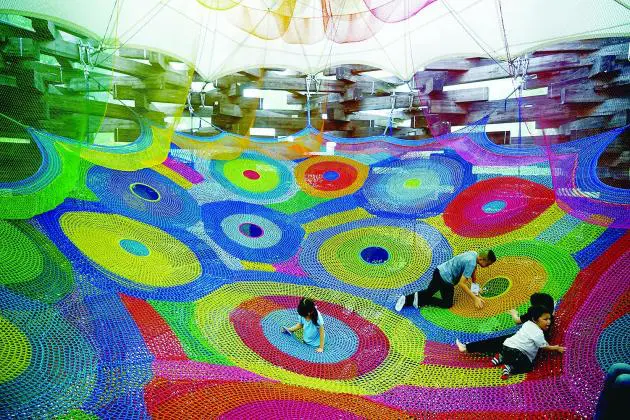
The children especially adored an area at the museum called “Woods of Net”, where the massive netting – knit by hand by artist Toshiko Horiuchi Macadam – is perfect for jumping on and rolling around. The kids were also given drawing books with both blank pages and pages with outlines of some of the sculptures for them to complete.
“This is a way to let children to explore their own imaginations and at the same time teach them to observe what’s around them,” a member of the museum staff said. “Parents can improve even a baby’s ability to focus by sharing their knowledge of colours and shapes.”
Back in Tokyo, origami expert Mariko Miyamoto showed the youngsters some very remarkable shapes indeed, creating a menagerie of animals from sheets of paper. “Origami is not only fun – it’s also a great way to develop vital skills, such as learning the various geometric forms,” she said. “For the little ones, we start with a simple triangle, forming a mountain.”
Miyamoto warned that origami is beyond the understanding of kids under two, and sure enough the littlest of the little ones had to rely on their parents’ help to get up that mountain.
“Origami involves a step-to-step process and, to be successful, the student must watch and listen carefully to the instructions, and then carry them out with neatness and accuracy,” said the coach. “This trains the brain to think systematically and use logic. Japan includes origami as part of the school curriculum, particularly in elementary schools.”
Juntanee Sutatarntrakul lent a hand as her granddaughter April – who at about a year and a half was the littlest of the littlest on the trip – struggled with the folding. But even at that age, Juntanee said, she’d still be improving her small-muscle movements and coordinating her eyes and fingers.
April was nevertheless much more delighted with our next destination, the Tokyo Toy Museum in Shinjuku district. It’s even got a “Wooden Baby Room” set up especially for kids under two. Rather than wooden babies, the slide, crawl tunnel and various toys are arranged on a cedar floor, and everything is safe as well as practical.
Friendly museum attendants wearing red aprons guide both children and adults through their utterly low-tech world of non-digital pastimes, like board games, Chinese puzzles, Russian nesting dolls, table soccer and that maddeningly frustrating thing where you try to flip a tethered ball into a cup.
Afterward, three-year-old Thanawin Thumsuton was thinking of moving to Tokyo. “That was really fun playing with the different wooden toys, and I’d never seen some of them before. I could stay there for hours!”
His father Wicha didn’t mind forgetting about his mobile phone, either – at least temporarily – so he could spend some proper quality time with the family uninterrupted, unplugged and un-distracted. As for the trip as a whole, Wicha was delighted that his son had “had the opportunity to learn about another culture, try new foods, learn a new language and play with new friends. It will help him develop essential skills, like adaptability and getting along with people.”
At birth, a baby’s brain contains 100 billion neurons, and in the first five years of life that number multiplies at a tremendous rate as synapses develop to share and compare all the fresh information pouring in. It’s a time of extremely rapid development in cognition and in linguistic, social, emotional and motor skills.
“Parents hold the key to creating non-stop learning opportunities for their children,” says Associate Professor Tippawan Hansakunachai, head of paediatrics at Thammasat University’s Faculty of Medicine. “Research indicates that children who don’t have a chance to play or lack emotional engagement with their parents will likely have brains 20 to 30 per cent smaller than normal.”
The 25 Thai youngsters had no fear of that as we moved on to the Miraikan Museum of Emerging Science and Innovation in Odaiba district (miraikan is Japanese for “future”). Here again, the exhibits are interactive and hands-on.
The Miraikan is best known for its mammoth globe called Geo-Cosmos, which displays on LED panels – in close to real time – what’s happening with the world’s weather, ocean temperatures and vegetation cover, all in 10-million-pixel resolution.
There’s also a mock news studio where the anchorwoman is a robot named Kodomoroid. Visitors watch as she reads the latest updates on global issues and even the weather in space. Also watching her is Inter-robot, which accurately mimics all those human “co-host” reactions like nodding and murmuring in sympathy (or feigned interest).
A short animated film is meanwhile screened offering predictions about how our lifestyle will look in another 35 years, as experienced through a high-school girl in the year 2050. Among other astonishing (and perhaps optimistic) developments, she can change clothes with the push of a button and commutes to school in a one-person helicopter.
“From the attractions we’ve visited,” said Patcha of Mead Johnson, “we can see that tremendous non-stop learning opportunities for children can happen anywhere, particular those involving cognitive, physical, emotional and social development.
“Development in these areas depends on the attention parents give to stimulating their children’s learning experiences, no matter whether indoors or outdoors.”
