
Starting from scratch


Play
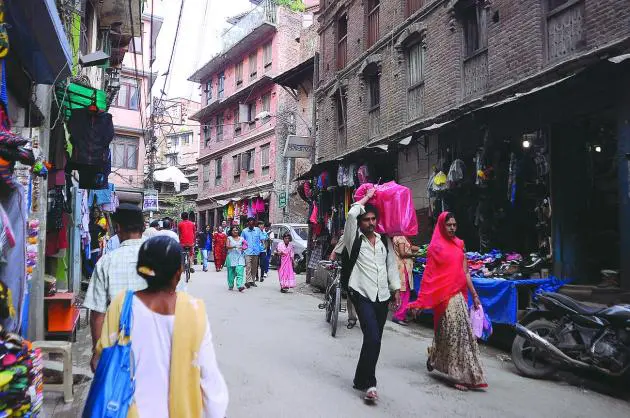
Nepal is returning to near normal after the massive earthquake in April though, for some residents, progress is much too slow
KUMARI LAMA smiles proudly as she gestures towards her week-old son who is sleeping soundly wrapped in a fluffy red blanket. The 26-year-old’s smile, though, is tinged with sadness as she recalls the day back in April when she and her husband, Jit Bahadur Lama, 27, lost everything they owned in the earthquake that struck Kathmandu valley, killing thousands and sending buildings tumbling to the ground.
Today, with support from within and outside their community, Kumari and Jit are slowly getting back on their feet, though they are far from being where they were six short months ago.
“It’s the best we can have, at least so far,” says Jit looking around his temporary one-room house, which includes an adjacent kitchen.
According to the intergovernmental research agency International Centre for Integrated Mountain Development, the massive 7.8 magnitude earthquake that hit the country on April 25 and which was centred on Gorkha District, 77 kilometres northwest of Kathmandu, affected 39 of Nepal’s 75 districts, with 14 districts identified as most affected.
More than 8,700 people lost their lives and over 22,000 were injured. The Ministry of Home Affair’s records also show that 200,000-plus buildings collapsed completely and another 214,000 were partially damaged.
In Jit’s home village of Bhattedanda in Dhulikel district, almost all the 100 houses collapsed in a heap of rubble, among them the young man’s two-storey brick residence.
Left in the dark for the first few days, Jit and his wife were then housed in a provisional camp where they lived with hundreds of shattered families. With Kumari pregnant and the government’s response still sluggish, Jit eagerly accepted the offer of support from the Nepali arm of the Thai non-profit organisation Change Fusion.
Luna Shrestha Thakur, executive director of Change Fusion Nepal, says the NGO was set up in 2008 to support social enterprises, just like its main office in Thailand. When the earthquake struck, she quickly made contact with one of her network partners, the Bhattedanda Women Cooperative, which was founded by village head Fulmaya Tamang, and decided to channel Change Fusion Nepal’s funding to help the villagers recover.
To help as many affected villagers as possible, the organisation used a blog and social networking to forge ties with organisations outside the country and before long was receiving both funding and offers of assistance. Among those who responded was the DT Families Foundation from Thailand, which decided to provide money to support 50 temporary houses plus 100 sets of solar cells for the people of Bhattedanda.
Wit Soontaranun, director of the foundation’s social contribution office, says the benefit of such collaboration is that the charities in other countries can be confident that their assistance is really reaching the affected villagers and responding to their needs.
The foundation adopted a similar approach in collaborating with other local organisations like Lumanti. This shelter support group with plenty of experience in the community consultation process has been working in the Thankot area since the quake and DT was happy to help with the funding of 90 temporary houses.
While their houses were also destroyed in the tremblor, the residents of Thankot have been in a sense luckier that those of Bhattedana in that they were able to discuss with the NGO how their temporary homes would be built. They are now housed in individual shelters more comfortable than that of Jit and his family, whose new home is little more than a few iron sheets wrapped with slings into an oval shape, creating a tiny room.
Kunda Dixit of Himalmedia, which owns several news magazines and papers including the Nepali Times, confirms that government efforts have been very slow given the scale of the incident.
“The Reconstruction Authority has yet to become functional because of the politics in this country,” he laments.
“However, voluntary and other groups, both Nepali and foreign, have delivered timely assistance. But a lot depends on the community too. When a community is well organised, it has been able to use outside help well and rebuild their lives. Communities that are not are finding it more difficult.
“The government should now focus on reconstruction,” Kunda stresses. “Getting financial help to families efficiently and without delay should be the priority.”
Jit says it will take him three to four years to rebuild his house, so the family will be living in their tiny room for some time to come.
“I will build my new house on the site of the old,” he says, adding that he is not afraid of another earthquake.
“I am a mountain man and I want to stay here, in my village.”
So far, he has received 15,000 Rupees (Bt8,330) out of the Rs 200,000 promised by the government and says he will need to earn at least another Rs 600,000 to rebuild his home.
“Life has changed and it is nothing like it was before. But I am confident I can rebuild and start again,” says the new father, adding that his son’s name was chosen to reflect his optimism for the future.
“I called him Asoka. It means ‘no sadness’,” he says with a smile.
