
A guide to a better world


Play
A comprehensive sourcebook shows consumers, civic groups and businesses how to take part in sustainable development
It’s natural enough in times of economic restraint and political turbulence to believe the country must have already reached its lowest point. Optimism is fed by the concept of pho phiang (just enough), which has found its clearest expression in His Majesty the King’s theory of a sufficiency economy.
“That’s always been the starting point for hope for people,” says Dr Priyanut Dharmapiya, director of the Sufficiency Economy Learning Centre. Applicable to everyone from farmers to entrepreneurs, it entails mindfulness of need and ability and a willingness to be moderate and prudent.
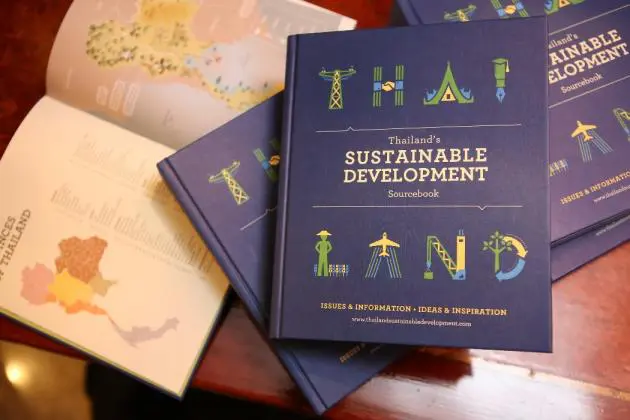
Now there’s a tremendously helpful book for those who either don’t understand the concept or aren’t sure how to apply it in life. “Thailand’s Sustainable Development Sourcebook” – just out from Editions Didier Millet, a publishing house with offices in Bangkok and Singapore – distils the key elements, defines the issues at stake and provides dozens of examples of businesses that are making the notion work, often in surprising and inspiring ways.
Released to coincide with the publication of the United Nations’ 2030 Agenda for Sustainable Development, “Thailand’s Sustainable Development Sourcebook” is doubly timely. Thailand next year assumes the chair of the Group of 77, a UN coalition of developing nations.
The book contains 62 well-researched articles on major sustainable-development programmes, written and peer-reviewed by 70 expert and internationally recognised authors. Dr Priyanut is among the many contributors. It deals frankly with some of the country’s most intractable issues and the obstacles to overcoming them, but is upbeat about the future. The King’s guidelines – and the royal projects – have, after all, laid the foundation here.
“Sustainable development is a very important movement worldwide today,” says editor-in-chief Nicholas Grossman, “and one that Thailand is involved in at many levels in different sectors – businesses, grassroots, communities, organisations – all taking this idea seriously.
“What we do in this book is introduce the subject clearly and show how Thailand fits into this international movement. We have articles on topics ranging from forest conservation, energy security and economic issues to gender equality, social issues and even culture issues. Culture is very important in Thailand, so we have sections on the monarchy, religion and heritage.
“Overall the book tries to connect the dots in what’s happening, highlighting pioneers and groundbreakers,” Grossman says. “It took about 18 months to put it all together, but the book is easy to read, with accessible information and more than 120 infographics. Every reader will find something of interest, since sustainability touches all of our lives in different ways.”
Among the specifics, the book serves as a guide to smarter shopping, he says. “People might be able to make better decisions and buy brands or products that follow sustainable practices. So we talk about how to read labels, and also how to save energy at home by using resources intelligently.
“A CEO might find out what other companies are doing and be inspired. A marketing professional might take note of the social enterprises doing environmental projects and say, ‘Let’s go work with them!’”
Grossman acknowledges that many individuals and groups have jumped on the “sustainable” bandwagon, but they don’t really belong there.
“There are a lot of public-relations agencies involved and everyone want to be associated with the subject, but with this book we give the issue real substance and explain in more detail – though not in a technical way – what sustainability is really about.”
While there are confusing differences between the global sustainable-development movement and His Majesty’s more philosophical sufficiency-economy notion, the principle is the same, Grossman says.
“It’s about using resources intelligently, caring about the environment, caring about people, about communities, being sensitive. So whether it’s the UN doing sustainable development or Thailand having a sufficiency economy, they are very similar. We only try to showcase the ideas being integrated into private practice for the sake of the future of society as a whole. It’s not simply going out and planting some trees – the typical ‘corporate social responsibility’ projects.”
Dr Priyanut has been involved in the movement for more than 15 years. She points out that, since the late 1990s, when the King first spoke about a sufficiency economy (setthakit pho phiang), it has widely been interpreted as a matter of “stopping and composing oneself”, regardless of your mood in that moment. “The phrase has become almost a mantra for Thais, a way to moderate their daily lives.
His Majesty’s idea is discussed on Pages 34 and 35 of the book – “probably the last two pages we wrote”, Priyanut says.
“To me, everything just seems to fall into place with this philosophy. Using mindfulness as the base and following the notion of sustainability righteously and prudently, we will not take advantage of others or be taken advantage of.”
A rewarding read
“Thailand’s Sustainable Development Sourcebook” is available at Asia Books, Kinokuniya and other leading bookstores, as well as through Amazon.com, at a suggested retail price of Bt1,750.
A website with excerpts from the book and other information is at www.ThailandSustainableDevelopment.com.
Eighty-eight years
A birthday poem to His Majesty the King by Glen Chatelier.
Eighty-eight years light up Thailand’s life
Spreading a rich glow on its history and people
Multiples of good deeds have reduced their strife
Through a King whose work has produced blessings uncountable
Eighty-eight years of his giving has yielded a celebration
Of a people who undoubtedly love their father
Champion of morality, spiritual immunity from life’s ills, and moderation
King whose actions succour and leave a people to seek panaceas no further
Blessings of the Triple-jewelled Gem we invoke for you
A caring, selfless King, talented and fortune-giving
May this birthday be an occasion new
For this Kingdom to experience joys glittering
A celebration we raise for our King wholeheartedly we praise
May this be the most salubrious of all his birthdays.
Glen Chatelier is director of the Office of International Affairs at Assumption University of Thailand.

