
At least they still dress well


Play
London fashion week puts a brave face on the Brexit
British Fashion put a brave face on the “Brexit” last Friday as it began its first catwalk shows since the vote, citing a surge in sales on the weak pound despite fears that leaving the European Union will hit exports and increase costs.
“It might not have been what we wanted, but I think there’s actually a sense of confidence,” said British designer Anya Hindmarch, one of hundreds showing their wares at London Fashion Week.
Organisers are hoping that the five-day event, which includes runway shows by Burberry, JW Anderson and Topshop Unique, will help alleviate Brexit blues in an industry that overwhelmingly wanted to stay in the EU.
“We have to look at the positives. Over the past few months, our luxury and retail has seen a bounce in terms of sales in the UK,” said Caroline Rush, chief executive of the British Fashion Council.
“We’re very much open for business. We’re known to be collaborators with the rest of the world, and I think it’s an opportunity for us to really demonstrate that over the next few days.”
Retail sales in Britain have largely held up since the June referendum, easing fears of an immediate loss of consumer confidence.
Analysts said this partly reflected falling prices, while the dramatic drop in the value of the pound has particularly boosted luxury items, which are now cheaper for tourists.
But the weak currency will also make it more expensive to import goods from overseas, with high street giant Next among those warning of a rise in prices next year.
Hindmarch, who has stores around the world including in China, Japan and the United States, said she believed the overall impact would be “negligible”.
“Suddenly we’re 10 per cent cheaper to sell, so we’re going to be selling more,” she said.
“We might be 4 per cent more expensive to buy – who knows? It’s all swings and roundabouts. It balances. I really don’t think it’s going to be mathematically a big problem.”
“The industry and businesses really need to focus on their margin,” Rush added, “really need to focus on their price and really think about that to protect themselves. Many of our businesses currency hedge in any case, and for those that don’t, it’s made them think about it.”
The potential loss of access to the European single market is a big concern, however, as the bloc accounts for about 70 per cent of British textiles and apparel exports.
“My biggest concern is my Italian suppliers, who are very nervous,” Hindmarch said. “I make almost everything in Italy. So many people do here.”
There is also the risk that restricting immigration into Britain – a major issue in the referendum campaign – will deter the foreign talent that has helped turn London into a unique creative melting pot.
“Many of our young designers weren’t necessary born in the UK but came here to study. They wanted to stay and build businesses and they’re now employing hundreds if not thousands of people,” said Rush.
Prime Minister Theresa May held a reception of key industry figures on
the eve of Fashion Week, following the example of her predecessor’s wife, Samantha Cameron, who attended Thursday’s event at Downing Street.
May sought to reassure the fears of the industry, which contributes 28 billion pounds (Bt1.3 trillion) to the economy and supports nearly 900,000 jobs, while giving little away on her plans for Brexit.
“From our home-grown start-ups to international fashion houses, every business in the industry will play a major role in ensuring we make a success of Brexit,” May said.
Rush said the sector has sent a clear message to the government about its concerns, but had also raised the potential opportunities.
“There was a lot of talk about whether this is going to see a resurgence in manufacturing within the UK, how can we put investment into that.”
VERSACE
Under low lights and with a pumping music soundtrack, bright young things wearing black leather and slouchy ripped denim put some swagger into London Fashion Week, courtesy of Donatella Versace.
The Italian designer showed her diffusion line Versus in a club-like atmosphere, a typically tough and sexy collection brimming with attitude.
There were cutaway dresses exposing the shoulder and stomach, with a silver zip running down the back, and pleated and leather mini-skirts – one with the belt left provocatively open – matched with leather jackets.
Bonded mesh dresses and crop tops brought a sporty edge to the collection, which also featured cropped, zip-up bomber jackets, military-style knits and washed out ripped denim with metal and crystals sparkling underneath.
“This is about everything real,” she said. “It’s about how the Versus Versace generation live their lives, and the wardrobe that gives them power.”
GARETH PUGH
Earlier in the evening, British designer Gareth Pugh took a more conceptual approach with a show built around the narrative of the opera “Eliogabalo”, for which he made the costumes and which opened in Paris on Friday.
“Eliogabalo” tells the story of a tyrant in imperial Rome, a self-proclaimed sun god, represented in the London show in a repeating pattern of the sun and its rays that stretched across dresses, coats and trousers.
To the sound of loud drums, the first model emerged with a large sun behind her head, followed by others wearing black coats with a mosaic of gold triangles arranged at the breast and hems.
JONATHAN ANDERSON
Saturday saw an eagerly anticipated show by Northern Irish designer Jonathan Anderson, the creative director of Spanish fashion house Loewe, who has his own label in London.
There were loose linen dresses, jumpers with oversized rolls of fabric at the sleeves and hem, and tops inspired by men’s 16th-century doublets with voluminous sleeves and quilting.
But where kings such as Henry VIII had their clothes made in heavy fabrics, Anderson’s were in linen or hessian.
“I liked the idea of women wearing something that was so masculine, something that was really heavy but that is cut out of something incredibly light,” he said.
MARY KATRANTZOU
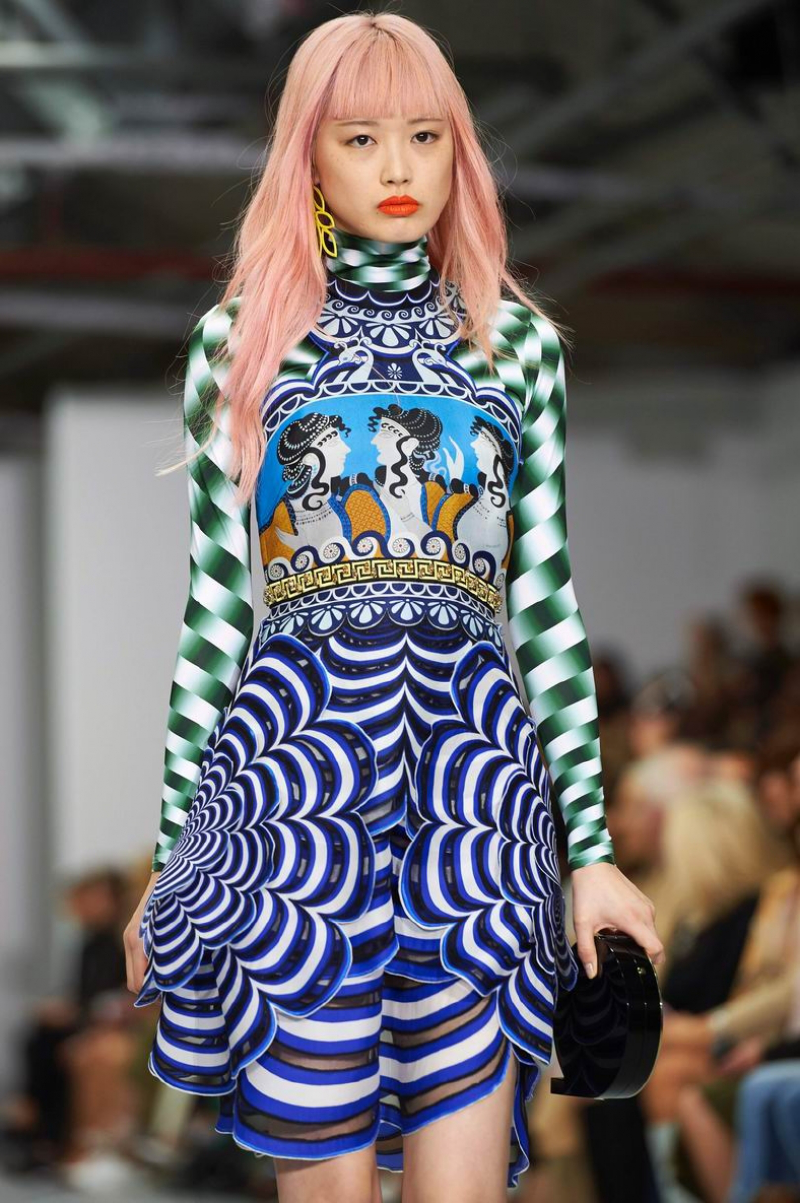
Mary Katrantzou is ready for spring in her native Greece judging from the classical pillars that lined the centre of her runway show on Sunday.
Greece’s own economic upheaval has rallied its defenders, who point out that it was the birthplace of democracy, architecture, medicine, theatre and, yes, the Olympic Games.
Katrantzou joined the patriotic ovation with a dazzling array of multicolour spiral and linear prints that formed optical illusions with a Greek vase at the centre. The illusions shimmered as the models moved.
Plexi paillettes and different materials added their own remarkable optics. One skirt bore layers of scalloped tulle in yellow and black and the skirts and dresses mimicked the clatter of Spartan armour as they moved.
In shape the clothes clung to the body. Peplums appeared on sleek, colour-blocked skirt-suits. The accompanying clutches and top-handle bags in the shapes of letters were fun as well as stylish. Laurel-leaf earrings dangled from one ear.
