
Enchanted by diversity


Concerned that the fast pace of development could impact on the indigenous culture of Ha Giang province, a Japanese visitor steps in to help
Japanese Yasushi Ogura is not a businessman, but this long-term visitor to Vietnam has nonetheless invested his hard-earned cash to help a farming couple open a coffee shop in the northernmost part of the country.
His interest is not in earning a return on his investment, but to help preserve the indigenous culture of ethnic minority communities in Ha Giang Province.
His dedication has won him a special place in the hearts of ethnic minority residents of Lo Lo Chai Village in Ha Giang Province.
“It is the ethnic diversity in Vietnam and the scenic landscape of the mountainous areas that has made me fall in love with Vietnam, and brings me back, time and again,” Ogura says.
“I especially love Ha Giang for its pristine beauty and unique culture. That indigenous customs and traditions are present in the daily life of ethnic people really interests me. Some traditional crafts like linen weaving and wine-making are still well preserved and the traditional architecture is also well demonstrated through the houses here.”
But Ogura is concerned that the fast pace of development and modernisation will result in a degradation of the indigenous culture, history and architecture. “It could disappear soon if we don’t take action,” he says.
“This has pushed me to do something for the locals, who lead such a hard life due to extreme weather and unfavourable agricultural conditions.”
Lo Lo Chai, which Ogura considers his second home, is a poor rural village at the foot of the Lung Cu Flag Tower.
“Mong and Lo Lo are the two major ethnic groups in this village. I decided to support a Lo Lo family as the population of this ethnic group in Ha Giang is small and they do not have many opportunities to introduce their culture.
“What’s more, Lo Lo people, who are very friendly and open, can speak fluent Vietnamese so it is easy for me to communicate with them.”
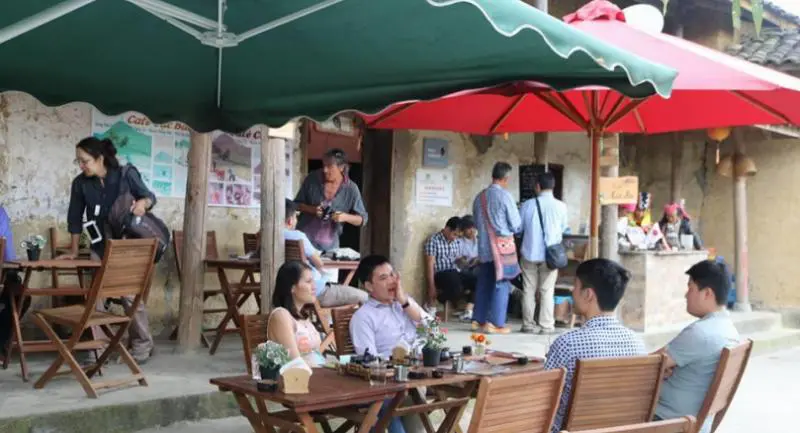
Last year, Ogura constructed a coffee shop near the Lung Cu Flag Tower for Diu Di Chien’s family.
“The coffee shop is for the family to do business to have a better life as well as to be aware of the need to preserve and promote traditional culture,” Ogura explains.
The cafe, named Ca phe Cuc Bac, the northernmost coffee house, is an upgrade of Chien’s house. The original architecture of the house has been maintained with a fence made of stones and a thick wall that keeps it warm in winter and cool in summer.
Chien and his wife Luc Thi Van, were farmers before they took over the coffee house.
“Before 2015, we mostly worked on the farm. The rice we grew was just enough to feed the family and there was nothing to sell.
“Since we began running the coffee house, we’ve been earning enough to cover the studies of our three children and enjoy a stable life,” Chien says.
The project was funded entirely by Ogura and some Vietnamese friends who he befriended during his stays in Vietnam.
Tran Giang, one of Ogura’s friends is full of praise for his Japanese buddy.”I was impressed and moved by his enthusiasm and optimism. He pays special attention to the sanitation of the area and constantly reminds me to instruct the couple to keep the coffee shop clean.”
Last year, Ogura asked Giang, who has working experience in the tourism sector and in coffee making, to help the local family manage the coffee shop.
When the construction was almost complete, Ogura and Giang designed the menu for the coffee shop and she helped the locals to arrange the cups, clean the equipment and make a few drinks.
“The couple couldn’t write Vietnamese. So during the first few days, I taught them how to write in Vietnamese and the basic skills needed to manage the cafe. They were keen to learn and quickly picked everything up,” Giang says.
These days Ogura spreads word of the coffee shop through his Vietnamese and Japanese acquaintances.
“The northern mountainous provinces of Vietnam are mostly visited by western tourists. Not many Japanese visited this area. So I told my Japanese friends about the pristine beauty and now more people are coming here,” Ogura says.
Ogura, 59, first came to Vietnam in 1995, but it was only in 2002 that he made his first trip to Ha Giang.
“The Dong Van karst plateau is really special and unique. It’s a beauty that cannot be found anywhere else,” he says.
That year, Ogura stopped in Tuyen Quang City for a day on the way back to Hanoi.
“While I was strolling around in Tuyen Quang city, I saw a lovely student who was in 8th grade. I took a photo of her, which made the little girl very excited and happy. I still remember her smile when I took that photo. It was obvious that she rarely saw a foreigner and she shyly asked me to send her the photo.
As promised, Ogura sent the photo to the girl after he returned to Japan, and a month later was surprised to receive a reply.
“I had to use a dictionary to translate her letter. I was happy and surprised to hear from her. Her handwriting was very nice and the content was interesting.”
Since then, Ogura and the Vietnamese student have written a few times to each other. “Thanks to her, I know more about the life of Vietnamese people. We recently met again in Hanoi. That eighth-grade student is now a doctor!.
“Meeting with her not only gave me a chance to know more about Vietnam, but is also one of the reasons I love this country,” said Ogura.
In the last few years, Ogura has taken to visiting Vietnam once a month and now has many Vietnamese friends
“Vietnamese people, especially the young, like talking to foreigners, especially Japanese and have a high sense of respect for seniors. So I have made a lot of friends along the way,” he smiles.
