
Creating compassion through art
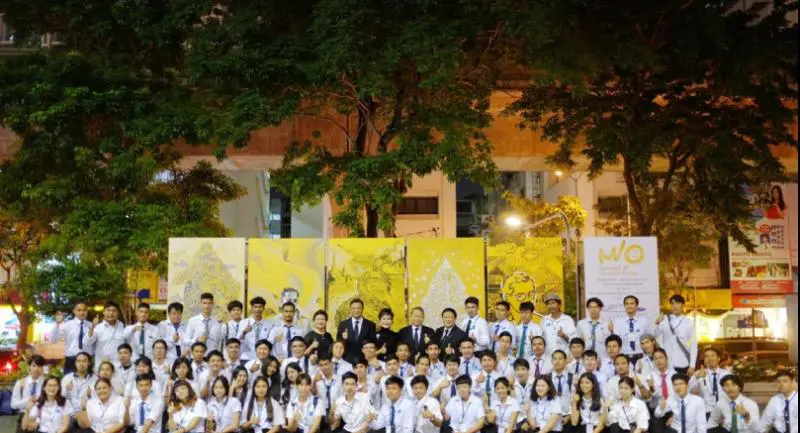


A contest on the theme "Happiness and Fun in Self-Sufficient Living" draws expressive works from young art students
POPULAR LOCAL art contest the Bualuang 101 Art Competition recently announced the results of its 2016 edition, awarding the top honours to Pejung Misatit, a Karen student attending the Payap campus of Rajamangala University of Technology s art and architecture faculty in Chiang Mai.
The winning piece is an oil painting titled “Happiness and Fun in Self-sufficient Living” and is now on display along with 70 other artworks at The Queen’s Gallery on Rajdamnoen Klang Road in Bangkok.
Now in its ninth year, the Bualuang Foundation-organised contest had as its theme the “70-year Reign of Thailand’s Revered King Rama IX” and drew entries from all over the country.
As ever, preparation was serious with art students from 35 faculties and 33 educational institutes taking part in a 10-day “reality show” art camp last month where they received training and advice from respected National Artists and leading art professors.
Along with naming Pejung “Bualuang Artist of the Year”, the competition also honoured Napat Leelahapong with the Bualuang Creative Artist Award and Weerawat Wattanapanyasin with the Bualuang Outstanding Prize.
“This year the contestants had the chance to use their art to convey their deepest gratitude for His Majesty’s 70 years of work for his subjects,” says Khunying Chodchoy Sophonpanich, director of the Bangkok Bank Foundation and the chairwoman of the competition.
“Since its launch in 2007, the art contest has attracted a lot of young artists and been a great success. It has allowed undergraduate art students to learn from real-life experiences and fully showcase their talent. Many Bualuang 101 artists have gone on to achieve success as professional artists and art instructors, or continued their studies either in Thailand and overseas. We organise the competition to support the nation’s art students as it helps expands their opportunities.”
Winner Pejung says that his painting reflects the happiness of the Karen hilltribe people in Mae Lob village in Omkoi district of Chiang Mai, where the sufficiency economy philosophy is practised.
“Although I was not born when the late King travelled throughout the North to help his subjects, I’ve been raised with love and told the stories about His Majesty’s kindness towards the hilltribe people. Everybody in the village believes that firmly in the constant support of His Majesty and that makes me feel warm and secure. During the reign of King Rama IX, Thai people were taught about the sufficiency economy. The Karen lead a very simple life. We are happy to be in the forest. We might be far from the city, but we are happy in our own sufficient way. We are all brothers and sisters – we help each other. We weave our own fabric. We eat wild plants and hunt for food. I wanted to portray this happiness through my oil painting. The people in my picture wear bright clothing and they are collecting bamboo shoots. There are houses, river, and trees. The most challenging aspect of creating this work was getting the composition and dimension right,” Pejung says.
The young man expressed his heartfelt thanks to his supporters, the
organisers and his teachers. He took home a scholarship worth Bt100,000 and says he will spend the prize money wisely on buying toys, student uniforms, and school supplies for the children in his village to encourage them to pay more attention at school.
Napat, 21, a senior student at Faculty of Fine Arts, Thai Arts Department, Chiang Mai University, says his work titled “Plant a Tree in Your Heart” and made with natural materials tells a story about forests and water.
“My inspiration came from the late King’s work for his subjects. About 70 per cent of that work related to the forests and water so I wanted to create a piece of art from only natural materials – branches, bark, palm, fruits and coconut shells, all of which I had being collecting for a while. My work talks about water sources and weirs, projects which are located nationwide. I used rubber to tell the stories about tribal people in the forest living an interdependent life with nature. There’s a river running through their community and it flows to the para-rubber plantation below. The para-rubber is a local product in my hometown in Ranong province and I want to support the local economy because the rubber price is dropping,” he explains.
Weerawat, 23, a fifth-year student at the Department of Art, Faculty of Humanities and Social Science, Chiang Mai Rajabhat University, was recognised for “To Do Good by Stealth: Putting Gold Leaf on the Back of Buddha Image”. His collage features a large portrait of His Majesty made out of 99 embossed bronze sheets, each of which features one of His Majesty’s royal duties.
“The idea came to me when I saw the brass sheets we call django gold, the brass leaf used in Lanna art for covering a pagoda. I wanted to use it to tell the stories of His Majesty. Embossing brass sheets is more difficult than drawing on a canvas because it involves dimension. After the embossing was complete, I put the 99 bronze sheets together in a collage and painted His Majesty’s image with varnishing oil,” he explains.
Professor Vichoke Mukdamanee, National Artist and director of Art Centre, Silpakorn University, is hopeful that the students will follow the example of the late King, who was known as the Supreme Artist.
“I used to organise the late King’s exhibitions and discovered that there were more than 130 works divided into three categories – paintings, portraits, and sculptures. His Majesty liked to create Buddha images and lifelike statues. He also designed graphics, which today are often featured on greeting cards. He would closely study the details, especially proportion and scale, then reproduce these in a larger size. He drew his Royal Father from photos and Her Majesty Queen Sirikit from real life. It’s easy to see from his scale drawings how hard he studied and researched before putting brush to canvas.
“We can also see the development of his work through the sketches he drew to improve his artistic skills. He would invite local artists to share their opinions of his technique. And because of the amount of time he put into studying, every one of his art pieces is truly beautiful and meaningful,” says Vichoke.
National Artist Chalermchai Kositpipat, one of the judges, laughs at the coincidence of all three winners this year coming from art schools in the North.
“The judges’ decisions were unanimous. Every picture portrayed the message very well and the techniques were creative and excellent. Other pieces were also interesting. Some of the contestants do not have great techniques but use philosophy to create amazing art. These modern artists can be roughly divided into two groups. The first group comprises those who are skilled but not creative. Their works can be repetitive. Members of the second group are creative and descriptive verbally, but not able to translate their ideas into great works. These artists need to sharpen their skills. If you are out of ideas, just spend some time thinking. Those who have great ideas but not great techniques need to practice. More importantly, it is necessary to have art teachers who can help groom art students to be able to reach their potential and creativity,” he says.
NOW ON SHOW
- Ten images created by participants on the competition’s orientation day and illustrating various aspects of the late Monarch’s kindness and compassion are on display in front of the Bangkok Bank Head Office, Silom Road, until December 31.
- The winning works in the Bualuang Artist 101 contest along with those of all the contestants can be viewed at The Queen's Gallery until January 13.
- Check out the highlights of this year’s competition at Facebook.com/Bualuang101 and Instagram at @Bualuang101.
For more information, |call 02 281 5360-1.
