
A gift from Salgado


Worn down witnessing war and suffering, the esteemed photographer went looking for hope
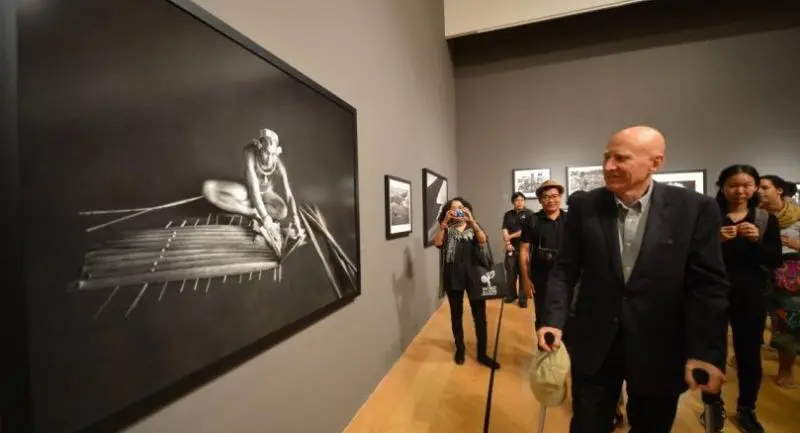
Local admirers of celebrated Brazilian photographer Sebastiao Salgado surprised him with a birthday party when he arrived on February 8 to open his major exhibition “The World Through His Eyes” at the Bangkok Art and Culture Centre.
The show on the eighth floor of the centre continues through March 8.

The venerable Brazilian photojournalist Sebastiao Salgado opens the retrospective of his work in Bangkok. Photo courtesy of the Royal Photographic Society of Thailand
Using canes after a recent accident but still youthful at 72, Salgado has documented social injustice and endangered lives all around the world. He famously immerses himself in his chosen subject matter, living for weeks in the midst of the people or animals he is chronicling to fully understand their predicament.
The aim always is to be a participant in the story – and to find that single frame that captures the fragility of a vanishing world or the fortitude of the human spirit.
On behalf of the culture centre and the Royal Photographic Society of Thailand, art historian Sundaram Tagore has mounted more than 100 of his powerful black-and-white images spanning a three-decade career.
Tagore has his main eponymous gallery in Paris and another in Singapore and represents Salgado, who is also based in Paris, where the images were printed, to stunning effect.
“Curating this show was very challenging,” Tagore said at the opening. “The ‘Migrations’ segment of ‘Exodus’ is very large, so I had to try and strike a balance in the relationships among the series.”
In stark blacks and whites and sombre greys, the photos range from haunting images of disappearing landscapes to scenes of mass human displacement, each one infused with empathy and respect for subjects often seen in pitiful circumstances.

The exhibition offers generous samplings from Salgado’s best-known series – “Workers”, shot between 1986 and 1992, “Exodus” (also known as “Immigrants”, 1993-1999) and “Genesis” (2004-2011). There is also a portfolio of silver-gelatin prints entitled “Other Americas”.
“Genesis” is the first collection to greet visitors, a gorgeous homage to nature in all its beauty, from exotic wildlife to fascinating studies of people of every race. Salgado said he deliberately sought out a more uplifting theme after he began to lose hope in humanity following the dire subject matter of “Workers” and “Exodus”.
“After ‘Migrations’ Sebastiao felt exhausted and completely burned out,” Tagore said. “He’d seen so much violence, sadness and hopelessness, because of war. He ended up in Rwanda, where people are killing each other in front of you, and he lost hope.
“Then he went back to Brazil and spent time with his family, and that’s how he came up with the idea for ‘Genesis’. Because when he saw [the famously picturesque] Minas Gerais in Brazil, a country he left at 15 years old, he saw a land so pretty, like a paradise. He said there might be parts of the world that could still provide him with hope. So ‘Migration’ led to ‘Genesis’, but each series reflects a reality and each one has its own narrative.”
Indeed, “Genesis” feels every bit as real as the gritty images of human suffering that preceded it.
The series extends to one remote locale after another, visiting the Mentawai tribe on a West Sumatra island, Waura fishermen in Brazil’s Upper Mato Grosso, the Mursi women of Ethiopia and the Nenets living among the snowy mountains of Siberia’s Yamal Peninsula.
Perhaps the most fascinating people depicted are the Zo’e of Brazil’s Para state, contentedly naked in the forests, wooden pins piercing their lower lips and extending from their chins.

The landscapes are remarkable, unspoiled by man – in Madagascar, Antarctica, Botswana, the Galapagos. Sometimes, Salgado admitted at the exhibition opening, there was danger.
“Twice I was almost killed, but my guide saved me, I don’t know how. You just find yourself in moments like that. I was in a plane crash in Brazil and all my film was destroyed. That’s the life, you see? That’s the profession. When you’ve worked in 137 different countries, danger will sometimes appear.”

From the “Workers” series, this 1989 photo shows a family leaving a coal mine in Bihar, India, having just delivered food to the labourers. The Nation/Anan Chantarasoot
The "Workers” series includes images from India, Vietnam, China, Bangladesh and the Philippines, but not Thailand. Salgado has travelled here, though.
“I took a trip by bus to do a story and saw people from Laos in Thailand,” he said. “I was in Chiang Mai and visited a village there. I’ve come here other times to meet people, once to see one of the world’s biggest collectors of photograph and cameras, Khun Surat. [The late Surat Osathanugrah served as president of the Royal Photographic Society.]
“Thailand is a photographer’s paradise. It’s not too big a country, but there’s so much diversity in the people, the geography, the economic activity. In fact Thailand is a very easy, comfortable country. Thais are open-minded and like to be photographed, so it’s a great place for photographers.”
Salgado said he’s noticed many similarities between Thailand and Brazil.
“The most important similarity is that we’re both trying to become developed countries. We both have hilltribes and have agriculture as the primary sector.”

Like most photojournalists of his generation, Salgado prefers to record the world in monochrome.
“Nothing in the world is in black and white – everything is in colour. In fact a black-and-white picture is actually just different tones of grey. The hardest grey becomes black and the softest becomes white. When you go inside the black and white you reinterpret the reality. If I made a colour picture, it would be an illusion, not reality. That’s one reason.
“The second reason is that when I started in photography, everyone used colour to make a nice photograph and all you needed was the right light and the right film. When shooting in black and white you need to see contact sheets to assess the positive image. With colour pictures you lose that sequence.
“I have a small darkroom and develop my own film and print my pictures, but there’s no colour processing. Black and white has become my life and the story of my photography is in black and white.”
Salgado has earned numerous photographic prizes and is a goodwill ambassador for Unicef and an honorary member of the US Academy of Arts and Sciences. Exhibitions of his work have long toured the world. Salgado’s life and career were examined in the 2013 book “From My Land to the Planet” and the Oscar-nominated 2014 documentary movie “The Salt of the Earth” by Wim Wenders and Sebastiao’s son Juliano Ribeiro.
As seen in the Wenders movie, Salgado and his wife Leila have since the 1990s been labouring to restore a small part of the Atlantic Forest in Brazil. In 1998 it was declared a nature reserve, enjoying government protection. It’s now home to the Instituto Terra they founded to pursue conservation and educate the public.
Salgado isn’t about to retire. He’s deep into another photo series. But, asked when it will be finished and go on public view, he said, “I have no idea. I think I’ll take about three more years.”
SCENES OF A NEW WORLD
- The exhibition “Sebastiao Salgado: The World Through His Eyes” continues through March 8 on the eighth floor of the Bangkok Art and Culture Centre.
- The award-winning film “The Salt of the Earth” will be screened for free on Thursday at 6pm in the culture centre’s auditorium.
- Learn more at www.BACC.or.th.
