
Nearly two months’ warning failed to stop 51 deep South attacks, southern army chief admits



Lt Gen Norathip Poinok says authorities had nearly two months’ warning, but intelligence lacked precise targets and local cooperation remained limited.
Fourth Army Area commander Lt Gen Norathip Poinok has acknowledged shortcomings in intelligence and community engagement after 51 incidents struck Pattani, Yala and Narathiwat, despite security agencies receiving warnings for nearly two months.
The incidents occurred between 8pm and midnight on Saturday (August 22, 2026) across Thailand’s three southern border provinces. Norathip discussed the security response in an interview with the Inside Thailand programme on Monday.
He said intelligence had indicated that government offices, high-voltage power pylons, 7-Eleven stores and major shopping centres could be targeted.
Authorities had convened meetings involving all relevant agencies and increased patrols, surveillance and security measures before the attacks, he said.
However, the intelligence could not pinpoint the exact places or times at which the incidents would occur.
“The intelligence could not be that specific — that they would act at this time and in this place,” Norathip said.
He said the area requiring protection was extensive and the attackers deliberately chose sites where security personnel were absent, as well as shops or shopping centres when few people were present.


Community engagement ‘not good enough’
Asked whether authorities had failed to receive useful information from local communities, Norathip acknowledged weaknesses in efforts to build public cooperation.
“This is a problem in the area. We have not received enough support from local people,” he said. “We must admit that our community engagement is still not good enough.”
When the programme asked whether this amounted to a political defeat for the authorities, Norathip said several factors affected public cooperation.
Security agencies were able to reach communities throughout the area, he said, but some residents feared they could be attacked if they were identified as having provided information to officials.
“Villagers are more afraid of the insurgents than willing to cooperate with the authorities,” he said.
Asked whether residents were withholding information because the authorities could not protect them, Norathip replied: “To some extent.”
He later rejected the suggestion that security agencies received no help from local communities at all.
“We do have public support. It is not that we receive none,” he said. “But it is within a limited framework. We have informants and several community networks.”
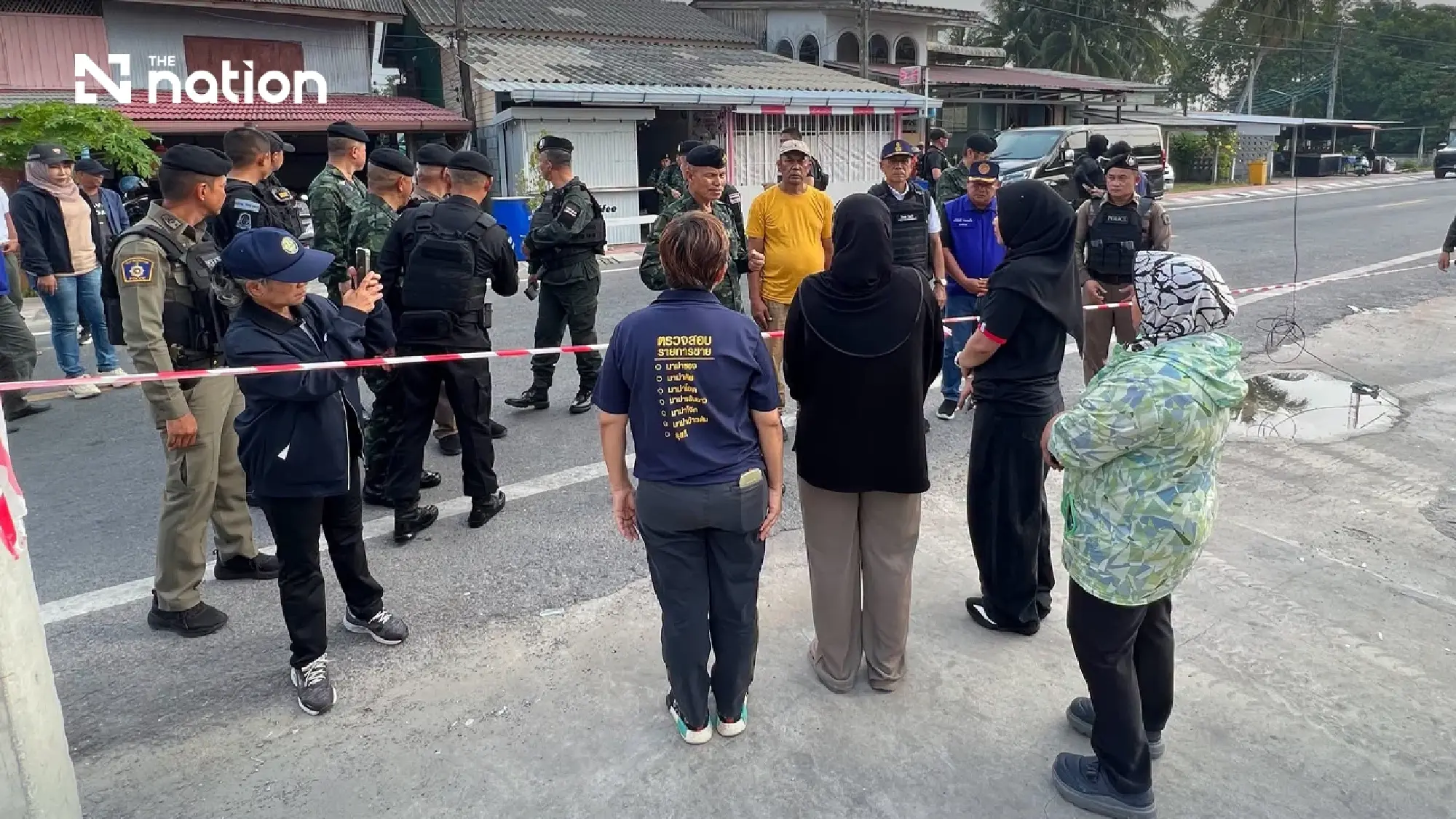

Norathip points to possible retaliation
Norathip said the latest violence may have been retaliation for security operations conducted during the previous month following the attack on the Bukeh Sami checkpoint in Narathiwat.
Five paramilitary rangers were killed when gunmen opened fire and threw pipe bombs at the checkpoint in Ra-ngae district on July 22.
Norathip said he subsequently ordered all units to carry out cordon-and-search operations against suspected networks and places used as hideouts.
The operations continued for more than a month. Search warrants were issued and nearly 30 people were brought in for questioning, he said.
“If we acted like the perpetrators, things would be different,” Norathip said. “But we are the state. We cannot act like them.”
He said those called in were taken to a questioning centre for investigation rather than being dealt with outside the legal process.
Authorities had also launched a 90-day anti-drug operation that was still under way and expected to end next month.
The campaign had resulted in numerous arrests involving drug-trafficking networks and the seizure of large quantities of narcotics, affecting what Norathip described as sources of finance for the insurgency movement.
Security forces had also intensified enforcement against illegal cross-border trade.
Norathip said contraband cigarettes worth more than 100 million baht had been seized in July. On August 13, authorities confiscated two million cigarettes and 18.7 million baht in cash.
He said attempts had subsequently been made to lobby officials over the seizure.
“Several issues came together at the same time as the movement was already preparing to act,” he said. “These networks cannot survive without money.”
Attackers may be embedded in communities
Norathip was also questioned about further incidents reported on Sunday, after security forces had been placed on alert following the initial four-hour wave of attacks.
He said all units had been ordered to establish checkpoints and increase security, but some of those responsible were people based inside the affected communities.
The perpetrators used networks established within villages and did not always travel by road, he said.
“Sometimes they walk out from behind a village to carry out an attack,” Norathip said.
They also selected government premises with little or no overnight protection. A local administrative office, for example, might have only one night guard, whom the attackers could restrain before carrying out the incident.
“The area is not small. It is extensive,” he said. “They choose whichever weak point they believe they can exploit.”
Asked whether those responsible for the arson attacks could be living in the communities where the incidents occurred, Norathip replied: “That is highly possible.”
Military to intensify proactive operations
Norathip said the military would increase proactive operations, particularly patrols, inspections and intelligence gathering.
He said some changes had already been made to intelligence work.
Operations against identified targets were also under way, although he declined to disclose how they would be conducted.
The programme questioned whether the deployment of substantial numbers of personnel from the First Army Area to Narathiwat, including changes at command level, had failed to improve security.
Norathip said the rotation had both advantages and disadvantages.
Newly deployed units were alert and had increased patrols, surveillance and operations against suspected networks, he said.
However, Narathiwat was also a centre of cross-border trade where large amounts of illegal activity involved influential figures and commercial groups.
Norathip alleged that some influential and business groups continued to use insurgent networks to carry out attacks.
“We are not tackling only one dimension,” he said. “There are several dimensions to the problem.”
Grey-market funding remains under scrutiny
Asked why authorities had not eliminated grey-market activities alleged to provide financial support to the Barisan Revolusi Nasional, or BRN, Norathip said security forces were continuing their enforcement operations.
“When I began touching these interests, that was when they started reacting,” he said.
The contraband cigarette trade alone was worth several hundred million baht a month, according to Norathip.
He also cited illegal fuel trading and irregularities involving the animal-feed trade. Trading animal feed was not a problem when conducted legally, he said, but much of the activity encountered by authorities breached the law.
“We are making arrests. It is not that we are doing nothing,” he said. “That is why several issues have emerged at the same time.”
Norathip renewed his call for a border fence, arguing that it would make illegal crossings and illicit trade easier to control.
“I want a border fence to be built,” he said. “People should be allowed to enter and leave only through permanent border checkpoints.”
A fence would help cut the movement’s sources of funding and make the broader security problem easier to address, he added.
Possible inaction within security apparatus
The programme also asked whether some soldiers or other security personnel might be involved in grey-market businesses and undermining the commander’s operations.
“It is something you inevitably have to consider,” Norathip replied. “It may be a factor.”
He said he repeatedly warned personnel during visits to military units not to become involved with illicit networks.
Anyone found to be involved would be returned to their parent unit and face an internal investigation. Personnel found guilty would be dismissed immediately, he said.
Norathip said the warning applied to soldiers, police officers and Border Patrol Police personnel.
He added that dismissal also affected the families of those involved, which was why he repeatedly warned personnel before offences occurred.
“With tens of thousands of people, there will be good people and bad people,” he said. “The question is how we keep as many as possible within the rules.”
Asked whether inaction at some levels of the security apparatus had allowed factors sustaining the BRN to remain in place, Norathip replied: “I believe that is probably the case.”
He did not identify any individuals, units or agencies.
Norathip acknowledged that the assignment could be exhausting but said he remained prepared to carry out the work entrusted to him.
“Sometimes, at certain moments, it is tiring,” he said. “But this is for the country.”
He said he was approaching retirement but would continue tackling illicit activity for the remainder of his tenure.
“If nobody begins dealing with these issues, nothing will move forward,” Norathip said. “These illegal activities have to be addressed. However much I can achieve, I will continue trying to do my utmost.”
