
Energy Ministers Issue Joint Imperative at Gastech: Cross-Border Infrastructure, Not Just Reserves, Will Define the AI Energy Era
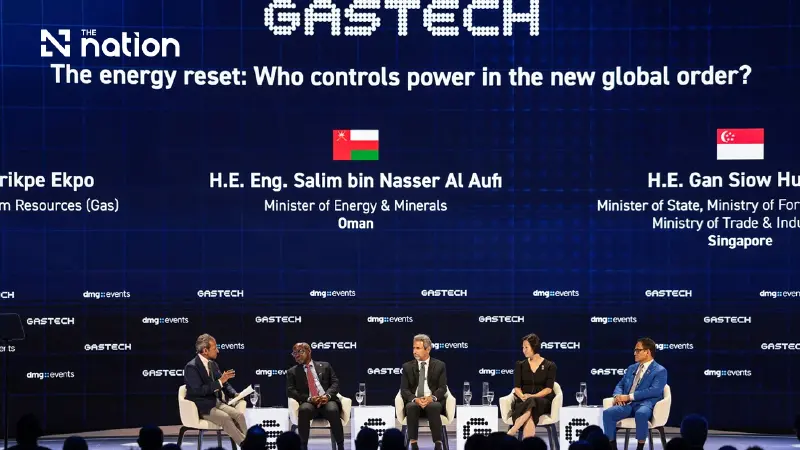


Ministers from Oman, Nigeria, Singapore and Timor-Leste tell Gastech that pipelines, grids and terminals — not reserves alone — will decide who has real energy security
- At the Gastech conference, energy ministers from several nations concluded that cross-border infrastructure like pipelines and power grids is now more critical for energy security than simply possessing large energy reserves.
- The urgency for this infrastructure is driven by an unprecedented surge in electricity demand from AI data centers, which threatens to create severe power bottlenecks.
- The ministers emphasized that no single nation can achieve energy resilience alone, calling for accelerated government commitments to collaborative projects like subsea power grids and regional gas pipelines.
- The consensus was that future energy powerhouses will be defined not by the volume of their reserves, but by their ability to convert those reserves into a reliable and accessible energy supply through robust infrastructure.
Ministers from Oman, Nigeria, Singapore and Timor-Leste tell Gastech that pipelines, grids and terminals — not reserves alone — will decide who has real energy security.
Global energy security has entered a new phase in which raw resource wealth counts for little without cross-border connectivity and rapid infrastructure expansion.
That was the consensus reached by energy ministers from Asia, the Middle East and Africa at Gastech on Monday (September 14), as they confronted an unprecedented surge in electricity demand from AI data centres alongside ongoing geopolitical shocks.
Their shared conclusion: no single nation can achieve energy resilience alone, and governments must accelerate commitments to subsea power grids, cross-border gas pipelines and expanded LNG import terminals to avoid severe power bottlenecks.
The panel, titled The Energy Reset: Who Controls Power in the New Global Order?, was held at BITEC in Bangkok on the opening day of Gastech, which runs until 17 September.
It was moderated by CNBC anchor Sri Jegarajah and brought together Oman's Minister of Energy and Minerals, Eng. Salim bin Nasser Al Aufi; Nigeria's Minister of State for Petroleum Resources, Ekperikpe Ekpo; Singapore's Minister of State for Trade and Industry and Foreign Affairs, Gan Siow Huang; and Timor-Leste's Minister of Petroleum and Mineral Resources, Francisco da Costa Monteiro.
Chokepoints, not fundamentals, are the problem
Asked whether the world was facing another destabilising energy shock, Al Aufi said the fundamentals of oil and gas supply remained sound.
"The resources are there. We know where they are... What we're struggling with is the ability to do the last piece, which is get it out from where it's produced to where it's needed the most, and that is not a technical problem," he said, pointing to disruption around the Strait of Hormuz as a short-term, logistical crisis rather than a structural one.
He acknowledged that oil prices "about $120 plus" and soaring LNG spot cargo rates were unsustainable but expected conditions to stabilise in the medium term as exporters diversify their routes to market — potentially via Yemen or northern corridors.
He also cautioned that alternative routes are not immune to disruption, citing recent damage to the East-West pipeline in Syria.
"If we create these conflicts, you're bound to get some sort of repercussion. It doesn't matter where you are in the world," he said.
Nigeria bets on gas infrastructure and regional pipelines
Ekpo said Nigeria was "very intentional" about scaling up gas production under the Petroleum Industry Act, which established a Gas Infrastructure Fund to draw in investors.
The country is supplying gas to Benin and Ghana and, via the West African Gas Pipeline, ultimately to Morocco, while negotiating a further link with Algeria.
He cited the OB3 and AKK pipeline projects, inherited from a previous administration, as central to moving gas from Nigeria's west to its east and north.
Domestically, Nigeria's "Decade of Gas" initiative, launched in 2021, has identified 20 projects to meet local and regional demand while freeing up surplus for export.
Ekpo said a "domestic delivery obligation" ensures Nigerians benefit first, alongside a presidential push to convert transport to compressed natural gas, including imported CNG buses and tax waivers on gas equipment, aimed at guarding against Nigeria's resources becoming "a resource curse" rather than a blessing.
Singapore pushes the case for an ASEAN power grid
Gan said Singapore, which draws 95 per cent of its power from natural gas, was doubling down on diversification and regional cooperation after the Middle East shock underlined its exposure.
Roughly half of its gas arrives by pipeline from Malaysia and Indonesia, with the remainder as LNG from Qatar, the United States, Australia and Mozambique.
A second LNG terminal, due to lift import capacity by 50 per cent to around 15 million tonnes a year by 2030, is under construction.
But she said diversification and buffers alone have limits, making a long-discussed ASEAN Power Grid — linking Southeast Asia's under-tapped hydro, solar and wind potential in countries such as Laos, Cambodia and Vietnam to power-constrained markets like Singapore — increasingly urgent.
Singapore hopes to secure endorsement of a legal and governance framework for subsea power cables at an upcoming ASEAN meeting, with the full framework expected when it chairs the bloc in 2027.
She said the surge in AI-related data-centre demand had sharpened the case for speed: "With AI, the data centres, we are seeing a big jump in energy demand... there is this recognition that we need to [move] faster."
Timor-Leste eyes market entry for Greater Sunrise
Monteiro said Timor-Leste's strategy also rests on diversifying sources and geography and pointed to the long-delayed Greater Sunrise gas field, where a legal framework was finalised last September after roughly eight years of negotiation.
He said the country now hopes to reach a final investment decision by 2029.
On managing resource wealth, he noted Timor-Leste modelled its sovereign wealth fund on Norway's, channelling gas revenue into a fund that remains untouchable outside an approved budget process.
"Not the highest reserves, but the most reliable supply"
Closing the session, the ministers converged on a single theme: cooperation, not competition, will define energy security in the AI era.
"Energy resilience is key, and no single country can achieve energy resilience on its own," Gan said, calling for both bilateral partnerships and multilateral frameworks to unlock ASEAN's renewable potential.
Al Aufi added that better mutual understanding between developers and host nations — over jobs, local supply chains and shared prosperity — was essential to sustaining long-term partnerships.
Ekpo offered the panel's closing line: "The powerhouse of tomorrow will not ever be countries with the highest volume of reserves. Rather, countries that will be able to convert the reserves into reliable, affordable and accessible energy."
That, he said, would require collaboration on technology, finance and infrastructure to meet demand at a national, regional and international level.
