
Anutin Vows Bold Energy Push, 50m Baht Solar Scheme, as Gastech Opens in Bangkok
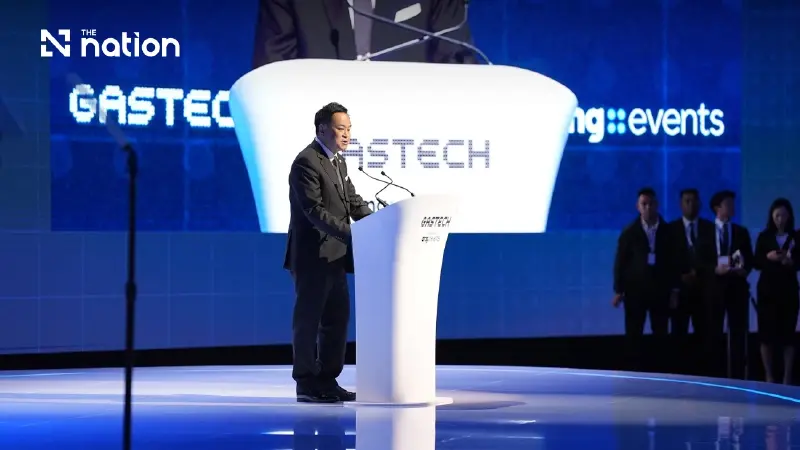


Anutin Charnvirakul launches a rooftop solar support scheme and sets out a three-point energy strategy as Gastech 2026 opens in Bangkok
- At the Gastech 2026 conference in Bangkok, Thai Prime Minister Anutin Charnvirakul announced a 50 million baht scheme to help households install rooftop solar panels.
- The Prime Minister unveiled a three-pronged energy strategy focused on security and affordability, a practical transition to renewables, and linking energy policy to economic investment.
- As part of the strategy, natural gas and LNG will continue to play an essential role in Thailand's power system during the transition to ensure reliability and manage costs.
- The overall goal of the energy push is to position Thailand as a "trusted partner" for global energy investment and cooperation.
Anutin Charnvirakul launches a rooftop solar support scheme and sets out a three-point energy strategy as Gastech 2026 opens in Bangkok.
Thailand's Prime Minister, Anutin Charnvirakul, used his opening address at Gastech 2026 in Bangkok on Monday to unveil a new rooftop solar support programme and lay out a three-pronged energy strategy, positioning Thailand as what he called a "trusted partner" for global energy investment and cooperation.
Speaking to an audience of ministers, chief executives and industry delegates at the Bangkok International Trade and Exhibition Centre (BITEC), Anutin announced that, starting in mid-October, the government will launch a scheme worth 50 million baht to help households install rooftop solar panels.
Tax exemptions will also be offered on selected imported solar components, he said, describing the move as "a practical step to help families reduce their electricity costs, expand access to clean energy, and strengthen our resilience against future energy price shocks."
The announcement came as Anutin framed Thailand's energy challenge in stark terms familiar to governments worldwide: how to secure sufficient, affordable energy for citizens and industry while moving towards a cleaner future.
"This is not a theoretical question," he told delegates. "Energy prices affect household expenses, the cost of doing business, our national security, and the decisions of investors."
He noted that electricity demand in Thailand is rising rapidly, driven not only by industrial growth but increasingly by artificial intelligence, cloud computing and data centres — a trend echoed throughout the opening session by other speakers.

Three strategic priorities
The Prime Minister set out three priorities underpinning Thailand's approach to the so-called energy trilemma of security, affordability and sustainability.
The first, he said, is energy security and affordability. Natural gas, he stressed, "remains an important foundation of Thailand's power system," providing the reliability and flexibility needed as renewable energy expands.
Gas and LNG will therefore continue to play "an essential role during the transition", even as Thailand works to diversify supply and reduce its exposure to volatility in global markets.
"A transition that leaves people unable to pay their energy bills will not be sustainable," Anutin warned. "We must keep the system secure, the cost manageable, and the benefits widely shared."
The second priority is making the transition practical and achievable. Alongside the rooftop solar scheme, the Prime Minister pointed to investment in grid modernisation and energy storage and highlighted bioenergy as a particular national strength.
Thailand's agricultural base and existing supply chains, he said, allow crop residues and by-products to be converted into ethanol, biodiesel and biomethane — creating value, in his words, "not only for industry but also for farmers and local communities."
The third priority is connecting energy policy with investment and economic opportunity. Anutin said investors today need more than incentives — they need "clear rules, timely decisions, modern infrastructure, skilled people and reliable access to cleaner energy."

He cited figures showing the scale of momentum already building: in the first half of 2026, Thailand's Board of Investment received investment promotion applications worth approximately 1.4 trillion baht (around US$43.6 billion), a 37 per cent increase on the same period last year.
These projects, he said, have the potential to create more than 82,000 jobs, with much of the momentum coming from digital infrastructure, clean energy and advanced manufacturing.
"Attracting investment is only the beginning," Anutin added. "Our goal is to ensure that investment also develops high skills, strengthens local supply chains, and creates better jobs and incomes for our people."
A call for partnership
The Prime Minister said Thailand welcomes cooperation across natural gas and LNG, renewable energy, energy storage, carbon management, hydrogen and bioenergy and invited governments, companies, investors and innovators to "turn promising ideas into practical solutions at scale."
Drawing on Thailand's position at the heart of Southeast Asia, its industrial base, infrastructure and business networks, he said the country aims to become "a trusted platform for energy investment, innovation and cooperation in this region."
Closing his address, Anutin urged delegates to use the four-day event to move beyond discussing what the energy future should look like and focus instead on what can practically be built through investment, technology and knowledge-sharing.
"Thailand stands ready to be your trusted partner," he said. "Let us work together to build an energy future that is secure, affordable, cleaner, and capable of supporting growth for generations to come."
About Gastech 2026
Gastech, now in its 54th year, is being held in Bangkok for the first time since 2008, running from 14 to 17 September at BITEC. Organised by dmg events, this year's edition has brought together more than 5,000 attendees from over 150 countries and 850 companies, including more than 25 ministers, across some 200 conference sessions.
For the first time, the event has introduced two dedicated sectors covering electrification and AI for energy, reflecting what organisers describe as the growing convergence between molecules and the electricity grid.
The opening ceremony also featured remarks from Christopher Hudson, President of Dmg Events, and Thailand's Energy Minister, Akanat Promphan. National consortia partners include EGAT, PTT, Gulf, Ratch and EGCO, alongside co-host companies Chevron, ExxonMobil and Shell. Organisers say last year's edition of Gastech facilitated US$60 billion in agreements and investment.
The programme continues this week with a ministerial panel featuring energy ministers from Nigeria, Oman, Singapore and Timor-Leste, an energy talk featuring former UK Prime Minister Tony Blair, and a CEO panel on Asia's energy sector featuring leadership from JERA and Petronas.
