
Japan’s shipbuilders increase investment to double domestic output
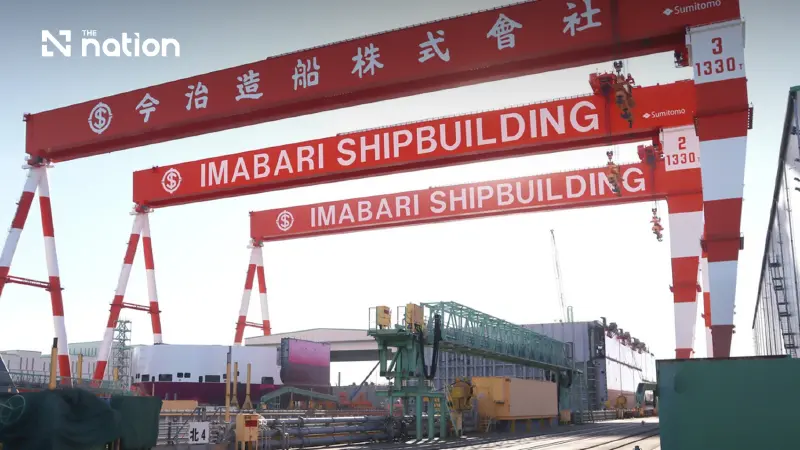


Plans for 900 billion yen in public and private investment are in place, but rising equipment costs could complicate Japan’s shipyard expansion.
- A public and private investment drive, expected to exceed 1 trillion yen, aims to double Japan's national shipbuilding output to 18 million gross tons.
- Investments are focused on modernizing production through robotic welding, AI-equipped robots, new cranes, and the restoration of damaged infrastructure.
- The Japanese government is a key backer, designating shipbuilding as a strategic sector and providing substantial subsidies to support the industry's revitalization and expansion.
Robotic welding, new cranes and the restoration of an earthquake-damaged dock are among the projects in a nationwide investment drive expected to exceed 1 trillion yen as Japan seeks to double shipbuilding output.
Shipbuilders are keen to invest, with public and private spending decisions totalling 900 billion yen already made.
Production at some yards is expected to rise to more than twice its current level.
Japan’s builders have struggled to compete against Chinese and South Korean rivals.
The government has selected shipbuilding as one of 17 strategic sectors for concentrated investment.
The national production goal is a combined gross tonnage of 18 million, twice Japan’s 2024 output.
Public and private investment in the industry is intended to reach about 1 trillion yen by 2035.
Whether companies can carry out their investment programmes as intended remains uncertain, however, as cranes and other production equipment become more expensive.
“We greatly appreciate the government’s support, but our cash outflow is substantial,” an industry official said. “We need to scrutinize plans carefully.”
Workforce shortages, including a lack of skilled welders, are driving Kawasaki Heavy Industries Ltd president Yasuhiko Hashimoto’s determination to “transform shipbuilding sites”.
The company intends to deploy robots equipped with artificial intelligence as part of digitalisation at its Sakaide plant in Kagawa Prefecture.
The shipbuilding revitalisation fund is set to provide 15.6 billion yen in subsidies to Kawasaki.
Jib cranes for heavy lifting and robots to increase steel plate welding capacity feature in the plans of Imabari Shipbuilding Co Ltd, Japan’s largest shipbuilder.
The equipment is intended for facilities including Marugame Headquarters in Marugame, Kagawa Prefecture, western Japan, and Saijo Shipyard in Saijo, in neighbouring Ehime Prefecture.
The transport ministry has earmarked the fund’s largest subsidy allocation, 113.8 billion yen, for the Imabari Shipbuilding group, where total investment is expected to reach around 300 billion yen.
The company said it would track production levels continuously while pursuing a twofold increase in output.
At Oshima Shipbuilding Co Ltd’s Koyagi plant in Nagasaki, south-western Japan, a crane installation and building improvements are planned.
The goal is annual production of about 10 bulk carriers by around 2031, taking output to 2.5 times its current level.
Hakodate Dock Co Ltd, based in Hakodate in Japan’s northernmost prefecture of Hokkaido, is pursuing a return to service for its No. 4 dock.
A major earthquake off south-western Hokkaido put the dock out of use in 1993.
Together, Hakodate Dock and its parent, Namura Shipbuilding Co Ltd, plan to spend up to about 150 billion yen over the coming decade, with government aid contributing 49.9 billion yen.
That programme also includes investment at Namura’s main shipyard in Imari, Saga Prefecture, south-western Japan.
Hakodate Dock plans to remove the water from the damaged dock for a condition assessment before restoration work begins.
Ship construction there is expected to restart around 2032.
Successful restoration is expected to lift the company’s annual production of small bulk carriers to more than twice the approximately five vessels built in 2024.

[Copyright The Jiji Press, Ltd.]
