
EEC sees three-airport high-speed rail at risk ahead of board review
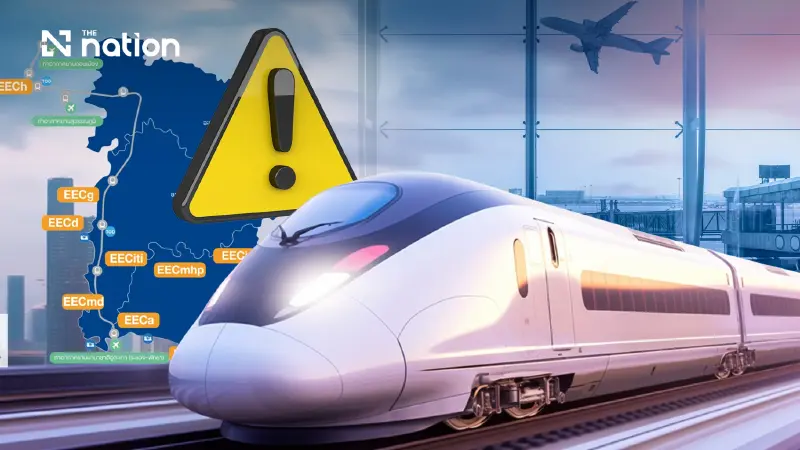


Thailand's EEC Policy Committee will consider the future of the three-airport high-speed rail deal in November after CP sought to end the contract.
- Thailand's high-speed rail project, linking three major airports, is at risk of collapse after its private partner sought to terminate the contract.
- Financial institutions have declined to provide funding for the project, following studies that raised serious concerns about its commercial viability.
- The Eastern Economic Corridor (EEC) Policy Committee is scheduled to review the troubled project's future at a meeting in November.
- If the current agreement is cancelled, the government is considering alternative development models, including a lower-speed railway, to reduce costs.
Thailand’s high-speed rail project linking Don Mueang, Suvarnabhumi and U-Tapao airports faces possible collapse after its private partner sought to terminate its contract and financial institutions declined to provide funding, according to the Eastern Economic Corridor Office (EECO).
Chula Sukmanop, secretary-general of the EECO, acknowledged on Monday (October 26) that the original project would be extremely difficult to deliver because circumstances had changed considerably and financial feasibility studies had raised serious concerns about its commercial viability.
The project, developed under a public-private partnership (PPP) agreement, has also become entangled in contractual disputes involving the CP Group-linked private concessionaire and the State Railway of Thailand (SRT).

EEC board to review troubled rail project in November
Chula explained that the high-speed rail project had not been discussed at Monday's meeting of the Eastern Economic Corridor (EEC) Policy Committee, chaired by Prime Minister Anutin Charnvirakul.
However, Anutin instructed officials to prepare the matter for consideration at the committee's next meeting in November.
It remains uncertain whether a final decision on the project's future can be reached at that meeting.
Because the railway was developed under a PPP agreement governed by EEC legislation, any decision to terminate or restructure the contract must undergo careful legal examination.
Financial feasibility assessments have indicated that the original investment model is no longer commercially viable, discouraging banks from providing loans.
Although the Office of the Attorney General has reviewed the proposed contractual amendments and determined that changes would be legally permissible, Chula stressed that revising the agreement would not resolve the fundamental financing problem.
Without financial backing, the project could not proceed even if the contractual amendments were approved.
CP requests contract termination as legal disputes continue
The CP Group-linked private concessionaire has formally notified the SRT of its intention to terminate the high-speed rail agreement. However, the SRT has not yet accepted that the notification constitutes a legally valid termination of the contract.
The matter has therefore entered dispute-resolution proceedings, with negotiations continuing over the conditions for ending the agreement.
Chula emphasised that the PPP concession remains legally binding until its termination is formally approved.
“In legal terms, the PPP concession has not yet formally ended. All parties must continue to comply with the contract,” he explained.
He compared the situation to a marriage that had not yet been legally dissolved, making it difficult for either party to pursue a new arrangement before the existing agreement was settled.
Any formal termination would require approval from the EEC Policy Committee before the proposal could be submitted to the Cabinet. If the parties cannot reach an agreement, the dispute may have to be resolved through the courts.
Chula also noted that the government could exercise its right to seize the contractual guarantee if clear evidence established that the state had suffered losses.
Meanwhile, the SRT must expedite legal proceedings to recover more than THB10 billion in outstanding fees associated with the Airport Rail Link (ARL), ensuring that its claims are filed before the relevant limitation periods expire.

Thailand considers lower-speed rail and alternative investment models
Despite uncertainty surrounding the existing agreement, Chula reaffirmed the importance of maintaining a railway connection between Bangkok, U-Tapao Airport and Rayong province.
If the current contract is formally terminated, the government will need to consider alternative development models. These could include direct public investment or a new PPP structure designed to make private-sector participation financially feasible.
One possibility involves modifying the railway's technical specifications by reducing its operating speed from the originally planned 250 kilometres per hour to 160 kilometres per hour.
The revised scheme could also establish an electrified railway network extending into Rayong, providing broader transport connections instead of primarily serving passengers travelling between airports.
Such an approach could reduce investment costs while better supporting economic development throughout the EEC.
The government would nevertheless need to assess the financial viability and practical requirements of any replacement project before proceeding.
Laem Chabang expansion adds urgency to rail development
Chula also highlighted the need to reorganise Thailand's eastern railway network to accommodate increased freight traffic from the third-phase expansion of Laem Chabang Port.
The port expansion is expected to become operational in approximately four years, potentially increasing annual container volumes from around 11 million to 18 million.
This growth would place significantly greater pressure on the railway corridor connecting Chachoengsao Junction, the Lat Krabang Inland Container Depot (ICD) and Laem Chabang Port.
To prevent congestion and improve efficiency, Chula proposed separating freight and passenger rail operations.
Under the proposed arrangement, freight trains would continue using existing railway tracks, while passenger trains and electric rail services would operate along a separate alignment. This would help reduce delays caused by trains waiting to pass one another and improve the overall capacity of the eastern transport network.
Chula acknowledged that several obstacles still need to be addressed in the Laem Chabang Port expansion project. He stressed that these issues would need to be addressed in stages to ensure that the project meets its objectives.
