
US marks first anniversary of Thai-Cambodia peace accords, credits Trump
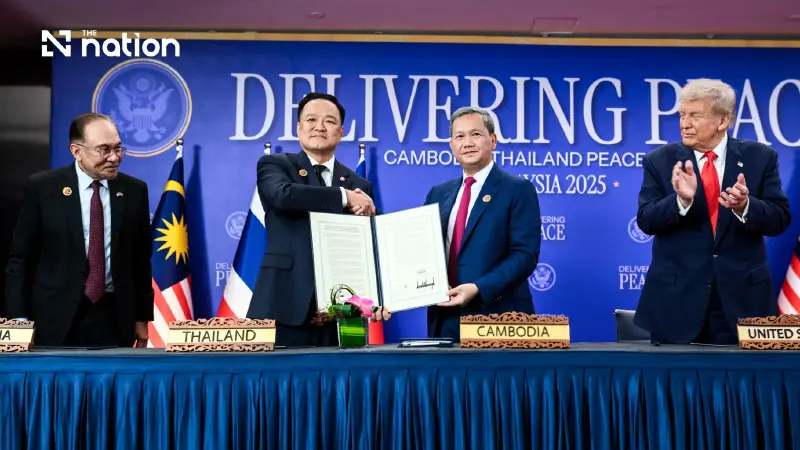


The United States marks the first anniversary of the Kuala Lumpur Peace Accords, crediting Donald Trump’s role in bringing Thailand and Cambodia together.
The United States has marked the first anniversary of the Kuala Lumpur Peace Accords between Thailand and Cambodia, with Secretary of State Marco Rubio highlighting President Donald Trump’s role in bringing the two countries together.
In a statement dated October 25, Rubio described the agreement as a landmark diplomatic achievement made possible by Trump’s leadership and commitment to peace.
“The United States continues to work with both sides to support implementation of the agreement and help make the promise of lasting peace a reality for the people of both nations,” Rubio said.
The agreement was signed in Kuala Lumpur on October 26, 2025, by Prime Minister Anutin Charnvirakul of Thailand and Cambodian Prime Minister Hun Manet, with Trump and Malaysian Prime Minister Anwar Ibrahim serving as witnesses.
The White House refers to the arrangement as the Kuala Lumpur Peace Accords, while Thailand’s Ministry of Foreign Affairs describes the signed document as the Joint Declaration by the Prime Minister of the Kingdom of Cambodia and the Prime Minister of the Kingdom of Thailand on the outcomes of their meeting in Kuala Lumpur.

Agreement set out steps to reduce border tensions
The declaration followed an earlier ceasefire reached in July 2025 and set out a series of measures aimed at de-escalating tensions and creating conditions for lasting peace along the Thai-Cambodian border.
Both sides reaffirmed their commitment to refrain from the threat or use of force and to resolve disputes peacefully in accordance with international law.
The agreement also provided for military de-escalation, including the withdrawal of heavy and destructive weapons from border areas to their normal military positions under observation and verification arrangements.
Thailand and Cambodia also agreed to establish an ASEAN Observer Team, comprising personnel from Association of Southeast Asian Nations member states, to support monitoring of the ceasefire.
Other commitments included humanitarian demining in border areas and measures to prevent the dissemination of false information, accusations and inflammatory rhetoric that could heighten tensions.

Existing border mechanisms retained
The declaration reaffirmed that border disputes and demarcation issues should be handled peacefully through existing bilateral mechanisms.
These include the Regional Border Committee, General Border Committee and Thailand-Cambodia Joint Boundary Commission.
The two countries also agreed to strengthen cooperation, information sharing and border controls to combat transnational crime affecting citizens on both sides.
Thailand’s Foreign Ministry described the declaration at the time as a significant step towards de-escalation, citing the withdrawal of heavy weapons, humanitarian demining, action against illegal activities and management of border encroachment issues among its main elements.
Rubio said Washington would continue working with Bangkok and Phnom Penh to support implementation of their commitments and advance the prospect of long-term peace between the two neighbours.
