
Myanmar and sea disputes test ASEAN unity at Manila summit


Leaders meeting in Manila will review Myanmar’s peace plan and South China Sea talks as rising fuel costs put regional cooperation to the test.
- ASEAN leaders are reviewing the bloc's five-point consensus peace plan for Myanmar's civil war, a crisis that highlights divisions as some member states renew engagement with the military government.
- Disputes in the South China Sea are a key topic, with discussions planned with China over a long-delayed Code of Conduct, though progress on the text itself remains a challenge.
- The summit's host, Philippine President Ferdinand Marcos Jr., has explicitly called for ASEAN to "act as one," underscoring the pressure on the group's cohesion when facing these and other regional crises.
Foreign ministers from the Association of Southeast Asian Nations (ASEAN) begin talks in Manila on Saturday (November 14, 2026), seeking a common response to rising energy costs, security tensions and an approaching El Niño ahead of a three-day leaders’ summit.
ASEAN leaders will meet representatives of major powers, including the United States, China and Japan, at the November 15–17 gathering. Discussions will cover the economic consequences of the Middle East conflict, Myanmar’s civil war, South China Sea disputes and pollution crossing national borders.
Philippine President Ferdinand Marcos Jr., whose country chairs ASEAN, has called for a united response to the overlapping challenges.
“Especially at a time when we face multiple crises, from rising oil prices to security concerns and the approaching El Niño, ASEAN needs to act as one,” Marcos said ahead of the meetings.
“It is very important that we are united and find plans and solutions to address these problems,” Marcos added.

Higher fuel costs squeeze families as oil reserve proposal remains under study
The Philippines and other Southeast Asian economies dependent on imported fuel are confronting higher household and business costs, alongside additional pressure on inflation. The disruption has exposed weaknesses in regional energy security, while proposals for a shared oil stockpile remain under examination.
For Filipino jeepney driver Lito Albino, 50, the conflict involving Iran has meant longer working hours and lower earnings. With three children and household bills to cover, Albino described rising fuel prices as an increasingly heavy burden on his family.
Albino appealed to US President Donald Trump ahead of the summit to help end the conflict, arguing that ordinary workers were paying for a war in which they had played no part.
“No one truly wins in a war. It is the poor and marginalised people like us who suffer the most,” Albino said.
Trump, who will attend the Manila summit, indicated earlier this week that further US military strikes on Iran were unlikely following appeals from countries including Qatar.
Reuters reported that Trump’s comments provided some reassurance to energy markets. However, the possibility of renewed military action and interruptions to oil supplies remains a concern for countries reliant on fuel imports.
A separate summit of the Japan-led Asia Zero Emission Community is also scheduled for next week. The framework aims to strengthen energy security while supporting economic growth and decarbonisation.

ASEAN leaders to review Myanmar peace framework
ASEAN leaders are expected to assess implementation of the five-point consensus, the bloc’s principal framework for addressing Myanmar’s crisis, Philippine foreign ministry spokesperson Dominic Xavier Imperial told a press conference on Friday (November 13).
Imperial indicated that the leaders’ decision would appear in a negotiated document released after the summit.
Myanmar’s military overthrew Aung San Suu Kyi’s elected government in 2021, triggering a civil war. United Nations estimates cited by Reuters put the death toll at 100,000, with more than 3.5 million people displaced.
Min Aung Hlaing’s military has received support from China, India and Russia. His administration has also gained greater international recognition in recent months, with some ASEAN members renewing engagement.
US officials have held secret talks with Myanmar’s military-backed rulers as the Trump administration moves away from years of isolation, Reuters reported.
South China Sea progress estimate refers to negotiations
ASEAN’s discussions with China will include the long-delayed South China Sea Code of Conduct, with Imperial putting overall progress in the negotiations at about 70%.
Imperial stressed that the estimate described how far the negotiating process had advanced. It did not mean that negotiators had agreed on 70% of the text.
Trump visit and Myanmar leadership draw protest plans
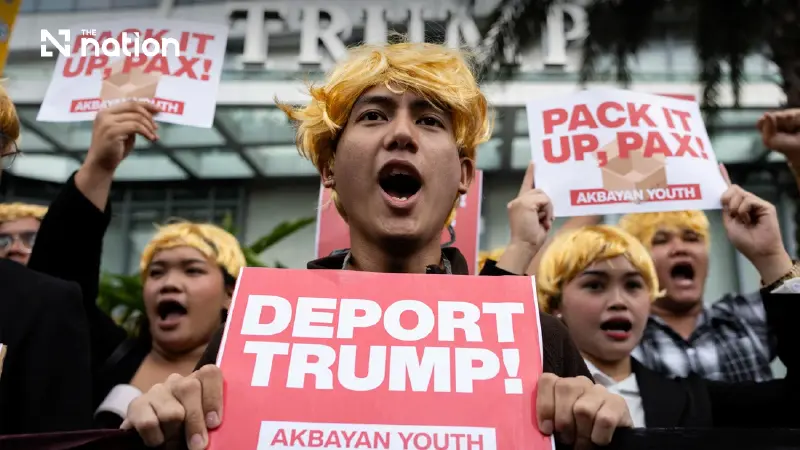
Workers, students and left-wing groups are expected to demonstrate during Trump’s visit, demanding an end to the Middle East conflict and the scrapping of the US-led Pax Silica initiative, which focuses on supply chains for artificial intelligence, semiconductors and critical minerals.
Activists also plan to raise Myanmar’s crisis during the summit, calling on ASEAN to continue excluding coup leader-turned-president Min Aung Hlaing from meetings of the bloc’s leaders.
