
MIT researcher outlines possible fivefold rise in Bangkok’s extreme-rain risk at Nov 12 forum
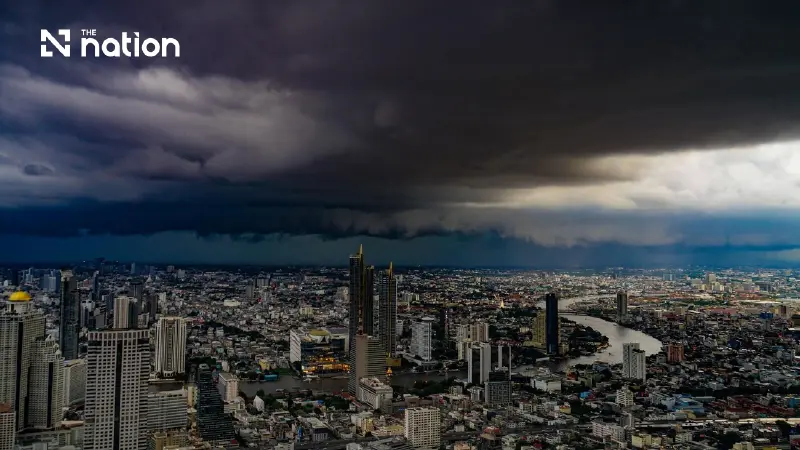


Researchers urge Bangkok to test drainage and prepare community flood plans as modelling points to greater risks from extreme rainfall.
- According to MIT researcher Dr. Sai Ravela, climate modeling shows the annual probability of Bangkok experiencing extreme rainfall (approx. 350mm in a day) could increase fivefold, from 1% to 5%.
- This increase in risk means an event previously considered a "100-year event" could occur as frequently as every 20 years under some future climate scenarios.
- The projections were presented at a forum in Bangkok on November 12 and are based on the CEDoS extreme-climate data system, a joint project between MIT and Chulalongkorn University.
Bangkok’s annual probability of rainfall reaching about 350mm in a single day could increase from approximately 1% to 5% under some future climate scenarios, according to modelling presented by Dr Sai Ravela of the Massachusetts Institute of Technology (MIT) in Bangkok on November 12, 2026.
Assist Prof Pongsak Suttinon, head of Chulalongkorn University’s Department of Water Resources Engineering, called for the Bangkok Metropolitan Administration (BMA) to test its drainage infrastructure against future rainfall scenarios, prioritise flood investment and strengthen community preparedness.
The researchers spoke at Water Resilience Forum 4/2026 in the SX Grand Plenary Hall at Queen Sirikit National Convention Center. The event explored “The Truth of Water: Understanding Water, Understanding the Future” under the broader theme of how societies should adapt to living with water.
September’s rainfall illustrates Bangkok’s drainage challenge
Pongsak estimated that around 300mm of accumulated rainfall over one to two days in September 2026 represented approximately 250 million cubic metres of water, roughly a quarter of the storage capacity of Pa Sak Jolasid Dam.

Bangkok can pump approximately 100 million cubic metres of water into the Chao Phraya River each day, according to Pongsak. The comparison illustrated the scale of the drainage challenge, including the possibility that some neighbourhoods could remain waterlogged even while pumping continues.
Pongsak described the prospect of previously rare downpours becoming more frequent as a potential “new normal”. Planning for those conditions would require Bangkok to assess the capacity of its canals, drains and pumping stations and decide where investment should begin.
A 1% annual rainfall probability could become 5%
Ravela used a daily rainfall total of approximately 350mm, which Post Today reported had caused serious disruption in Bangkok in October 2026, to explain the modelling. Under present-day climate conditions, the simulations put the annual probability of rainfall reaching that level at around 1%, commonly described as a 100-year event.

Some future climate scenarios raised that probability to approximately 5% per year, equivalent to a 20-year event and a fivefold increase in likelihood. These return periods describe annual probabilities, not fixed intervals between downpours.
Ravela illustrated the difficulty of estimating rare events through Storm Wipha’s impact on Nan province. Even a relatively weak storm can produce more intense rainfall when it interacts with the monsoon, making both the severity and likelihood of such combinations important for planners.
Historical records contain relatively few examples of storms occurring alongside monsoon conditions, Ravela explained. Observing one severe storm in 40 years of records is insufficient to establish a 40-year return period; similarly, exceptionally rare rainfall leaves limited observations for estimating a 100-year event.
Ravela’s team therefore uses modelling to assess rainfall probabilities and how they could change, helping planners consider the level of protection that drainage and flood-defence systems should provide.
Ravela also presented an example in which an extreme rainfall total of around 300mm could increase by up to approximately 30% around 2080. Simulations around 2040 showed smaller changes, while national maps indicated more intense extreme rainfall in the Northeast, northwestern Thailand and the South across almost all the scenarios presented.
The projections came from CEDoS, an extreme-climate data system developed jointly by the Water Resilience Center at Chulalongkorn University’s Faculty of Engineering and MIT. Ravela said the web-based system allows users to examine rainfall simulations at a resolution of approximately 5 × 5 kilometres, with plans to improve this to one kilometre for Bangkok and Rayong.

Worst-case map assumes 900mm of rain over three days
Ravela separately presented a worst-case Bangkok flood illustration assuming 300mm of rain each day for three consecutive days, totalling 900mm. The calculation also assumed saturated ground, high tides, elevated river and canal levels, and no effective drainage.
The map classified areas with water depths of 5cm or more as flooded. Light blue indicated shallow standing water, while the darkest blue represented depths exceeding 1.5 metres, with several concentrations in eastern and southern Bangkok under the stated assumptions.
The presentation explicitly labelled the map an illustrative static screening calculation, rather than a hydrodynamic forecast. Ravela stressed that identifying the risks to particular streets or communities would require actual infrastructure and drainage data, and proposed working with the BMA to make the modelling more representative of the city.
Pongsak used flooding at Nan Hospital to illustrate why the location of essential equipment also matters. The hospital, which he described as having been built with a budget running into billions of baht, placed MRI and CT scanners and backup generators on the ground floor, exposing them to potential flood damage.
Moving heavy hospital equipment upstairs would subsequently require checks on whether the building could support the additional weight, Pongsak noted.
For Bangkok, combining flood maps with the locations of hospitals, communities, vulnerable residents and economic districts could help identify services at risk of interruption and areas requiring assistance in advance.
Three priorities for Bangkok’s flood preparations
Pongsak proposed three areas of preparation before another extreme rainfall event:
1. Test drainage against future rainfall. Use several climate scenarios to assess the capacity of drains, canals and pumping stations, including locations where water could accumulate even when pumps operate at full capacity.
2. Prioritise investment across the river basin. Assess Bangkok alongside neighbouring provinces because waterways and supply-chain disruptions cross administrative boundaries. Estimates of community and economic damage should help determine where investment is most urgent.
3. Prepare community response plans. Establish safe locations, evacuation routes, communication arrangements and clear responsibilities for assisting vulnerable residents so communities can act promptly.
One proposed stress test would combine upstream flows comparable to the 2011 floods, rainfall like that experienced in September and high tides occurring simultaneously. Testing Bangkok’s systems against those combined conditions could help identify where additional drainage capacity, water-storage areas and ready-to-use evacuation plans are needed.
