
Salin: The Thai Drummer Turning Isan Rhythms into a Global Groove
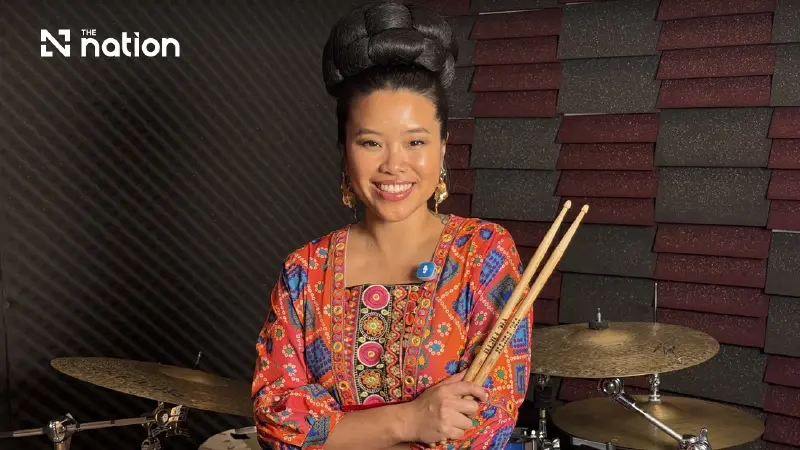


Juno-nominated drummer, composer and producer Salin fuses Isan folk, funk and Afro-jazz – and says every girl should feel free to take up space
- Salin is a Juno-nominated Thai drummer, composer, and producer who creates a unique global sound by fusing traditional Isan folk music with funk, soul, and Afro-jazz.
- Her album "Rammana" was inspired by a trip to north-eastern Thailand and specifically weaves Isan music and indigenous instruments with 1970s West African Afrobeat.
- This work has earned her international recognition, including a Juno nomination for Global Music Album of the Year, successfully bringing Isan rhythms to a wider audience.
- Salin believes Isan music, Afrobeat, and funk are a natural pairing as they all share a common spirit of fun, freedom, and a love for life, which she aims to express in her music.
Juno-nominated drummer, composer and producer Salin fuses Isan folk, funk and Afro-jazz – and says every girl should feel free to take up space.
Some careers begin with a grand plan. Salin Cheewapansri’s began with a mother who thought her daughter had too much free time. “She just thought I was too free,” the Bangkok-born drummer recalls. “She said, ‘You’re so young and so free, you have too much time.’”
Salin had wanted to learn the guitar, but at the Yamaha music school the drum teacher was fun – and her mother had a simple solution. “She said, ‘Just learn that too. Just fill your time with instruments.’” It was, in hindsight, a wise nudge.
Today Salin is a Juno-nominated drummer, composer and producer based in Canada, the creator of a sound she calls “Afro Thai Funk”, and one of the most distinctive voices in contemporary global jazz.
A drum kit with no gender
For a woman who has become a trailblazer in a male-dominated field, Salin’s early years were remarkably free of limits.
“I never really thought of the drum as a masculine instrument,” she says. “My parents never thought, ‘Oh, you’re a woman; you shouldn’t play the drums.’ Actually, it was my mum who introduced the drums.”
Her great-great-grandfather was a drummer too, and her father plays the violin, though no one in the family had made music a career before her.
“So I never felt like it wasn’t for me.”
The prejudice came later, once she turned professional, and has grown sharper in composing and producing – roles that happen behind the scenes. A drummer can at least be seen.
“I still have people come up to me and wonder who wrote the songs on my album,” she says.

Even her own bandmates have doubted her authorship when she brings in new material. “It’s an ongoing battle, and I think that is something that needs to be talked about more.”
There is no bitterness in the way she says it – only a steady insistence that the conversation happen.
From metal to Isan
Born in the mid-1990s and raised in Bangkok, Salin began in rock and metal before gravitating towards funk and soul, inspired by James Brown, Al Green, D’Angelo and Erykah Badu.
In Canada she played drums on Dominique Fils-Aimé’s Juno-winning album Stay Tuned, performed at the Montreal International Jazz Festival and released her debut album, Cosmic Island.
As a producer, she led the creation of Bel & Quinn’s Donte Sann Yo, nominated for Best World Album at the 2024 Juno Awards. Then came the project closest to her heart.
A trip to north-eastern Thailand inspired Rammana, which weaves Isan music and indigenous Thai instruments together with soul, funk and 1970s West African Afrobeat.
Recorded with Thai and Canadian musicians, it earned a 2026 Juno nomination for Global Music Album of the Year, and Salin was named one of six artists in CBC’s Revelation Canada 2025.
Carrying Thai culture abroad, though, has never felt like crossing a border.
“It’s like coming home every time,” she says. “I never think of it as, ‘I am doing this abroad.’ I just love doing it. I thought it was a really cool culture that we have here, so I am happy to do this.”
The pairing is no accident.
“Isan music is for people who want to have fun – and Afrobeat is the same, and funk as well. They love living life, they love being free. That’s what I want my music to say too.”

Showing who you are, not what you can do
In an essay for Women’s History Month, Salin argued that modern life has become “too masculine” and urged readers to embrace rest as a defence against burnout.
Drumming, a loud and physical art, might seem an unlikely place to practise that. She sees it differently.
“The masculine energy in performing is like, ‘Let me show you what I can do,’” she explains. “The feminine energy is, ‘Let me show you who I am.’ So when I play, I really try to feel what I want to say, and play that, rather than coming from that showing-off energy.”
That intent shapes her live shows, which draw on the healing rituals of Isan. “Music always takes you to a space out of reality, and I think that’s what we need sometimes – a moment to escape,” she says.
For women facing burnout, she adds, “the present feels overwhelming. When I make music, I try to put people in a trance-like state, and I think that helps calm the nervous system.”
Becoming the role model she never had
Blending genres that rarely met meant Salin had no template to follow. Asked about the hardest mindset shift, she is unshowy.
“It was definitely a challenge because, like you mentioned, there was no role model for me. But it was a really fun process of trial and error.”
What pleases her now is seeing others follow.
“When I was growing up, no one was there to mix Isan music with traditional Thai instruments and modern music,” she says. “So I’m just happy to see that people are embracing their culture more and remixing more.”
Asked how the industry can open doors for girls who dream of becoming producers and sound engineers, she points to visibility and learning.
“Putting role models out there, showing women that this is possible – and also education.”

The space you take
Salin’s story has not been one of overnight success. It has been built from small choices: saying yes to one more instrument, following her curiosity to north-eastern Thailand, and carrying on when people asked who really wrote her songs.
Her music has since reached NPR and BBC Radio London, and in 2026 she returned to a Thai stage at Bangkok Design Week. Asked what she would say to anyone holding a pair of drumsticks for the first time, she keeps it simple.
“The space you take is yours,” Salin says. “You can do whatever you want, and you are free to do whatever you want.” And to everyone else, a few words more: “I want you to be free to do whatever you please.”
