
Thailand to test Cambodia’s sincerity through six trust measures
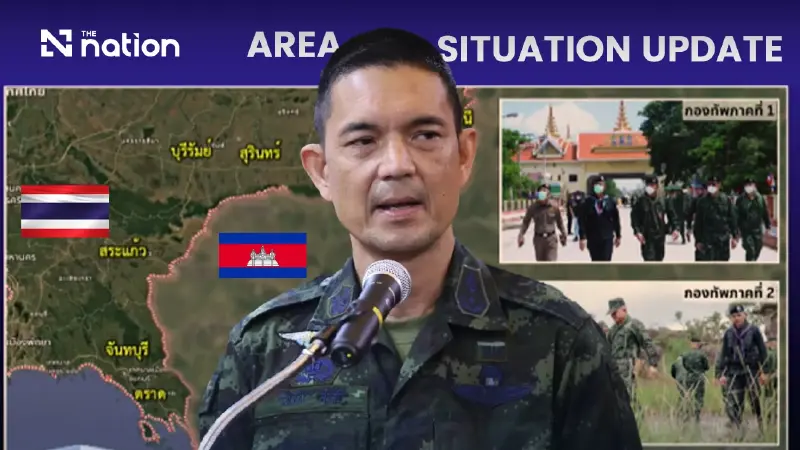


Thailand’s military remains ready to respond along the Cambodian border, while the next maritime conciliation meeting is expected in November.
- Thailand will use a set of six agreed confidence-building measures as a primary tool to test Cambodia's sincerity regarding their ongoing maritime dispute.
- The measures, proposed by a Conciliation Commission, include commitments to positive communication, avoiding escalation, and establishing direct communication channels between the two navies.
- Thai officials state that sincerity will be judged on the full implementation of the entire package of measures, not just selective compliance with certain provisions.
- While these diplomatic measures are being pursued, Thailand's armed forces remain on high alert and fully prepared to respond to any border incidents.
Thailand will judge Cambodia’s sincerity based on whether it fully implements six agreed confidence-building measures, while the armed forces remain fully prepared to respond to border incidents, Thai officials said on October 22, 2026.
At a briefing by the Joint Information Centre on the Thailand-Cambodia Situation (JIC), officials outlined continued military vigilance alongside the maritime conciliation process. The army reaffirmed its strict adherence to the ceasefire agreement.
Maratee Nalita Andamo, deputy spokesperson for the Ministry of Foreign Affairs, stressed that approval of the six measures was only a starting point. Success would depend on implementation of the package as a whole, rather than compliance with selected provisions, and actual adherence would need to be monitored.
“The measures will be a tool for both countries, especially Thailand, to test the sincerity of the other side,” Maratee said.
Six measures support Thailand-Cambodia maritime talks
Maratee said the Conciliation Commission had proposed the six confidence-building measures to preserve an atmosphere conducive to the compulsory conciliation proceedings under the United Nations Convention on the Law of the Sea (UNCLOS). The proposals emphasised restraint and avoiding actions or misleading public communications that could increase tensions.
Rear Adm Chanin Sriyaphai, Royal Thai Navy spokesperson and director of the Security Affairs Bureau at the Naval Operations Department, confirmed the navy’s support for all six measures:
- Commitment to the conciliation process.
- Positive and constructive communication.
- Avoiding escalation of the dispute.
- Engagement between the two countries.
- Direct communication channels between the two navies.
- Implementation of the confidence-building guidelines.
Confidence-building measures were already part of Thailand’s negotiations with other countries, Maratee noted. Either party could ask the commission for clarification if it had concerns or questions.
Maratee explained that the second meeting with the commission, held in The Hague, the Netherlands, had covered both maritime delimitation and confidence-building measures. Thailand presented its position, technical information, evidence and relevant principles of international law to help the commission consider a fair and sustainable resolution.
For the official account of the second meeting, Maratee referred to the statement issued by the Permanent Court of Arbitration (PCA), which serves as the Registry, or secretariat, for the proceedings.
The Royal Thai Navy has assigned operations and hydrographic specialists to Thailand’s delegation to provide technical information and recommendations, Chanin said. The navy would continue supporting the delegation.
To prepare for implementation of the six measures, the navy had met the Office of the National Security Council and the Thai Maritime Enforcement Command Centre, Chanin added. The discussions considered their application to maritime security, with the aim of establishing a common understanding and coordinated action.
A third meeting with the Conciliation Commission is expected in November, Maratee said, although Thailand is awaiting confirmation of the schedule from the PCA. Previous meetings had generally been held around the middle of the month.
Thai border remains at Level 1.5 under constant surveillance
Rear Adm Surasant Kongsiri, spokesperson for the Ministry of Defence, said the JIC’s assessment remained between green and yellow, equivalent to Level 1.5. Conditions along the Thailand-Cambodia border were not normal and continued to cause concern, requiring constant vigilance by military units and intelligence agencies.

The JIC’s assessment system ranges from green Level 1, requiring monitoring, to dark-red Level 5, representing a crisis that could lead to armed clashes, Surasant explained.
Maj Gen Winthai Suvaree, spokesperson for the Royal Thai Army, said troops continued to follow Army Commander-in-Chief Gen Pana Claewplodtook’s instructions to maintain surveillance and readiness to respond at any time, while strictly observing the ceasefire.
Necessary border-security improvements would continue alongside cautious efforts to address landmines, which remained an obstacle to operations, Winthai said. Safety would remain a priority in every operation.
Pana had also instructed army units to coordinate closely with the JIC and the Ministry of Foreign Affairs on public communications, Winthai added. Distorted information would prompt an immediate coordinated response.
Along the land and maritime borders in Chanthaburi and Trat, naval forces remained deployed for continuous security surveillance, Chanin said. Operations against unlawful entry and the smuggling of goods into and out of Thailand were also continuing.
Air force reviews lessons from two rounds of clashes
Gp Capt Natthanai Chanpleng, assistant spokesperson for the Royal Thai Air Force, said the service had reviewed lessons over more than 14 months encompassing two rounds of clashes with Cambodia and preparations for combat.
The air force’s reviews covered mission planning, air operations and cooperation between the armed services, Natthanai explained. The findings were intended to guide continued capability development, including more modern and precise operations and technology to monitor military movements and targets that could affect Thailand.
Natthanai emphasised cooperation with the Royal Thai Armed Forces, the army, navy, Royal Thai Police and other security agencies. Every mission required precision, efforts to minimise its impacts, and an approach grounded in caution and confidence.
The air force’s preparations were not intended as provocation, Natthanai stressed, but the service remained ready for every combat mission required of it.
“We do not want to fight, but if we want peace, we must be prepared for war,” Natthanai said, citing the air force commander-in-chief’s position.
Natthanai asked the public to have confidence in the Royal Thai Air Force’s operational readiness.
