
Chula signs KTIS research pact and showcases farm innovations
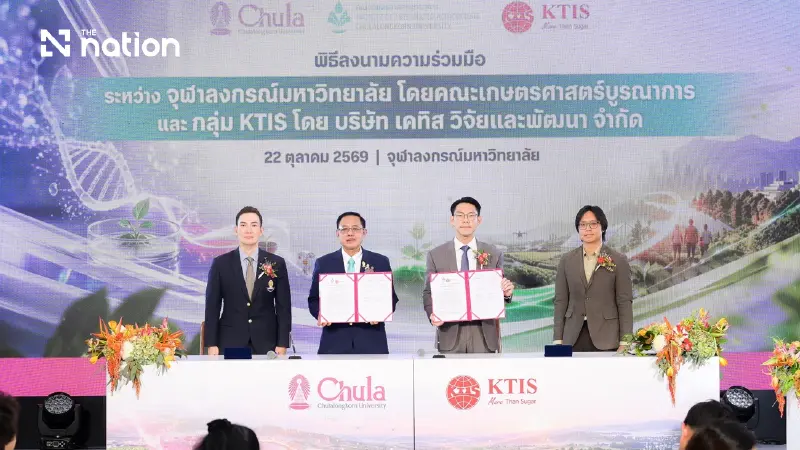


Chulalongkorn University signs a new KTIS research pact to develop high-value farm products and train agricultural entrepreneurs, alongside an innovation showcase.
- Chulalongkorn University has signed a research agreement with KTIS Group to commercialise agricultural research and turn raw materials into high-value products.
- The partnership aims to create value from agricultural waste, strengthen research capabilities, and provide students and academics with practical experience at KTIS industrial facilities.
- The university showcased several agricultural innovations with commercial potential, including PFAS-free food packaging, natural skincare products, and a smart plant factory.
Chulalongkorn University has signed a new memorandum of understanding (MOU) with KTIS Group to turn agricultural research and raw materials into high-value commercial products, reinforcing the importance of integrated agriculture in connecting academic knowledge with real industrial needs.
The agreement, signed through KTIS Research and Development Co Ltd, was announced at the university's “From Agriculture to Value, From Innovation to Sustainability” event at Chula Narumit House in Bangkok on Thursday (October 22).
The collaboration forms part of a broader strategy by Chula's Faculty of Integrated Agriculture to prepare students for agricultural entrepreneurship, develop commercially viable innovations and create greater economic value from Thailand's agricultural resources.

KTIS partnership connects academic research with industry
Assoc Prof Dr Pantawat Sampanpanish, Dean of the Faculty of Integrated Agriculture, explained that the new agreement builds on an earlier partnership with KTIS Group, established on March 6, which focused on environmentally friendly food packaging and reducing the use of per- and polyfluoroalkyl substances (PFAS).
The latest MOU expands cooperation into agricultural research, industrial applications and workforce development.
Its three principal objectives are to develop technologies that create value from agricultural waste and industrial by-products, strengthen research capabilities among academics and students, and pursue further joint projects with commercial potential.
Pantawat emphasised that universities possess academic knowledge and research expertise but need opportunities to test ideas against the practical challenges faced by industry.
KTIS Group, with operations covering sugar production, paper pulp, environmentally friendly packaging, ethanol, fertiliser and biomass-generated electricity, provides an industrial environment in which research can be applied and evaluated.
Through the partnership, Chula researchers and students could gain practical experience at approximately seven or eight KTIS industrial facilities, working alongside operational teams to identify problems and develop potential solutions.
Pantawat stressed that the faculty wanted cooperation agreements to produce tangible outcomes through continued collaboration, rather than partnerships that ended after the signing ceremony.
A KTIS Group representative highlighted the company's commitment to developing technologies under the Bio-Circular-Green (BCG) economic model, which promotes more efficient resource use and converts waste into valuable products.
The company's Nakhon Sawan Biocomplex forms part of its efforts to develop higher-value bio-based products, including biochemicals and bioplastics.
The representative emphasised that combining Chula's academic expertise with KTIS's industrial capabilities could accelerate the practical application of research while supporting economic, social and environmental development.

Integrated agriculture prepares students for modern farming
Prof Dr Wilert Puriwat, President of Chulalongkorn University, highlighted the university's decision to transform its former School of Agricultural Resources into the Faculty of Integrated Agriculture.
The restructuring is intended to strengthen agricultural education and research by bringing knowledge from different disciplines together and preparing students for the changing demands of the agricultural sector.
Wilert emphasised that modern farmers must develop skills beyond conventional crop and livestock production. They also need the ability to manage businesses, understand consumer demand and create additional value from agricultural products.
He explained that integrated education involves more than bringing separate academic subjects together. It requires combining knowledge and expertise to develop solutions that can be applied in practice.
"If a country wants good innovation, it must start with innovators. Innovators must always come before innovation," he explained.
Pantawat reinforced this approach, stressing that students must be trained to recognise agricultural problems, investigate their underlying causes and identify opportunities to develop marketable products.
He cited falling rice prices as an example, explaining that students should investigate whether the problem stems from crop quality, pests or other production factors before designing solutions.
The faculty therefore aims to develop graduates who can combine agricultural knowledge with entrepreneurship, research and practical experience to address industry challenges.

Chula showcases agricultural innovations with commercial potential
As part of this approach, the Faculty of Integrated Agriculture unveiled approximately 10–12 prototype products, demonstrating how agricultural research and raw materials can be developed into higher-value goods.
The innovations showcased included:
- PFAS-free food packaging: Biodegradable food containers made from sugarcane bagasse, developed in collaboration with KTIS Group. The packaging contains no PFAS, commonly known as “forever chemicals”, which have raised environmental and health concerns. The containers have already been introduced in university canteens.
- Natural skincare products: Cosmetics formulated with sea grape algae extracts and herbal ingredients, designed to improve skin moisture and brightness.
- Precision-formulated protein powder: A nutritional product combining animal and plant proteins, developed using research into muscle protein composition, protein synthesis and how the body uses amino acids.
- Thai cocoa innovations: Research aimed at creating additional value throughout the cocoa supply chain by making greater use of cocoa harvests, agricultural by-products and waste, while generating income opportunities for farming communities.
- Ready-to-eat meat products: Processed meat seasoned with makhwaen, a northern Thai spice, developed to offer convenient food options while promoting the use of local ingredients.
- Plant-based protein bars: Nutritional products made from mushrooms and other plant proteins, providing alternative protein sources while increasing the value of agricultural produce.
- Chula AgriSphere smart plant factory: A closed-system growing facility using Internet of Things technology, sensors and automated lighting and temperature controls to support year-round vegetable production, regardless of seasonal conditions. The innovation is designed to contribute to food safety and food security.

Turning agricultural innovations into business opportunities
Pantawat emphasised that developing prototypes was only the first stage of innovation. Students and researchers must also assess consumer expectations, improve their products and determine whether they can succeed commercially.
He explained that developers should be prepared to modify products or discontinue projects that cannot meet market requirements.
The faculty is also working through CU Agri Enterprise to provide a pathway for promising innovations to reach consumers.
Beyond Bangkok, the faculty has agricultural operations in Nan, Chiang Mai, Saraburi and Chon Buri, which provide plant and animal materials for research and product development.
Pantawat stressed that commercial success should not benefit only researchers or businesses but should also create opportunities for farmers and the communities supplying agricultural materials.
He highlighted the importance of establishing mechanisms through which income or other benefits generated from agricultural innovations could be shared with farming communities.
Through its expanded partnership with KTIS and its agricultural innovation programme, Chulalongkorn University aims to establish a stronger connection between education, research, industry and farmers, while preparing graduates to create commercially viable products that support the sustainable development of Thailand's agricultural sector.
