
Thailand backs US-Myanmar talks before November ASEAN summit
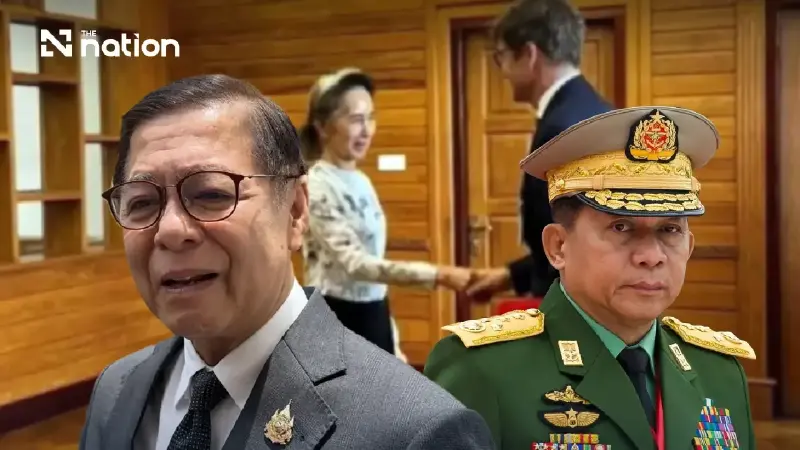


Sihasak expects ASEAN talks on Myanmar in November but is unsure whether restoring full representation will be discussed at the Manila summit.
- Thailand has officially expressed its support for renewed talks and engagement between the United States and Myanmar's military government.
- The Thai Foreign Minister clarified that this support aims to prevent Myanmar's isolation and encourage peaceful resolution, not to legitimize the regime.
- Thailand anticipates that the approach to Myanmar will be a topic of "substantive" and "in-depth" discussion at the upcoming ASEAN summit in November.
- This backing comes as the U.S. has increased contact with Myanmar's generals, holding two meetings in the month prior to the statement.
Thailand supports renewed US engagement with Myanmar and expects regional leaders to discuss their approach to the country at a summit in Manila in November, Deputy Prime Minister and Foreign Minister Sihasak Phuangketkeow said on 23 October 2026.
Speaking to Reuters in Lisbon, Sihasak said engagement “does not mean legitimizing the regime” and should encourage peaceful conflict resolution and reconciliation with Myanmar’s opposition.
“We don't want to see Myanmar isolated, we don't want Myanmar to be an arena for geopolitical rivalry ... so the US engagement is something that we welcome,” Sihasak said.
The United States and Myanmar’s military-backed government held talks in Tokyo two weeks before Sihasak’s interview, their second meeting in a month. Washington has been increasing contact with the generals it shunned after the 2021 coup.
Myanmar’s full ASEAN representation remains uncertain
Sihasak expects substantial discussions on Myanmar at the Association of Southeast Asian Nations (ASEAN) summit in November, but could not confirm whether restoring the country’s full representation would be considered. Myanmar’s political leaders have been excluded from ASEAN summits since the 2021 coup.
Sihasak described “some shift in ASEAN's position” on Myanmar, pointing to recent visits by Myanmar President Min Aung Hlaing to Laos, Cambodia, Vietnam, Thailand and Malaysia.
“It's good that we're going to have a very substantive, very extensive, and very in-depth discussion on how to proceed on Myanmar,” Sihasak said of the November ASEAN summit.
Sihasak sees possible Cambodia settlement within 12 to 18 months
Thailand and Cambodia could resolve their longstanding land and maritime boundary disputes within 12 to 18 months, Sihasak said, despite acknowledging that negotiations had made limited progress.
“It is possible, everything is possible,” Sihasak said, while stressing that rebuilding confidence and addressing security concerns along the land border, where clashes have occurred, must come first.
Cambodia initiated a conciliation process under the United Nations Convention on the Law of the Sea in June 2026. The move followed Thailand’s termination in May of a joint development framework agreed in 2001, after deadly border clashes.
The first meeting in the Thailand-Cambodia maritime conciliation process took place about a month before Sihasak’s interview on 23 October. “Right now, we haven't achieved, to be very frank, much progress,” Sihasak said.
The Thailand-Cambodia maritime dispute concerns overlapping claims to about 26,000 sq km in the Gulf of Thailand, an area believed to contain oil and gas reserves worth around US$300 billion. Sihasak said Thailand wanted the boundary settled before discussing how to share the resources.
Thailand-EU trade talks could conclude by the end of 2026
Free-trade negotiations between Thailand and the European Union are in their final stage and could be completed by the end of 2026 if both sides have the political will, Sihasak said.
