
US shifts policy to engage Myanmar military government directly in September talks
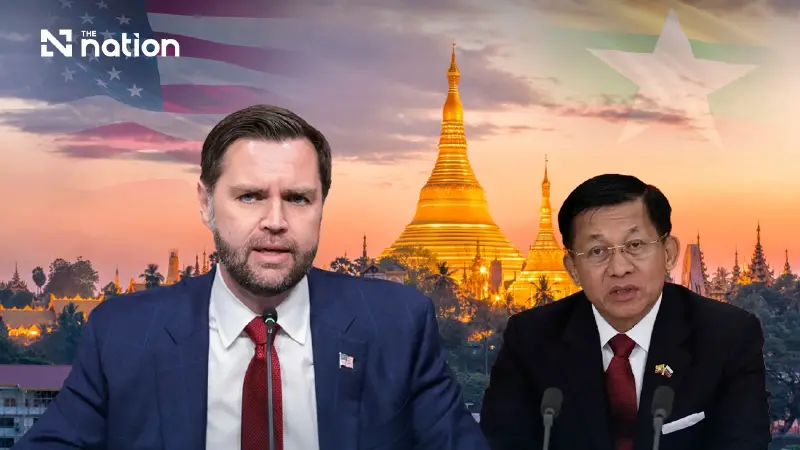


US Assistant Secretary Michael Vance met Myanmar's Min Aung Hlaing in September to negotiate prisoner release and discuss rare earths
- The United States has shifted its policy from isolating Myanmar's military government to direct engagement, marked by a high-level meeting in September between a U.S. Assistant Secretary of State and junta leader Min Aung Hlaing.
- The initial purpose of the talks was to secure the release of a detained American citizen, but the scope has broadened to include U.S. strategic interests like dismantling scam centers and accessing Myanmar's rare earth minerals.
- This policy change has drawn sharp criticism from U.S. lawmakers who argue that engaging with the regime confers legitimacy on it and undermines American values, particularly in light of the military's ongoing violence.
The United States has shifted its foreign policy stance from isolating Myanmar's military government to engaging in direct talks, marking a major departure from Washington's previous posture since the 2021 coup. Michael Vance, US Assistant Secretary of State for Intelligence and Research, led recent discussions in Myanmar aimed at securing the release of detained American citizens and addressing regional security issues.
Direct high-level talks in Naypyidaw
Vance met with Myanmar leader Min Aung Hlaing in Naypyidaw on September 15 to 16, marking the highest-level contact between Washington and the regime since the 2021 military takeover. The primary objective of the visit was to secure the release of American businessman and former American Chamber of Commerce president Adam Castillo, who had been detained at Yangon airport on June 11.
Sources indicated that the engagement has since broadened beyond the prisoner release to encompass key US strategic interests, including efforts to dismantle scam centres targeting American citizens and exploring access to Myanmar's substantial rare earth mineral reserves.

Strategic interests and regional pushback
The diplomatic shift reflects a transition under the Trump administration from democracy promotion toward transactional foreign policy. US officials have engaged with multiple factions in Myanmar's complex conflict, with the FBI coordinating directly with local authorities regarding online financial scams.
However, the policy change has drawn sharp criticism from Democratic lawmakers, including House Foreign Affairs Committee ranking member Gregory Meeks, who argued that engaging with Min Aung Hlaing undermines US values and confers international legitimacy on a brutal regime without enforcing congressional sanctions.
Meanwhile, less than two weeks after Vance's visit, a military airstrike on a crowded market in Rakhine State resulted in over 50 deaths and numerous injuries.
Diplomatic lobbying and international positioning
As Washington reassesses its diplomatic approach to diversify critical mineral supply chains away from China, Myanmar's administration has similarly stepped up its diplomatic efforts in the United States.
Records show that DCI Group engaged long-time Trump adviser Roger Stone in April to lobby on behalf of Myanmar's Ministry of Information, highlighting Washington's risk of missing out on critical mineral access.
While the State Department maintains that it interacts with all groups in Myanmar to protect US interests while condemning violence and calling for the release of political prisoners, the evolving relationship signals a complex recalibration of American influence in Southeast Asia.
