
Thailand tightens border security after Myanmar spillover injures one civilian on Oct 29
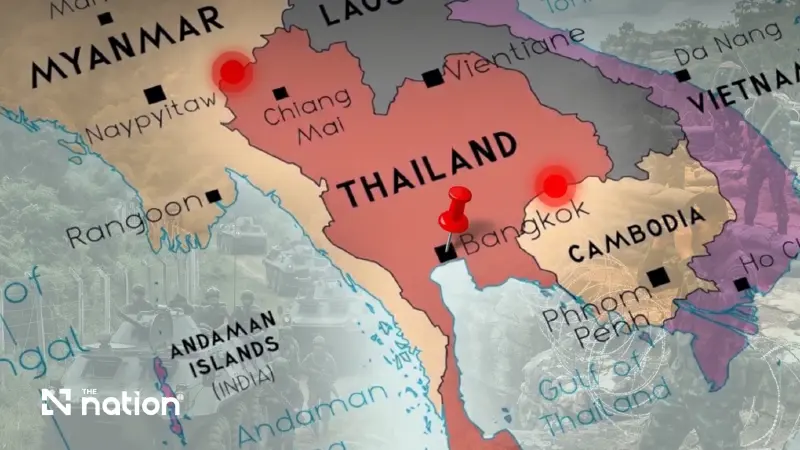


Thailand is stepping up civilian protection along the Myanmar frontier while keeping troops ready on the Cambodian border through November and December.
- Thailand is tightening security on its Myanmar border after stray rounds from fighting in Myanmar injured one civilian and damaged homes in Mae Sot on October 29.
- In response, Thai authorities have increased patrols, prepared civilian evacuation plans, and temporarily suspended goods transport through some unofficial crossings in Tak province.
- Thai military and government officials have contacted their Myanmar counterparts, urging them to conduct military operations cautiously to prevent further impact on Thai lives and property.
Thailand is tightening security along its Myanmar frontier to contain the effects of cross-border fighting while maintaining readiness on the Cambodian border, after stray rounds injured one civilian in Mae Sot on October 29, 2026, and damaged homes.
General Pana Klaewplodtook, commander-in-chief of the Royal Thai Army, has instructed Lieutenant General Worathep Boonya, commander of the Third Army Region, to keep the western frontier stable and prevent developments in Myanmar from adding pressure to the security situation along the Cambodian border.
The precautions follow Myanmar military attacks on ethnic armed groups near the frontier with Tak and Mae Hong Son. The transition from the rainy season to cooler, drier weather is also creating conditions more favourable for military operations.
Myanmar border patrols and evacuation preparations
Thai government and military leaders have contacted Myanmar authorities to urge caution over operations that could affect communities across the border. Local security units are maintaining round-the-clock patrols to protect residents and monitor developments.
The response included a seven-day suspension of goods transport through unofficial crossings in Mae Sot and Phop Phra districts in Tak, scheduled from October 30 to November 5. The measure did not constitute a blanket closure of authorised border trade, and the government specified that reopening affected routes would depend on security conditions.
General Chaipruak Doungprapat, secretary-general of the National Security Council (NSC), identified Myawaddy, opposite Mae Sot, as an area of concern and indicated that the army was following established procedures.
The NSC reiterated its earlier resolutions to agencies operating in the border area. Military preparations covered personnel movements, weapons and equipment, alongside plans to evacuate people from high-risk locations as quickly as possible in an emergency.
Local administrative authorities have also prepared temporary reception areas. Bangkok Biznews reported that no people fleeing this round of fighting had crossed into Thailand at the time of its account, attributing this to the attacks taking place several kilometres inside Myanmar.
General Ukrit Boontanon, Chief of Defence Forces, invited Brigadier General Win Thu Lin, Myanmar’s defence attaché in Bangkok, for discussions on the situation. Ukrit emphasised that military operations on the Myanmar side should be conducted cautiously, taking account of the potential consequences for Thai lives and property.
Cambodian frontier remains under surveillance
Thailand’s Cambodian border remains subject to military and intelligence monitoring. Bangkok Biznews reported that the Joint Information Center on the Thailand–Cambodia Situation maintained its assessment at Level 1.5, indicating abnormal conditions requiring vigilance and placing the situation between the green and yellow categories.
Bangkok Biznews also reported that Cambodian soldiers had attempted to climb towards Hill 642, a strategic position in the Preah Vihear sector, using ropes tied to trees. The reported movement occurred along a cliff near Chong Phra Phalai and the Phu Phi viewpoint in Kantharalak district, Si Sa Ket.
Thai troops detected the movement before the Cambodian soldiers reached the hill, fired warning shots with live ammunition and cut the ropes, according to Bangkok Biznews. The outlet reported that Thai forces erected barbed-wire barriers on both sides of the site and strengthened their presence at strategic positions, while other locations remained potential points of confrontation.
Bangkok Biznews further reported that Cambodian troops were concerned about a possible Thai attempt to seize Preah Vihear Temple in any future clash. The outlet also alleged that the temple had been used as a military base for attacks on Thai troops during earlier fighting.
Army inspections reinforce year-end readiness
Major General Winthai Suvaree, the army spokesman, outlined security and personnel priorities following Pana’s inspection of the Cambodian frontier on November 2–3. The visits focused on border operations, frontline morale and readiness to respond to developments through November and December.
The inspection programme took in the Burapha Task Force in Sa Kaeo and the Suranaree Task Force, which is responsible for five provinces. Although conducted as part of the army’s routine inspection cycle, the tour also reinforced instructions for troops to remain alert.
Pana and his delegation received a briefing on border conditions and key operations at Burapha Task Force headquarters in Watthana Nakhon district, Sa Kaeo, on November 2. The delegation then visited Task Force 3 headquarters under the Suranaree Task Force in Si Sa Ket to review sovereignty-protection missions, living conditions and basic facilities for personnel.
Pana continued the inspection at Suranaree Task Force headquarters in Mueang district, Surin, on November 3, meeting troops and reviewing developments along the frontier.
Winthai said Pana had instructed military units to coordinate intelligence systematically, comprehensively and promptly, alongside maintaining personnel and equipment readiness. Operational plans were also to be reviewed and improved so that units could respond effectively to changing circumstances.
Thai border units were directed to maintain strict patrols and surveillance while complying with the law, international rules and recognised principles to uphold the legitimacy of Thailand’s actions.
Pana’s instructions also covered appropriate troop rotations to support personnel’s health, physical recovery and mental well-being, ensuring that frontline units remained capable of protecting national sovereignty and civilian safety.
Source: Krungthep Turakij
