
Indonesia VP resigns Nov 12 with 60 days to elect successor
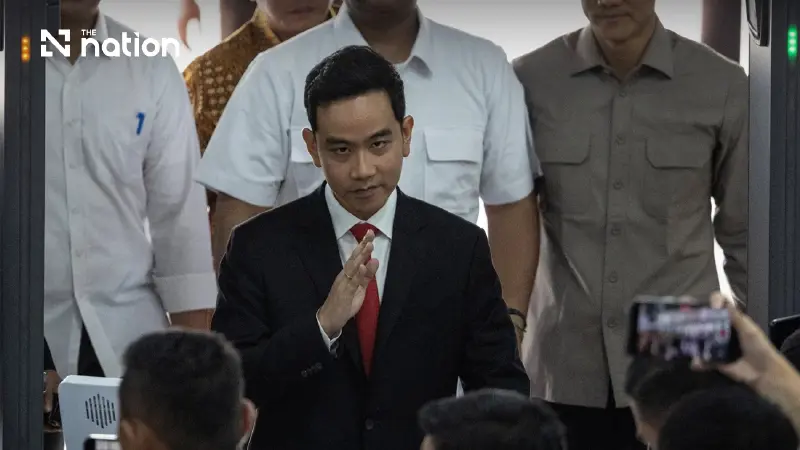


Gibran denies his resignation is linked to education rulings, while Indonesia’s assembly must elect a successor from two presidential nominees.
- Indonesia’s Vice-President Gibran Rakabuming Raka formally resigned on November 12 amid mounting pressure over his educational qualifications and a potential impeachment.
- Despite the controversy, Gibran stated his resignation was a personal decision to preserve the government's ability to function, a move President Prabowo Subianto accepted.
- According to Indonesia's Constitution, the People’s Consultative Assembly (MPR) now has 60 days to elect a new vice-president from two candidates nominated by the president.
Indonesia’s Vice-President Gibran Rakabuming Raka formally submitted his resignation on November 12, 2026, following court findings over his educational qualifications and mounting impeachment pressure, setting in motion the process to choose his replacement.
Gibran, 39, the eldest son of former president Joko “Jokowi” Widodo, denied that his departure was connected to the qualifications controversy. In a video address late that day, Gibran described the decision as personal and maintained that his educational documents were complete.
President Prabowo Subianto accepted the resignation with a “heavy heart”, while Jokowi reaffirmed support for the administration amid concerns about strains in the alliance between Indonesia’s current and former leaders.
Court findings and impeachment pressure preceded resignation
Indonesia’s Supreme Court annulled Gibran’s overseas high-school equivalency certificate on October 30. Earlier that month, the Constitutional Court had found insufficient documentary evidence that his foreign education met the minimum qualifications required for election.
The Constitutional Court did not, however, disqualify Gibran from office. Its published account stated that the application was inadmissible because the applicants lacked legal standing.

Prabowo had advised Gibran earlier in the week to continue contesting the case, including requesting a judicial review of the Supreme Court ruling. Political pressure nevertheless intensified.
Hundreds of people demonstrated in Jakarta and other cities on November 10 against government policies, with some groups also calling for Gibran’s impeachment, CNA reported.
A group of 120 lawmakers from all eight parliamentary factions signed a proposal on November 11 to exercise the House of Representatives’ right to express an opinion, a mechanism that could lead to impeachment proceedings.
Gibran thanked Prabowo for his trust in the late video address and rejected any suggestion that resigning amounted to an admission of incapacity.
“This decision to step down is also not a declaration of inability. Rather, it is a major step that I must take to preserve the government’s capacity to move forward further,” Gibran said.
Gibran also argued that “democracy needs to be managed better”.

Assembly must elect a replacement within 60 days
Gibran arrived at the parliamentary complex in Jakarta at 11.15am local time on November 12 and declined to answer questions from waiting journalists, CNA reported. After meeting leaders of the People’s Consultative Assembly, known as the MPR, privately for about 20 minutes, Gibran left without making a statement.
MPR speaker Ahmad Muzani confirmed that Gibran had submitted a resignation letter and wanted the assembly to process his departure. The same letter had also been delivered to Prabowo.
Coordinating Minister for Law, Human Rights, Immigration and Corrections Yusril Ihza Mahendra clarified that the resignation itself did not require MPR approval. The assembly’s responsibility was to formally recognise the vacancy and begin the constitutional replacement process.
Under Article 8(2) of Indonesia’s Constitution, the MPR must elect a new vice-president within 60 days of the vacancy arising, choosing between two candidates nominated by the president.

Prabowo praises Gibran as Jokowi maintains support
Gibran met Prabowo both before and after visiting parliament, according to the presidential office. Following the morning meeting, Prabowo personally accompanied Gibran to his vehicle.
Prabowo publicly thanked Gibran during the afternoon appearance at the presidential palace, praising his assistance during the election campaign and the government’s first two years, which the president credited with producing tangible results.
“I felt assisted. He did his job well,” Prabowo said, referring to Gibran’s work across Indonesia.
Prabowo described Gibran’s decision to avoid further controversy over his qualifications as demonstrating courage, responsibility and statesmanship in the national interest. Gibran bowed and embraced Prabowo after the speech.
Jokowi told reporters outside his home in Solo, Central Java, that he had encouraged his son before the parliamentary visit and reminded him that “positions are temporary”.
“We will continue to support President Prabowo’s administration, especially programmes that serve the interests of the broader public,” Jokowi said.
Jokowi’s assurance could help ease concerns about the political alliance. Jokowi twice defeated Prabowo in presidential elections before backing the former general when term limits prevented Jokowi from running again.
Gibran was elected alongside Prabowo in 2024. During that election, Jokowi faced accusations of influencing a court decision that changed eligibility rules and allowed his son to stand.

Rupiah falls amid wider political uncertainty
Indonesia’s rupiah weakened by as much as 0.6% on November 12 to a record low of 18,255 against the US dollar. The political turmoil has weakened investor sentiment amid scrutiny of Prabowo’s flagship programmes and concerns about the government’s management of Southeast Asia’s largest economy.
Reuters described Gibran’s departure as Indonesia’s highest-profile resignation since President Suharto stepped down in 1998.
Analysts cited by Reuters identified a separate investigation into alleged illegal wiretapping by senior police officers as another sign of divisions between Prabowo and Jokowi. The investigation involves former police chief Listyo Sigit Prabowo, widely regarded as a Jokowi loyalist.
Police announced on November 12 that they had sufficient preliminary evidence to pursue treason charges against four suspects in connection with the alleged wiretapping of Prabowo, other politicians, activists and journalists.
Lawmakers urged current police chief Suyudi Ario Seto to establish who allegedly instructed Listyo to carry out the surveillance and what political interests might have been involved.
