
Thai official reaffirms commitment to ceasefire accord with Cambodia


Thailand is ready to submit evidence for scrutiny and calls for practical cooperation to rebuild trust while upholding its right to defend its sovereignty.
- A Thai official, Prapas Sornchaidee, reaffirmed Thailand's commitment to the December 27, 2025, ceasefire agreement in response to Cambodian accusations of invasion.
- The official urged Cambodia to stop making accusations at international forums and instead return to implementing the accord's provisions, such as maintaining troop deployments and using coordination channels.
- While reaffirming the commitment to peace, the official stated that Thailand acted in self-defense and is prepared to submit evidence to a verification process to prove its compliance.
- Prapas called for both sides to use existing mechanisms to build trust and verify facts, stressing that lasting peace depends on actions and adherence to the agreement, not words on the world stage.
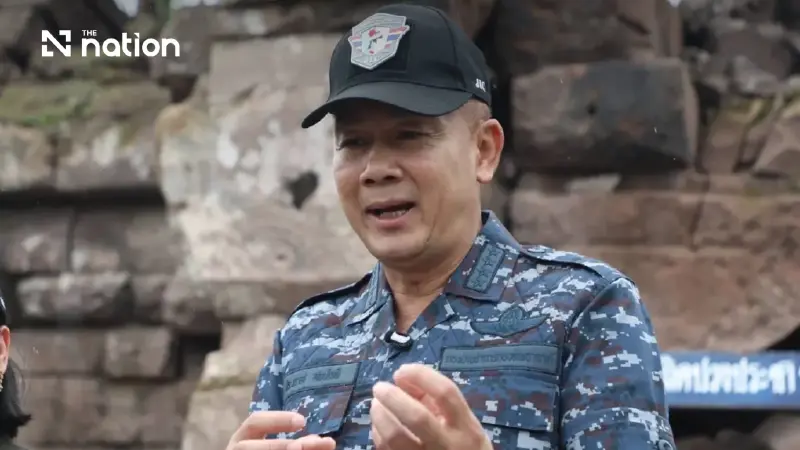
ACM Prapas Sornchaidee, director of the Joint Information Center on the Thailand–Cambodia Situation (JIC), responded in an interview on Sunday (November 15, 2026) to Samdech Hun Manet’s accusations at the Francophonie Summit that Thailand had invaded and occupied Cambodian territory.
Prapas reaffirmed Thailand’s commitment to the joint statement of December 27, 2025, and urged Cambodia to resume implementing the agreement in earnest instead of making accusations at international forums, which could undermine trust and peace-building efforts between the two countries.
He urged all sides to revisit what the two countries had agreed in the joint statement on December 27, 2025.
Its key provisions covered a ceasefire, maintaining agreed troop deployments, refraining from reinforcements or provocation, using coordination channels, reducing landmine risks and creating conditions conducive to peace.
The priority now was to establish which side was genuinely honouring the commitments made under the agreement, rather than compete to accuse each other at international forums, Prapas stressed.
Lasting peace required both sides to build mutual trust instead of creating suspicion between their peoples.
Thailand maintained, on the basis of records of events and evidence it had gathered, that it had not initiated the attacks and that its actions were intended to defend itself and protect its people.
Prapas added that Thailand was ready to submit evidence that could be disclosed, including a chronology of events, coordinates, photographs, damage reports and other supporting information, to an appropriate verification process.
“If there are allegations that Thailand has invaded or occupied any area, I ask that verifiable evidence also be provided, because repeating claims does not make those allegations true,” Prapas said.
“Allegations that contradict the evidence need to be corrected. We do not want the international community to judge on the basis of one side’s words, but to consider the facts comprehensively.”
He affirmed that every country had the right to present its position at international forums, but that this should come with a responsibility to respect the facts.
Repeated accusations without allowing evidence to be examined jointly could damage the trust both sides had been trying to build since the ceasefire.
Prapas called for effective use of existing arrangements, including coordination between military units, bilateral mechanisms within their respective mandates and the role of the ASEAN Observer Team (AOT).
Trust came from keeping commitments and taking action along the border, rather than declarations on the world stage, he stressed.
The joint statement remained an important framework for preventing a return to violence, he added.
Both sides needed to uphold the ceasefire, avoid increasing tensions, comply with the agreed restrictions on military forces and the use of unmanned aircraft, and use coordination channels to resolve incidents quickly.
Protecting civilians, humanitarian mine clearance, the work of observers and responsible communication also required attention, Prapas continued.
In particular, he highlighted clause 16, concerning communication and the dissemination of information, as a reminder that messages creating misunderstanding or hatred did not make peace more secure.
Compliance therefore had to be measured by actions, not words alone.
Thailand wanted peace, but that did not mean abandoning its duty to defend the country, Prapas said.
The Thai armed forces were responsible for safeguarding sovereignty, territorial integrity and public safety through measures appropriate to the situation and consistent with the relevant laws.
Thailand was ready to act on all fronts, including diplomacy, international law, communicating the facts, maintaining border security and exercising its legally recognised right to national defence.
If a threat arose that made the use of force necessary, any response would have to comply with the principles of necessity and proportionality and with international humanitarian law, he added.
Thailand would not initiate conflict, but would not neglect its duty to protect its sovereignty and the lives of Thai people.
“I call on all sides to return to strict adherence to the joint statement of Saturday (December 27, 2025), stop making allegations unsupported by evidence, allow joint verification of the facts and use the agreed mechanisms to build confidence,” Prapas said.
Thailand was ready to coexist peacefully with Cambodia as a neighbour, but good relations had to rest on truth, sincerity and mutual respect, he added.
The world stage should not become an arena for competing accusations; existing agreements should instead be used to build peace.
Thailand was ready to negotiate, establish the facts and defend its sovereignty by all lawful means, Prapas continued.
It did not want war, but would not allow unsubstantiated claims to undermine its rights, security and dignity.
