
Anutin sets out ASEAN proposals on AI, energy security and trade
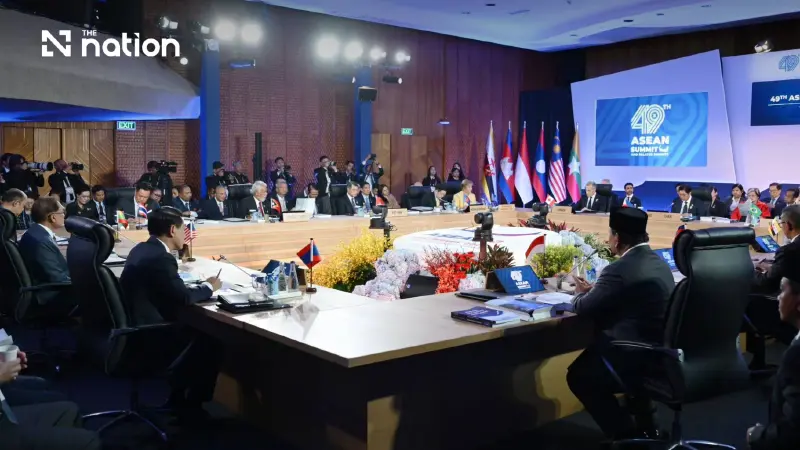


Thailand’s proposals at the Manila summit cover an ASEAN-led AI strategy, energy links, trade, online scams and cross-border pollution.
- Thai Prime Minister Anutin Charnvirakul proposed that ASEAN develop its own artificial intelligence (AI) strategy based on the region’s interests and priorities to avoid taking sides in geopolitical competition.
- He called for strengthening regional energy security through closer cooperation, specifically by developing the ASEAN Power Grid and expanding cross-border trade in renewable electricity.
- Anutin advocated for increased intra-ASEAN trade by calling for the faster implementation of the ASEAN Digital Economy Framework Agreement (DEFA) and the upgraded ASEAN Trade in Goods Agreement (ATIGA).
Thai Prime Minister and Interior Minister Anutin Charnvirakul has urged ASEAN to develop its own artificial intelligence (AI) strategy based on the region’s interests and priorities, allowing it to benefit from the technology without choosing sides in geopolitical competition.
Speaking at the plenary session of the 49th ASEAN Summit in Manila on Sunday (November 15, 2026), Anutin also called for deeper economic integration, stronger energy cooperation and joint action against online scams, transboundary haze and water pollution.
Government spokesman Ekapop Phianphiset outlined the remarks at the Philippine International Convention Center (PICC) at 10.15am Manila time, one hour ahead of Thailand. The Prime Minister’s proposals centred on three priorities: a united, resilient and people-centred ASEAN.

Anutin recalled that leaders had discussed the impact of the Middle East conflict at the mid-year ASEAN Summit in Cebu. He pointed to deeper challenges, including declining confidence in the rules-based international order, geopolitical tensions and increasing economic fragmentation.
These challenges reinforced the need for ASEAN to maintain its unity, strengthen its resilience and respond to the needs of its people.
Energy cooperation to strengthen regional resilience
Alongside his proposal for a regional AI strategy, Anutin called for closer energy cooperation through further development of the ASEAN Power Grid.
He proposed expanding cross-border trade in electricity generated from renewable sources, including solar power, as part of efforts to strengthen regional energy security.
Member states that are ready and interested could begin cooperating first, creating favourable conditions and momentum for wider regional integration.
Digital trade and closer economic ties
Under his proposal for a united ASEAN, Anutin emphasised stronger regional integration and closer economic relationships among member states.

Thailand welcomed the signing of the ASEAN Digital Economy Framework Agreement (DEFA). The Prime Minister called for faster implementation alongside the upgraded ASEAN Trade in Goods Agreement (ATIGA) to increase intra-ASEAN trade and create new economic opportunities.
Joint action on scams and public health
Anutin stressed that people-centred cooperation must protect the safety, health and well-being of ASEAN citizens.
He called for stronger action against online scam networks and cybercrime, building on the Global Partnership against Online Scams initiative.
His proposal would establish a regional network of key national agencies to exchange information, improve law enforcement coordination and support joint operations.
The Prime Minister also welcomed the agreement reached to establish the ASEAN Centre for Public Health Emergencies and Emerging Diseases (ACPHEED).
Thailand, as one of the centre’s host countries, reaffirmed its commitment to strengthening regional capabilities to prepare for future public health emergencies.
Immediate cooperation on cross-border pollution
Anutin urged member states to address transboundary environmental problems at their source, with particular attention to haze and water pollution.
“ASEAN must step up joint efforts to prevent and address transboundary environmental problems, particularly haze and water pollution, at their source,” he said.
“This includes promoting sustainable land and water management. The countries concerned must act and cooperate immediately.”
Looking ahead to ASEAN’s 60th anniversary
Anutin described ASEAN’s 60th anniversary in 2027 as an opportunity for member states to review and improve the organisation’s effectiveness and help shape its future direction.
He congratulated the Philippine President on the country’s successful ASEAN chairmanship and expressed Thailand’s full support for Singapore’s hosting role next year.
The Prime Minister also expressed confidence that member states could work together to make ASEAN more effective.
