
Chinese Envoy Vows Zero Protection for Toxic Polluters, Urges No Rush
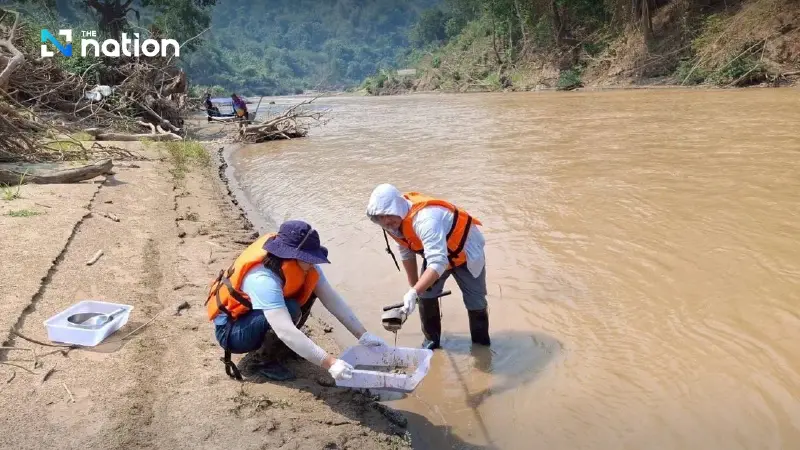


Beijing pledges strict legal action if Chinese firms are linked to Northern river toxins, while urging scientific probes before blame
- China's envoy vowed that any Chinese company found responsible for illegal pollution in Northern Thailand through joint investigations will face strict legal action without protection.
- He urged for scientific, objective, and fact-based investigations into the causes of the pollution, cautioning against hasty conclusions or assigning blame before official findings are available.
- China offered practical assistance to address the issue, including establishing a joint water quality monitoring lab, dispatching experts, and providing monitoring and water purification technology.
Beijing pledges strict legal action if Chinese firms are linked to Northern River toxins, while urging scientific probes before blame.
Chinese Ambassador to Thailand Zhang Jianwei pledged technical support and strict oversight over cross-border river pollution in Northern Thailand on Thursday, 26 November 2026, while highlighting a surge in high-level diplomacy following reciprocal prime ministerial visits and Thailand’s participation in the APEC summit in China.
Addressing a media briefing in Bangkok, Zhang expressed empathy for communities affected by water quality degradation along the Mae Sai, Kok and Ruak rivers along the Thai-Myanmar border.
Saying reports on residents’ daily lives and livelihoods weighed heavily on him, he noted that Beijing’s people-centred approach aligns with Thai Prime Minister Anutin Charnvirakul’s focus on public welfare and voiced support for Bangkok’s efforts to tackle water pollution.

Zhang set out three pillars guiding China’s response on transboundary river pollution.
First, Beijing requires Chinese companies operating abroad to obey local environmental laws and forbids ecological harm, promising strict legal action without exception if joint investigations prove a Chinese firm is responsible for illegal pollution.
Second, he called for scientific, objective and fact-based investigations into geological, weather and human factors rather than hasty conclusions or pre-judgements before official findings emerge.

Third, China offered practical assistance, including establishing a joint water quality monitoring laboratory in Northern Thailand, dispatching experts, providing monitoring equipment and water purification technology, and backing Thailand-Myanmar joint working group mechanisms.
The environmental pledge came as Zhang reviewed four months of intensive leader-level diplomacy between Beijing and Bangkok.
Premier Li Qiang made an official visit to Thailand — granting audiences with King Rama X and Queen Suthida, Queen Sirikit The Queen Mother and Princess Maha Chakri Sirindhorn — while Anutin travelled to China twice in four months and held two formal meetings with President Xi Jinping, most recently alongside the 33rd APEC Economic Leaders’ Meeting in Shenzhen.
Zhang said frequent top-level exchanges reflected the "China and Thailand as One Family" bond and underscored China’s priority on neighbourhood diplomacy and regional stability.
During Li’s visit, the two sides signed eight agreements spanning electric vehicles, vocational education, agriculture, customs clearance and security, and outlined a "Three Upgrades" roadmap covering green and agricultural cooperation, technological innovation and industrial integration, and regional and third-party market collaboration alongside the ASEAN-China Free Trade Area 3.0 upgrade.

He also addressed concerns raised by Thai business associations over competition affecting small and medium-sized enterprises, stating Beijing opposes predatory pricing or illegal conduct and detailing four support measures: local procurement matching with Thailand’s Board of Investment, technical and digital upskilling, joint research and industrial upgrading, and expanded agricultural market access.
Zhang noted that Chinese imports of Thai fresh durian rose 33.5%, mangosteen rose 19.1% and tropical fruit overall gained 12% in the first three quarters of 2026.
On regional and global affairs, Zhang said Shenzhen talks between Xi, US leadership and Russian representatives underscored major-power communication and open regionalism.
Marking the fifth anniversary of the China-ASEAN Comprehensive Strategic Partnership, he also pledged support for Thailand’s 2028 ASEAN chairmanship and ASEAN centrality, while pointing to joint security operations against telecom fraud, gambling syndicates and trafficking, alongside deployment of the "Zhu Rong" AI weather forecasting system and underground water monitoring stations.
