
DBD probes Chinese-language food delivery apps over foreign ownership, nominee risks
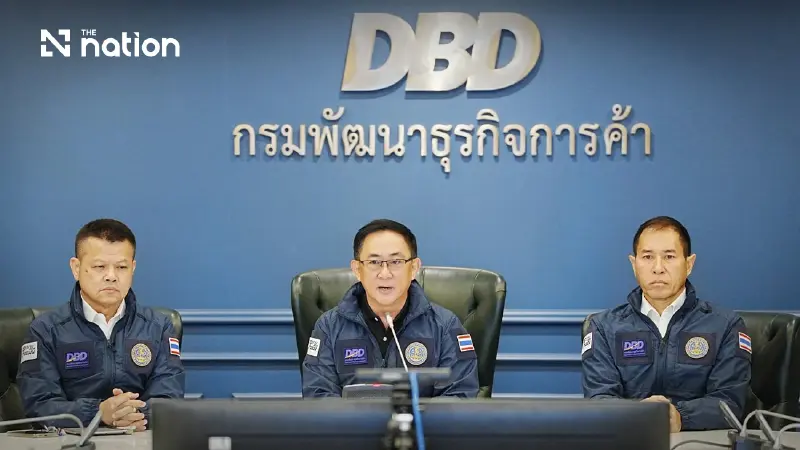


Thailand’s Department of Business Development is investigating three food delivery app operators serving Chinese-speaking customers in Bangkok and Pattaya, after one company was found to be foreign-owned without the required permission.
Thailand’s Department of Business Development is investigating three food delivery app operators serving Chinese-speaking customers in Bangkok and Pattaya, after finding that one company may be foreign-owned and operating without the required permission, while two others face further checks over their investment structures.
Poonpong Naiyanapakorn, director-general of the Department of Business Development, said the three companies that appeared in recent media reports had all been registered in Thailand. The first was registered on September 27, 2020, the second on September 1, 2021, and the third on August 3, 2023.
One operator classified as foreign-owned
Initial checks found that one of the three companies is classified as foreign-owned because foreign shareholders hold more than 50% of its shares. The company has not obtained permission to operate the business, Poonpong said.
The two other companies are classified as Thai companies because foreign shareholders hold less than 50% of their shares. However, the department will examine their investment structures in more detail to determine whether their Thai shareholding is genuine.
Under Thailand’s Foreign Business Act, a Thai-registered juristic person is treated as a foreign entity if at least half of its capital shares are held by foreigners, while foreigners are required to obtain permission before operating List Three businesses.
Probe focuses on ownership, not language
The applications have drawn public attention because they mainly serve Chinese-speaking customers in areas such as Huai Khwang, Sutthisan, Ratchada, Rama IX and Pattaya, with some platforms using Chinese as their main operating language.

However, Poonpong said the use of Chinese alone is not enough to determine whether an offence has been committed. It is only one factor for officials to consider.
He said the key issues are the shareholding structure and the source of investment. If Thai shareholders are found to be holding shares only in name while the actual capital comes from foreign investors, the case could fall under nominee shareholding.
App case widens into linked business checks
The department is also examining hotels, restaurants and other businesses in Huai Khwang that have been questioned over possible links to the app operators. More than 25 companies have reportedly been identified for checks.
Poonpong said the investigation is continuing because hotel, restaurant and retail businesses are among activities for which foreign operators must obtain permission before operating in Thailand.
The probe will follow two tracks. If foreigners hold 50% or more of the shares, officials will check whether the company has received permission to operate. If foreign shareholding is below 50% but Thai shareholders appear to be acting on behalf of foreign investors, officials will investigate possible nominee arrangements.
Penalties include jail terms and fines
If wrongdoing is found, the department will forward the case to investigators for legal action before it proceeds to court.
Nominee-related offences under the Foreign Business Act carry a jail term of up to three years, a fine of 100,000 to 1 million baht, or both. The law also allows the court to order the cessation of assistance, joint business operations, shareholding or partnership arrangements linked to the offence.
Platform rules under scrutiny
The latest investigation follows growing public scrutiny of Chinese-linked service platforms operating in Thailand. Attention has centred on platforms including GOKOO, E-GetS and Feixiang, which serve Chinese communities and have expanded beyond food delivery into areas such as travel, accommodation, beauty services, transport, language classes, medical services and visa-related support.
Several such apps have operated in Thailand for years, with services in Bangkok, Pattaya, Phuket, Chiang Mai, Rayong and other areas. The debate intensified after riders from a less familiar platform were seen making deliveries in locations including Huai Khwang, Sutthisan, Ratchada, Asok, Pattaya and Chonburi, raising questions about platform regulation, rider networks, ownership structures and operating licences.
DBD says old cases remain a challenge
Poonpong said the overall problem of foreign nominee businesses has declined, but a large number of older companies remain under review.
Over the past eight months, the Department of Business Development has mobilised staff from six divisions to intensify checks. Many of the cases still being found involve more than 95,000 companies accumulated over the past 20 to 30 years and spread across the country, he said.
The department’s main priority is to prevent new nominee cases from emerging while gradually inspecting and taking action against older registered companies.
Naturalised shareholders also under watch
Poonpong said officials have also begun seeing cases in which people of foreign descent obtain Thai nationality and then hold 51% of a company’s shares, allowing the business to be classified as Thai.
Although such cases are not yet widespread, he described them as a concern because the shareholders are legally Thai nationals. Officials will continue to examine financial trails in these cases, as they do in other investigations.
He added that preventing nominee businesses cannot be handled by one agency alone and requires cooperation among several agencies with relevant authority.
As for restaurants and other shops listed on the platforms, Poonpong said the department would consider inspections where necessary, focusing on areas that are useful and essential to the wider investigation.
