
Trump expects Iran war to end soon as Hormuz talks progress
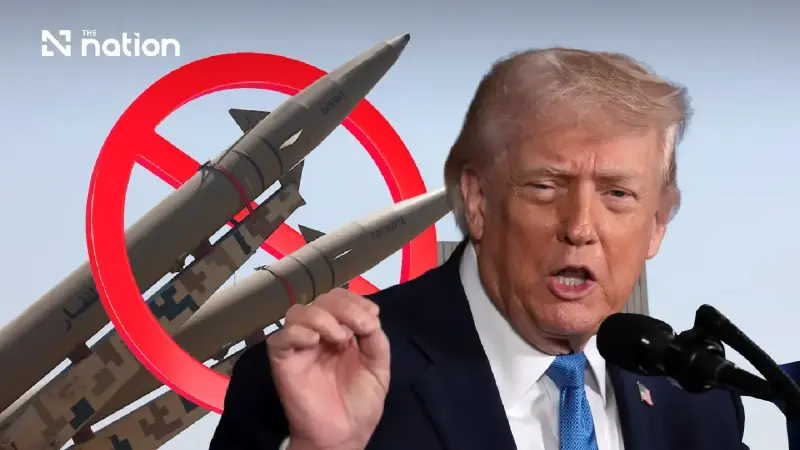


Iran and Oman are close to a temporary Hormuz shipping arrangement as Tehran considers barring US and Israeli vessels from the waterway
- President Trump stated he expects the war with Iran to end "pretty soon," suggesting the country cannot continue the conflict for much longer.
- His optimism is linked to advancing negotiations between Iran and Oman to create a new commercial shipping route through the Strait of Hormuz, which are reportedly in the final stages.
- The talks are complicated by a separate Iranian legislative proposal to restrict U.S. and Israeli vessels, a condition the United States rejects for the international waterway.
- Trump also acknowledged that U.S. stockpiles of certain military munitions are "a little bit tighter" after five months of conflict.
US President Donald Trump said he expected the war with Iran to end soon as negotiations over shipping through the Strait of Hormuz moved closer to an agreement but remained complicated by Iranian proposals to restrict US and Israeli vessels.
“I think it’s going to end pretty soon. I don’t think they can go much longer,” Trump told reporters in the Oval Office on Thursday (August 6), referring to Iran.

Iran and Oman have meanwhile moved towards completing an arrangement covering commercial traffic through the Strait of Hormuz. Iranian Foreign Ministry spokesman Esmaeil Baghaei said the two countries had agreed on the geographical coordinates of a navigation route and were in the final stages of drafting a joint statement.
The discussions come as an Iranian parliamentary committee separately reviews preliminary legislation that would bar US, Israeli and other vessels regarded by Tehran as hostile from using the strait.
Fars news agency reported that ships breaching the proposed restrictions could face fines of up to 20% of the value of their cargo. Reuters confirmed that the measure remained under committee review rather than being an agreed condition of the Iran-Oman shipping arrangement.
Washington rejects restrictions on passage
The United States has pushed back against any arrangement that would require ships to seek permission, pay charges or face restrictions on passage.

“Any temporary route must be completely unhindered, meaning no waiting for approval or permission and no fees or service charges,” a US official told CNBC when asked about the Iranian proposals.
The official added that the Strait of Hormuz was an international waterway and that no party had the right to control its shipping lanes or prevent vessels from passing through.
Under the preliminary legislation reported by Fars, Israeli cargo vessels and ships linked to Israel would be barred from the strait. Restrictions could also apply to countries and individuals deemed by Tehran to have caused damage to Iran until compensation was provided.
Iran and Oman have been negotiating separately over an interim shipping arrangement. An Iranian government official involved in the discussions told MS NOW that there would be no fees or service charges under the proposed deal.
The arrangement would cover inbound shipping through Iranian territorial waters and outbound traffic using a route closer to Oman, according to the official.
A senior Iranian source and two regional officials also told Reuters that the proposed arrangement would give Tehran control over ships entering the Gulf through the strait, while Oman would oversee outbound traffic.
The Iranian official, who was not named because of the sensitivity of the discussions, said the arrangement was intended to reopen a path towards the ceasefire framework and memorandum of understanding previously reached between Washington and Tehran.
The official said the International Maritime Organization and the United States would also take part in announcing the arrangement. Another Gulf government official told MS NOW that members of the Gulf Cooperation Council had endorsed it.
Iran says Oman talks are close to completion
Iranian Deputy Foreign Minister for Legal and International Affairs Kazem Gharibabadi said late Wednesday that the United States appeared ready to “return to the agreement”, although he denied that Tehran was currently holding direct negotiations with Washington.
“The path to an understanding is between Iran and Oman, and there are no negotiations with the United States taking place at this time,” he said.
Gharibabadi said on Thursday that the Iran-Oman understanding on the Strait of Hormuz was nearing completion.

Iran has sought changes to shipping routes through the strait, arguing that previous arrangements no longer meet its security requirements.
“The old route does not address the difficult conditions now prevailing, which affect the national security of the Islamic Republic of Iran,” Gharibabadi said.
Baghaei had given a similar assessment, saying Iran and Oman were finalising a joint statement provided that no outside party interfered. IRNA reported that Tehran and Muscat had been discussing a safe commercial shipping route for about two months.
The talks follow a memorandum of understanding reached between the United States and Iran in mid-June.
Under the June 17 arrangement described in the supplied reports, Tehran was to allow commercial vessels to pass through the Strait of Hormuz without charge for 60 days, while Washington agreed to lift its naval blockade on Iranian shipping and take other steps.
The framework was intended to open another 60-day period of negotiations, but fighting and disagreements over implementation subsequently continued.
Trump on Monday accused Iran’s leadership of being “duplicitous” over peace discussions and maintained that talks were taking place whether Tehran acknowledged them or not.
Treasury Secretary Scott Bessent had also indicated that an agreement to ease shipping through the strait could be reached within days, while Axios reported earlier in the week that the United States, Iran and Oman were approaching a temporary arrangement.
US Central Command has maintained that commercial vessels do not need an agreement with Tehran to use the southern route through Omani territorial waters. It said this week that the route remained open and free for commercial shipping.
Trump acknowledges pressure on US munitions stocks
Trump’s prediction of an early end to the war came as he acknowledged uneven supplies of US military munitions.
“We have certain types of munitions that are very powerful, that we have unlimited, virtual unlimited supply. We have others where it’s a little bit tighter,” he said.
Reuters reported earlier in the week that the US Army had used much of its global stockpile of highly accurate long-range missiles during the five-month conflict with Iran.
Trump said US defence companies were expanding production capacity, including by building facilities for Patriot and Tomahawk missiles.
Tensions around regional shipping have continued while the diplomatic discussions proceed.
UK Maritime Trade Operations said on Thursday that it had received a report concerning an explosion near a tanker in waters off Yemen and Oman the previous day.
Iran’s parliament, meanwhile, has yet to decide whether to advance the proposed restrictions on US, Israeli and other vessels. The preliminary measure remained under committee consideration on Thursday.
