
Phiphat denies Suvarnabhumi screening is lax, orders end to crew leniency
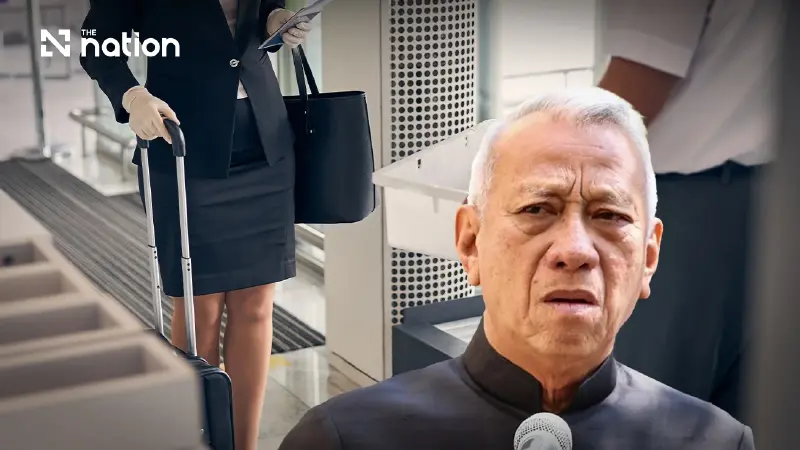


Deputy PM and Transport Minister Phiphat Ratchakitprakarn says airport screening at Suvarnabhumi is not lax, but crew members will now face stricter checks comparable to ordinary passengers.
Deputy Prime Minister and Transport Minister Phiphat Ratchakitprakarn on Tuesday insisted that screening at Suvarnabhumi Airport was not lax, following the arrest of a Thai Airways flight attendant accused of smuggling heroin into Australia.
The case prompted public questions over how the suspect was allegedly able to pass through Suvarnabhumi Airport before travelling overseas.
Phiphat said he had informed the director of Airports of Thailand Public Company Limited (AOT) that, under normal procedures, outbound international passengers are screened for explosives, while narcotics detection is supported by sniffer dogs. He admitted that this area needed improvement.
Asked whether the case would make it more difficult for Thais to travel abroad, Phiphat said Thai travellers were already subject to random checks, but not only Thais were screened. Travellers of all nationalities are normally subject to random checks with sniffer dogs upon arrival at destination countries.
He said the authorities now needed to look again at aviation personnel, including pilots and cabin crew. In the past, such personnel were treated with mutual professional courtesy, but from now on screening must become stricter and be brought into line with checks on general passengers.
Asked whether Thai Airways had introduced any measures, such as cancelling flights to Australia, Phiphat said not yet, adding that coordination was continuing. He said the incident had only recently occurred, and that Thai Airways executives, AOT and the Civil Aviation Training Centre would have to be instructed to tighten procedures. He confirmed that no flights to Australia had been cancelled.
Asked whether the incident would lead to airlines from Thailand facing tougher inspection, Phiphat said screening was already strict regardless of which country an airline came from. He noted that Australia, in particular, had strict checks, even requiring food brought by travellers to be removed if detected.
“We cannot be lax. We follow normal procedures. If people say we are lax, that would mean our system does not work. But we already have regular inspection measures for both safety and narcotics, and checks are carried out continuously,” he said.
“However, with this kind of concealment, ONCB officers also carry out inspections and in-depth intelligence checks. So please be assured. But it is normal that, despite precautions, there may be chances of items slipping through in many countries. We must try to find additional measures, possibly using technology or equipment to assist inspections.”
Phiphat acknowledged that, in the past, there had been a practice of showing courtesy to aviation personnel, including captains and cabin crew. As a result, narcotics checks using sniffer dogs may not have been emphasised as strictly as those for ordinary passengers.
Asked whether foreign countries used detection equipment, Phiphat said most relied on sniffer dogs. However, smuggling networks use many methods of concealment, including hiding drugs inside food cans. When inspected, such items may appear to be canned food, making it impossible to know what is inside.
He said the better approach would be to find modern methods and technologies capable of scanning inside items to detect whether narcotics are hidden there.
Phiphat said he was confident the incident would not lead Australia to ban or cancel flights operated by Thai Airways, as the two countries had always maintained cooperation. He also insisted that Thailand’s credibility had not been damaged, as the country follows international standards.
Australian authorities said in a joint AFP-ABF statement that the accused is a 26-year-old Thai national who arrived at Melbourne Airport on June 25 while working on an international flight. Officers allegedly detected irregularities during baggage screening and later charged her with importing and possessing a marketable quantity of a border-controlled drug, offences that each carry a maximum penalty of 25 years in prison under Australian law. She was remanded in custody on June 26 and is due to reappear before Melbourne Magistrates’ Court on September 14, while Australian officials warned that criminal syndicates continue to target “trusted insiders”, including airline crew, to breach border controls.
