
Farmers in five provinces advised to prepare as Bavi raises flood risk
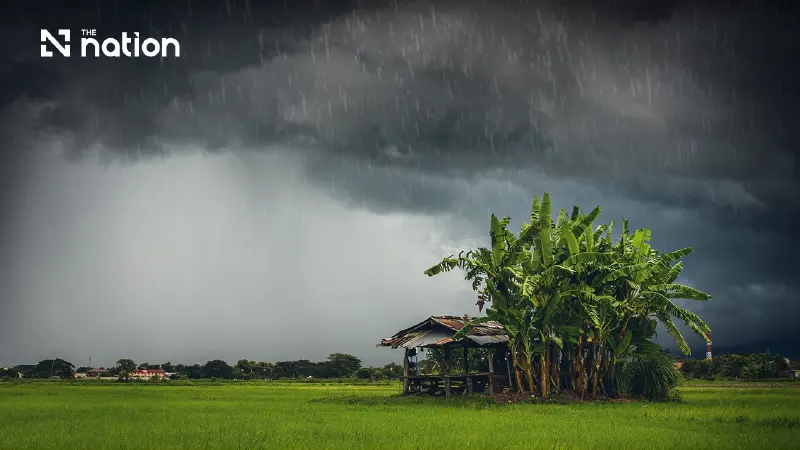


Farmers in five provinces are urged to prepare for flash floods and run-off as Typhoon Bavi strengthens Thailand’s southwest monsoon
- Farmers in five provinces—Ranong, Phang Nga, Chanthaburi, Trat, and Kanchanaburi—are on alert for heavy rain and flooding from July 10-15.
- The severe weather is caused by Typhoon Bavi strengthening the southwest monsoon, which is expected to bring flash floods and damage crops.
- Authorities have urged farmers to take protective measures, such as clearing drainage channels and pruning branches, to mitigate potential damage.
- Farmers whose crops are damaged may qualify for financial assistance, provided their registration with agricultural authorities is up to date.
The Department of Agricultural Extension has warned farmers in five provinces to prepare for heavy to very heavy rain, flash floods and forest run-off as Typhoon Bavi strengthens the southwest monsoon over Thailand.
Ranong, Phang Nga, Chanthaburi, Trat and Kanchanaburi have been placed under close watch from July 10–15 because accumulated rainfall could damage crops, agricultural produce and cultivated land.
Although the typhoon is not expected to move into Thailand, it is forecast to intensify the southwest monsoon covering the country, bringing persistent rainfall to vulnerable areas.

Anchalee Suvachittanont, director-general of the Department of Agricultural Extension, said the warning followed a Thai Meteorological Department advisory covering strong winds and waves in the Andaman Sea and upper Gulf of Thailand, as well as heavy rainfall along the western coast of the South, western parts of the Central region and the East.
She urged farmers in affected areas to prepare their fields and take preventive measures before conditions deteriorate.
Farmers urged to protect fields and improve drainage
Farmers in the Central region, the East and along the Andaman coast have been advised to assess conditions in their communities, inspect plots at risk and prepare measures to limit damage from the storm’s indirect influence.
Recommended precautions include pruning branches to reduce damage from strong winds and clearing drainage channels to prevent water from accumulating in fields.
Particular caution is required on July 11 and 12, when the southwest monsoon is expected to become stronger.
“The Department of Agricultural Extension recommends that farmers jointly assess the situation, inspect vulnerable areas and prepare measures to prevent and reduce the effects of Typhoon Bavi,” Anjalee said.
She added that farmers should complete crop maintenance and drainage preparations before the period of heaviest rain.
Rain expected to cover most of Thailand
Rain is forecast across an average of 60–70% of the country during mid-July, with nationwide rainfall coverage expected to increase to an average of 85% in August.
Prolonged heavy rain could damage crops and produce, as well as inundate agricultural land, prompting the department to call for both immediate protective measures and longer-term preparation.
The department also warned that climate variability and El Niño conditions during 2026 could contribute to accumulated rainfall in July and August.
Farmers should therefore prepare not only for the immediate weather threat but also strengthen their ability to adapt to changing climatic conditions and restore farmland after natural disasters.
Training promoted to support farm recovery
Agricultural authorities are encouraging farmers to develop skills in assessing the condition of plants and soil after floods, storms or other extreme weather events.
They are also promoting the appropriate production and use of biological products to protect and restore crops.
The department has supported farmer groups through community soil and fertiliser management centres and community pest-management centres, where participants receive practical training.
This includes producing Trichoderma fungi to control plant diseases and Metarhizium fungi to manage insect pests, helping farmers protect and rehabilitate their farms under varying weather conditions.
Updated registration required for disaster assistance
Farmers whose crops are damaged may qualify for assistance under Finance Ministry regulations once the relevant province declares an emergency disaster-assistance zone.
Authorities will verify that affected farmers have current registrations before processing requests for support.
Applications must follow the prescribed procedures and be submitted within 90 days of the disaster.
Farmers can track the progress of assistance through the Department of Agricultural Extension’s disaster information system.
The department also urged farmers to follow weather forecasts closely and contact local agricultural extension officers immediately when further advice or assistance is required.
