
Poll finds most older respondents say Thai welfare is inadequate



Suan Dusit Poll finds 74.65% of respondents aged 60 and over say existing welfare is inadequate, with community-based assistance their leading access demand.
Nearly three-quarters of older people surveyed in Thailand believe the existing state welfare system does not adequately meet their needs, according to a Suan Dusit Poll released after a four-day nationwide study.
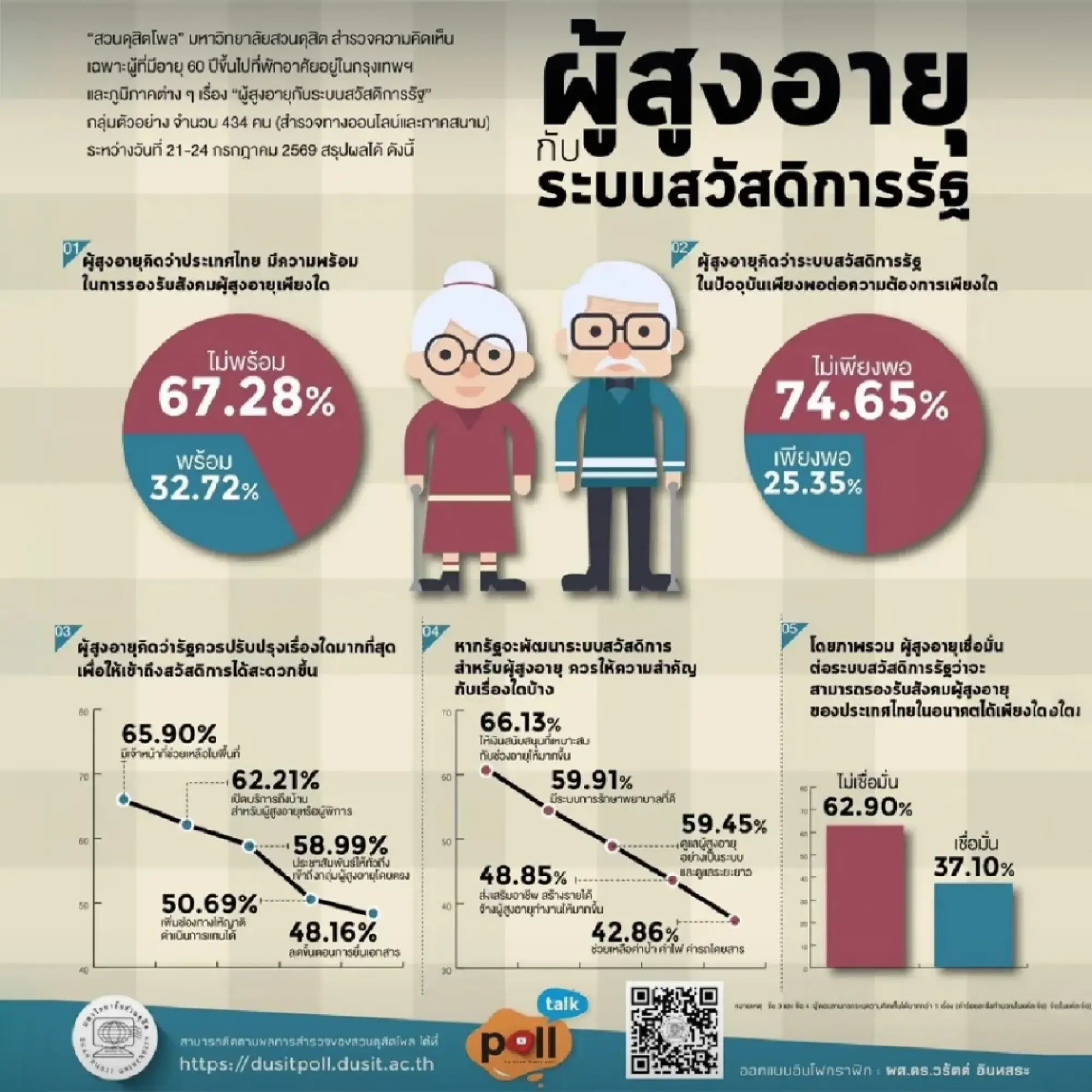
The survey covered 434 people aged 60 and over in Bangkok and other parts of the country. Online responses and field interviews were collected from July 21 to 24, 2026.
The results showed that 74.65% considered existing welfare inadequate, while 67.28% believed Thailand was not yet prepared to cope with an ageing society.
A further 62.90% expressed relatively little confidence that the state welfare system would be capable of supporting the country’s growing older population in the future.

Community-based assistance tops access demands
When asked what the government should improve most urgently to make welfare easier to obtain, 65.90% wanted officials stationed in local communities to help older people access their entitlements.
Respondents also called for services to be delivered at home and for information about welfare rights to reach all eligible groups, reflecting the travel difficulties faced by many older people.
In a separate question on priorities for developing the welfare system, 66.13% favoured greater financial support, with payments adjusted appropriately according to age.
They also placed importance on reliable medical care and a systematic long-term care system. These measures ranked above employment promotion and assistance with general living costs.


Experts call for welfare tailored to different needs
Dr Pornpan Buathong, president of Suan Dusit Poll, said an effective welfare system for older people should cover income, healthcare, housing and employment.
She argued that preparations for an ageing society must recognise that older people have different circumstances and needs. The system should provide equal access to entitlements and allow people to live with dignity.
Pornpan also cautioned against treating welfare as a short-term election promise that placed additional burdens on the public without delivering meaningful assistance.
Assistant Professor Sirima Boonmalert, a lecturer at Suan Dusit University’s School of Law and Politics, said the findings showed that older people remained dissatisfied with the level of state support and the difficulty of obtaining government services.
She noted that access barriers were a central concern, particularly for those unable to travel easily to government offices. Local assistance, home-based services and clearer communication would help ensure that eligible people were not excluded.
The low level of confidence recorded in the survey showed that Thailand needed substantive reform of welfare for older people as the country’s ageing population continued to expand, she added.
