
FTI Backs Government’s 35% EV Import Tax Hike to Support Domestic Manufacturing
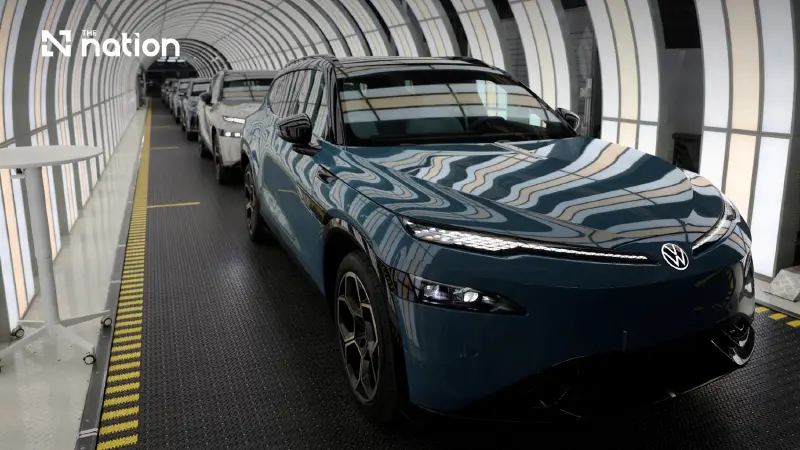


The Federation of Thai Industries backs a 35% excise tax on imported CBU EVs to ensure market fairness and drive domestic manufacturing from 2027
- The Federation of Thai Industries (FTI) has announced its support for the Thai government's decision to increase the excise tax on fully imported electric vehicles (EVs) to 35%.
- Effective January 1, 2027, the tax hike is designed to support domestic manufacturing by creating a fair market for companies that have invested in local production facilities.
- The new 35% rate will apply to imported Battery Electric Vehicles (BEVs) and Range Extended Electric Vehicles (REEVs) from manufacturers that do not have a production base in Thailand.
- The FTI believes this policy will encourage local industrialization, technology transfer, and job creation, strengthening Thailand's position as an automotive manufacturing hub.
The Federation of Thai Industries backs a 35% excise tax on imported CBU EVs to ensure market fairness and drive domestic manufacturing from 2027.
The Federation of Thai Industries (FTI) has voiced strong support for the government’s policy direction to safeguard Thailand's automotive sector, endorsing the Cabinet’s decision to increase the excise tax rate on completely built-up (CBU) imported electric vehicles to 35%.
The revised tax structure—approved during an official mobile Cabinet meeting in Udon Thani on 3 November 2026—covers imported Battery Electric Vehicles (BEVs), currently taxed at 10%, and Range Extended Electric Vehicles (REEVs), currently taxed at 15%.
The measure targets imported vehicles produced abroad without domestic manufacturing presence or local content and will take effect on 1 January 2027.

Level Playing Field for Local Investors
Pimjai Leeissarasakul, chairwoman of the FTI, stated that the 35% excise rate is vital to ensuring trade fairness for vehicle manufacturers that have committed substantial capital to setting up physical production bases in Thailand.
She noted that the policy sends a clear message that Thailand prioritises local industrialisation, advanced technology transfer, and job creation across domestic supply chains.
Finance Minister Ekniti Nitithanprapas emphasised that the policy rewards companies that employ local workers and nurture the domestic supply network.
According to Excise Department Director-General Pornchai Thiraveja, the restructuring aligns with earlier resolutions passed by the National Electric Vehicle Policy Committee on 25 November 2025 and 10 September 2026.
"Thailand’s automotive industry accounts for 10% of GDP and supports over 800,000 jobs across the supply chain, including more than 3,000 SMEs," said Pimjai. "Once the new tax structure takes effect in 2027, automotive sector growth is projected at no less than 7%, with annual production reaching at least 1.55 million units, subject to remaining inventory imported prior to the deadline."

Aligning with 'Reinvent Thailand' Strategy
The tax adjustment directly supports the FTI’s "Reinvent Thailand" strategy, driven under the Joint Public and Private Sector Consultative Committee (JPPCC).
The strategy aims to transition Thailand’s automotive manufacturing from volume-driven output to high-value creation.
This framework focuses on upgrading multi-powertrain technologies—encompassing commercial pickups alongside xEV variants (BEV, HEV, PHEV, and REEV)—while fostering the production of next-generation electronic components (E-Parts) and Connected and Automated Vehicle (CAV) systems.

Expanding Global Supply Chain Partnerships
Looking ahead, the FTI plans to build upon the government's regulatory framework by actively expanding Thailand’s automotive ecosystem.
The federation will lead proactive investment roadshows and business-matching initiatives, inviting traditional partners from Japan, Europe, and the United States, as well as leading global technology firms, to expand local manufacturing plants and research and development (R&D) centres.
By integrating local component suppliers and SMEs into global supply chains, the FTI aims to sustainably reinforce Thailand's position as a premier global hub for automotive manufacturing and export.
