
PM Anutin outlines four priorities for upper Northeast development
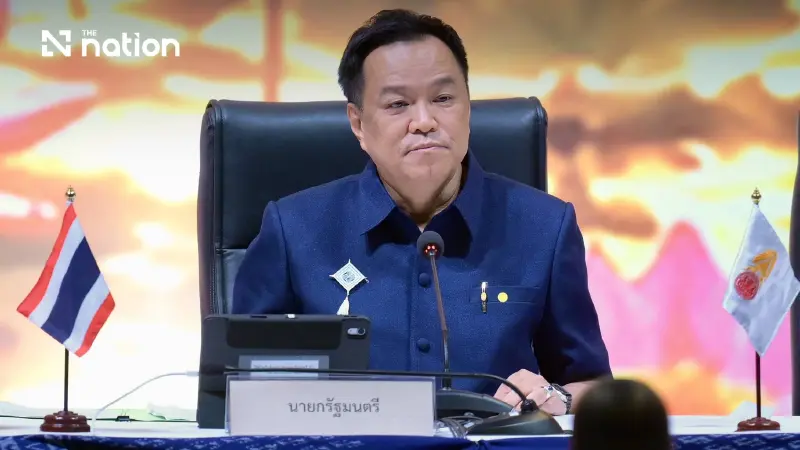


Plans include studies of a food innovation centre, a Bueng Kan border economic zone and airport, alongside tourism promotion and action on drugs.
- Improving agricultural and food production by adding value to key crops (rice, rubber, energy crops) and establishing a food innovation center to boost farmer incomes.
- Developing border trade and regional economic links through enhanced transport infrastructure and studying the feasibility of a new special economic zone and airport in Bueng Kan.
- Promoting quality, year-round tourism by creating linked travel routes that highlight the distinctive strengths of each province in the upper Northeast.
- Implementing a comprehensive strategy to tackle drug problems, focusing on suppression, prevention, and rehabilitation through improved technology and cooperation with neighboring countries.
Prime Minister Anutin Charnvirakul outlined four government priorities for developing the upper Northeast after a mobile Cabinet meeting in Udon Thani on Tuesday (November 3, 2026).
These cover agricultural and food production and trade, border trade, tourism, and comprehensive action to tackle drug problems.
“Each mobile Cabinet meeting gives us an opportunity to put the spotlight on a particular area, allowing the government to see both its problems and opportunities and listen closely to local people and officials working there.
Once news coverage is published, it also helps people in different regions across the country experience the distinctive character of the featured area and feel closer to the people who live there,” Anutin said.

Food innovation centre study and three key crop groups
The first priority is to improve the production of and trade in agricultural and food products.
Anutin said the government aimed to raise agricultural prices through new production methods and build on these to develop future food and bio-based industries.
The Ministry of Higher Education, Science, Research and Innovation has been tasked with studying how to establish a food innovation centre and a laboratory for testing compliance with food standards, to improve the competitiveness of Thai agricultural products and strengthen national food security.
The government will also promote three key groups of crops, focusing on adding value so that agriculture becomes a source of both food and energy for the future.
The first group is rice, with a focus on quality, added value and more efficient land use.
Measures will include improving production efficiency, developing rice varieties to meet higher standards and promoting environmentally friendly cultivation.

The second group is rubber.
The government will accelerate the processing of raw rubber into innovative products of high value for modern industries.
With rubber prices having risen sharply, it aims to maintain these levels for as long as possible by adding value through innovation for rubber businesses and growers.
The third group comprises energy crops, including oil palm, sugar cane and cassava.
The focus will be on bioenergy production and its further development into clean energy to support agricultural prices and reduce energy imports.
Anutin said the Ministry of Agriculture and Cooperatives, Ministry of Commerce, Ministry of Industry, Ministry of Energy and private sector would work together, balancing the country’s food and energy security.
The aim is to secure stable, sustainable incomes for Thai farmers and establish the Northeast as a major global production base for quality food.
Studies into Bueng Kan economic zone and airport
The second priority is developing border trade and regional economic links.
The government is focusing on transport infrastructure, connectivity and trade facilitation to link Thailand with other countries in the Mekong subregion through development of the Northeastern Economic Corridor, special economic zones and areas with high potential.
The Ministry of Interior and the Office of the National Economic and Social Development Council have been assigned to study the feasibility of developing Bueng Kan as an additional border special economic development zone.
They will also assess readiness for airport development in Bueng Kan and consider suitable investment promotion measures to maximise benefits, with the aim of making the provincial cluster a major regional trade gateway.
Year-round tourism and comprehensive action on drugs
Tourism, the third priority, will draw on the distinctive strengths of each province to develop quality tourism and link destinations into varied routes that attract visitors throughout the year.
The Ministry of Tourism and Sports will take the lead in considering the organisation of activities to stimulate tourism.
The final priority is a serious and comprehensive response to drug problems, covering suppression, prevention and rehabilitation.
The Royal Thai Police and Ministry of Interior have been assigned to lead improvements to databases and the use of modern technology, alongside cooperation with neighbouring countries, to make action against drugs more effective.
For treatment and rehabilitation, the government will build on Udon Model Plus, the Udon Thani Social Rehabilitation Centre’s comprehensive programme to help people who use drugs and those with drug dependence.
The Ministry of Social Development and Human Security will join the network to help build a safe, strong society over the long term.
Anutin said the meeting reaffirmed the government’s commitment to developing every region in a way that recognises each area’s distinctive character, addresses its problems and strengthens its potential for the greatest public benefit.
Mobile Cabinet meetings will be held in every region. Once all regions have been covered, the government will visit smaller areas within provinces that it believes have potential and can meet people’s various needs.
Higher-value farm products and higher farmer incomes
For the upper Northeast, he reiterated that the goals were higher farmer incomes, more valuable agricultural products, border areas serving as regional economic gateways, tourism revenue reaching communities and protection for the public from drug problems.
The relevant ministries have already been assigned responsibility for all these areas.
He said reports showed that nationwide average prices for several agricultural products had risen: main-crop jasmine rice to THB16,100 per tonne; non-glutinous paddy to THB8,750 per tonne; cassava to THB3.25 per kg; grade 3 raw rubber sheets to THB83 per kg; and oil palm fruit bunches to THB7.86 per kg.
He described the increases as significant.
The government therefore needed to move quickly to add value to these products, he said.
With conflicts continuing in several regions, he expected strong global demand for food and said Thailand was ready to show that it could strengthen food security for its partner countries.
He stressed the need to find ways to upgrade products and increase their value, sustaining demand and lifting the price base.
Such efforts would give farmers, food manufacturers and processors a chance to gain greater stability, increase their incomes and expand their opportunities.
Invitation to Udon Thani horticultural expo
Closing his remarks, Anutin promoted the Udon Thani International Horticultural Expo 2026, which has officially opened and will run until Sunday (March 14, 2027).
He described it as an important opportunity to promote tourism, expand agricultural knowledge and stimulate the economies of Udon Thani and neighbouring provinces.
He encouraged people to visit Udon Thani and the expo, where they could enjoy the event and its beauty, gain knowledge, and discover new information about using different plants to create opportunities for themselves.
