
Thaksin warns of 10 Thai risks from AI and new security threats
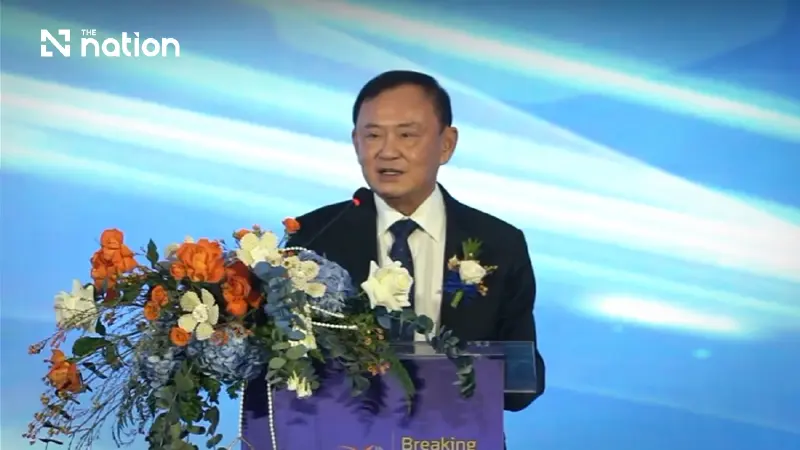


Thaksin Shinawatra urges Thailand to prepare for AI job losses, drone warfare, cyberattacks, energy costs and institutional weaknesses
- Former Prime Minister Thaksin Shinawatra warned that Thailand faces new security threats, including advanced warfare with drones and missiles, cyberattacks on critical infrastructure, and the use of AI in defense.
- He cautioned that artificial intelligence poses a major risk to the labor market by replacing routine and entry-level jobs, which will require workers to engage in lifelong learning.
- Thaksin also identified other key national risks, such as high energy costs, weaknesses in the rule of law that deter investors, and an inefficient public sector that could be streamlined with AI.
Former prime minister Thaksin Shinawatra has identified 10 areas of risk facing Thailand, ranging from emerging security threats and artificial intelligence to high energy costs, weaknesses in the rule of law and an inefficient public sector.

Speaking at the 30th anniversary of Somapa Information Technology Public Company Limited at Dusit Thani Bangkok on Tuesday (August 18, 2026), Thaksin urged Thailand to reassess its preparedness and adapt more quickly to global technological, economic and geopolitical changes.
His address focused on security challenges, technology and international cooperation.
Reflecting on an earlier phase of Thailand’s security modernisation, Thaksin cited the introduction of the Advance Passenger Information System following the September 11 attacks in the United States. The system allows passenger information to be screened before international travellers arrive at their destinations.

1. Border security and emerging threats
Thaksin argued that future security threats would become increasingly complex, extending beyond conventional border conflicts.
He pointed to missile and mass-drone attacks in the Middle East to illustrate how existing air-defence systems may be unable to intercept every incoming threat.
Thailand, he suggested, should strengthen its ability to respond to new forms of warfare while deploying surveillance drones to support border operations and reduce dependence on large numbers of personnel.
He also highlighted narcotics trafficking along the Thai–Myanmar border as a continuing national security challenge.
2. Robots and AI reshape defence
Robotics and AI are transforming warfare and other security operations, according to Thaksin.
He cited developments in China involving robotic dogs and machines designed for surveillance and security missions. Such technology could undertake dangerous tasks currently performed by personnel and potentially reduce casualties.
3. AI transforms the labour market
Thaksin predicted that traditional organisational structures would change from a pyramid into a diamond as AI replaced many routine and entry-level tasks.
Recent graduates could face the greatest pressure because many junior positions involve standardised work that AI can perform or support.
He argued that lifelong learning would consequently become more important than relying solely on academic qualifications, with workers needing to use AI to develop their skills continuously.

4. Cyberattacks threaten critical infrastructure
Cybersecurity represents another major vulnerability, particularly for essential infrastructure such as electricity and water systems, Thaksin warned.
A successful attack on these networks could disrupt daily life on a wide scale. Thailand should therefore give greater priority to protecting its digital and public-service infrastructure.
5. Longer lives will reshape society
Advances in anti-ageing treatments and cell-regeneration technology could allow people to live considerably longer, creating far-reaching social and economic consequences.
Thaksin suggested that longer lifespans could affect pension systems, retirement ages, employment patterns, family structures and future housing requirements.
6. Satellite communications require preparation
The expansion of low-Earth-orbit satellite networks, including services such as Starlink, will transform global communications, Thaksin predicted.
He noted that foreign satellite operators seeking to enter Thailand could encounter restrictions involving existing laws and foreign ownership.
Thailand should prepare both technologically and through an appropriate regulatory framework while considering the security implications of increasingly important satellite communications.
7. Energy costs affect competitiveness
Thailand needs to restructure its energy sector and provide wider access to alternative energy, Thaksin argued.
He proposed greater use of smart meters to help consumers manage electricity consumption more efficiently. Lower electricity costs would also strengthen industrial competitiveness and make Thailand more attractive to investors.
8. Thailand needs stronger partnerships
Thaksin called for a review of Thailand’s strategic relationships with major powers and long-standing partners, including Japan.
Rather than approaching each relationship separately, Thailand should establish clearer joint strategies that reflect changing geopolitical and economic conditions, he argued.
9. Rule of law underpins confidence
Investor confidence depends on a strong and predictable rule of law, according to Thaksin.
He argued that perceived weaknesses in Thailand’s legal system could undermine confidence and discourage investment. Strengthening legal institutions should therefore form part of the country’s economic strategy.
10. AI could streamline government
Thailand’s large bureaucracy and extensive body of laws risk becoming obstacles to effective administration, Thaksin warned.
He proposed using AI to improve public-sector efficiency, reduce repetitive work and enable government agencies to operate with fewer unnecessary procedures.
Thaksin concluded that Thailand must comprehensively reassess its readiness for new security threats, economic disruption and technological change.
He called for reforms covering the workforce, energy system, public administration and international strategy to ensure the country remains secure and competitive.
