
World Bank weighs crisis aid for up to 40 countries as energy costs rise
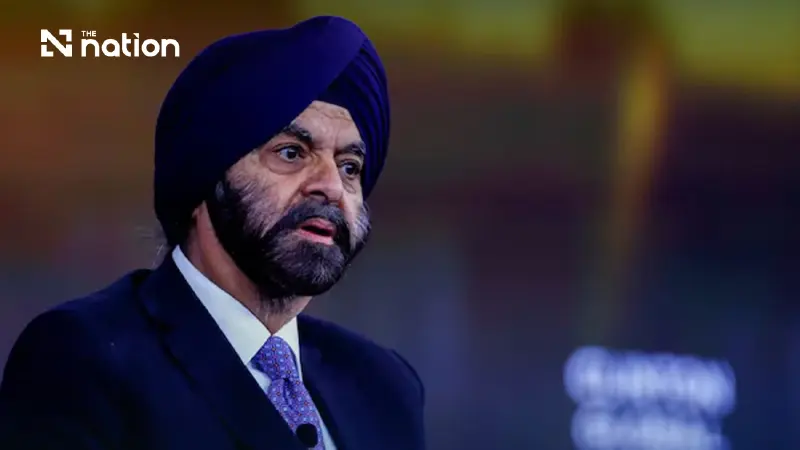


The World Bank is discussing crisis support with 30 to 40 countries hit by energy and price shocks, with up to US$100 billion available if conditions worsen.
The World Bank is in discussions with 30 to 40 countries over potential crisis support as developing economies face rising energy and food-production costs from the Middle East conflict, World Bank Group President Ajay Banga has told Reuters.
Speaking in Bangkok ahead of this week’s annual meetings of the International Monetary Fund and World Bank, Banga said the global economy had so far proved relatively resilient, helped partly by heavy investment in artificial intelligence and adjustments in global oil supply and demand.
That resilience meant relatively few countries initially sought assistance from the US$25 billion crisis window the World Bank made available after the Middle East war began in late February.
However, sharply higher diesel and fertiliser prices, combined with other risks including a looming “super El Niño”, were adding pressure on developing economies.
“There is pressure, and so I think maybe over the coming months, more countries will come for some slice of that first US$50 billion to US$60 billion,” Banga said.
The amount comprises the initial US$25 billion crisis facility and another US$35 billion that countries could access by redirecting resources from existing World Bank projects.
“We’re ready. We’re engaged. We’re having conversations with a number of them, you know, 30 to 40 countries are in dialogue with us,” he added.
Support could rise to US$100 billion
Banga noted that more countries had expressed interest in restructuring or repurposing existing World Bank projects rather than immediately drawing on the emergency facility for liquidity support.
If global conditions deteriorate significantly, the Bank could make as much as US$100 billion available, exceeding the roughly US$70 billion it disbursed during the Covid-19 pandemic.
Developing countries are confronting the new shocks with limited fiscal room after large pandemic-era spending and the inflation surge that followed Russia’s invasion of Ukraine.
World Bank estimates show that developing economies owe external creditors around US$400 billion in 2026, with interest payments accounting for about one-third of the total.
Private capital reaches record US$112 billion
Against that backdrop, the World Bank is placing greater emphasis on mobilising private investment.
The institution attracted a record US$112 billion in private capital in the financial year ending in June, up from US$69 billion a year earlier and more than three times the amount recorded in 2022 before Banga became president.
The Bank deployed another US$123 billion from its own resources, bringing combined financing to US$235 billion.
Banga said tapping private capital was increasingly important as many Western governments reduced official bilateral development assistance.
“There is no one answer that fits when the world has these kinds of issues,” he said. “What you need to do is figure out how to cut your coat to suit your cloth.”
He expects private capital mobilisation to increase further through expanded political-risk guarantees from the Multilateral Investment Guarantee Agency, greater local-currency financing and regulatory reforms designed to make developing markets more attractive to international investors.
Low-income countries still struggle to attract investment
Private investment growth has not been distributed evenly.
Upper-middle-income countries, including economies such as Argentina and India, attracted about US$50 billion, while lower-middle-income countries such as Bangladesh and Angola received around US$37 billion.
Only about US$3 billion flowed to low-income countries.
“In the smaller countries, it hasn’t multiplied enough, and there are challenges,” Banga said.
The Bank is expected to announce new initiatives during the Bangkok meetings aimed at ensuring micro, small and medium-sized enterprises also gain greater access to private capital.
By region, Latin America and the Caribbean attracted US$36.3 billion in private capital, Africa US$22 billion, Europe and Central Asia US$21.3 billion, and South Asia US$19.2 billion.
The 10 largest recipient countries were Brazil, India, Türkiye, Romania, Nigeria, Argentina, South Africa, Bangladesh, Mexico and Chile.
World Bank and IMF target debt burden
Banga added that the World Bank and IMF were working together on measures to address mounting debt pressures in developing countries, including efforts to strengthen domestic revenue collection.
The World Bank has already arranged debt-for-development swaps for Angola and Côte d’Ivoire and a portfolio-based guarantee for Argentina.
A further 14 to 15 operations are in the pipeline.
“We’ve got 14 or 15 in the pipeline, helping them rotate out higher-priced old debt for newer-priced debt with our guarantees,” Banga said.
The savings could then be redirected towards education, healthcare, water or environmental programmes.
Banga, who began his five-year term as President of the World Bank Group in June 2023, has made job creation and greater private-sector involvement central to the institution’s development strategy.
Source: Reuters
