
Five King Rama IX principles bring Thailand’s development experience to global stage
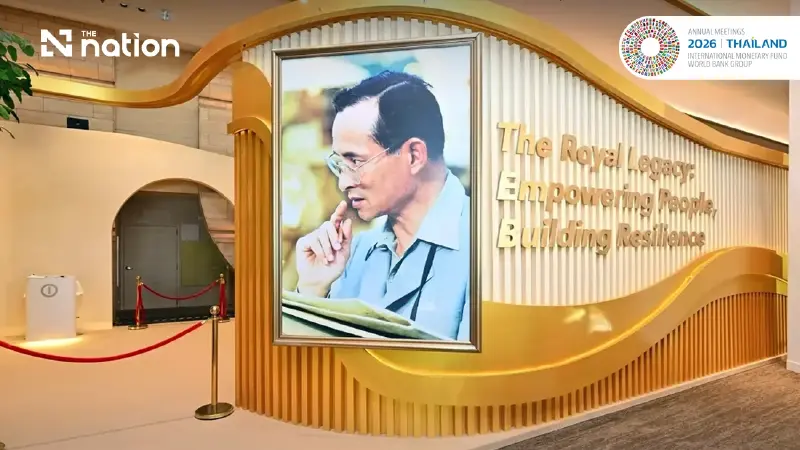


Thailand is presenting five development principles inspired by King Bhumibol Adulyadej the Great at the 2026 IMF-World Bank meetings, linking people-centred development with resilience and sustainability.
- Thailand is showcasing five development principles inspired by King Rama IX at the 2026 IMF and World Bank meetings to share its national development experience with the international community.
- The principles emphasize a people-centric approach, starting with small, local problems to address larger challenges, and following a methodical "Understand, Reach, Develop" process.
- Other key concepts include using nature-based solutions to solve environmental problems and building resilience against shocks at all levels, from individuals to the national economy.
- These principles are being presented to offer practical, experience-based contributions to global discussions on sustainable development and economic resilience.
Thailand is showcasing five development principles inspired by His Majesty King Bhumibol Adulyadej the Great, Rama IX, at the 2026 Annual Meetings of the International Monetary Fund and the World Bank Group, presenting decades of Thai development experience to an international audience.
Throughout his reign, King Bhumibol’s development initiatives sought to improve people’s quality of life by beginning with a detailed understanding of local problems and putting the needs of communities at the centre of solutions.
Those approaches are being presented at the Royal Pavilion within the Thailand Pavilion at the meetings, held at the Queen Sirikit National Convention Center in Bangkok from October 12 to 18.
The exhibition, “The Royal Legacy: Empowering People, Building Resilience”, highlights royal development initiatives, the Sufficiency Economy Philosophy and working principles centred on balance, resilience and improving people’s lives. The official host programme identifies the exhibition as a principal feature of the Thailand Pavilion.
Thailand’s broader theme as host is “Thailand’s New Horizons: Empowering People, Building Resilience”, reflecting an emphasis on giving people greater opportunities while strengthening the economy and society against future shocks.
Thai development experience taken to global stage
Veerathai Santiprabhob, former governor of the Bank of Thailand, explained that hosting the meetings provided Thailand with an opportunity to share its own development experience with the international community.
When working groups from the Finance Ministry and Bank of Thailand considered examples that could demonstrate both improvements in people’s lives and greater national resilience, the development approach of King Rama IX emerged as an important part of Thailand’s presentation.
From the many principles associated with the King’s development work, organisers selected five themes and linked them with the United Nations Sustainable Development Goals and other international development priorities.
The aim is to invite participants to consider how Thailand’s experience could contribute to discussions over challenges facing societies and economies today.
1. Addressing big problems by starting small
The first principle concerns the relationship between major national challenges and problems experienced by people at community level.
Veerathai explained that although King Rama IX considered broad macroeconomic and national problems, his work frequently began with specific issues affecting individual communities.
Solving problems at local level could create foundations for wider change.
The approach recognises that national development targets cannot be separated from the daily realities of communities. Understanding what prevents people in particular areas from progressing is therefore an essential part of tackling larger structural challenges.
Starting small does not mean losing sight of the bigger objective. Instead, local solutions can provide practical foundations for achieving it.
2. Putting people at the centre
The second principle is people-centric development.
Veerathai said King Rama IX placed importance on understanding the problems, needs and constraints facing people in each location rather than beginning with the priorities or administrative boundaries of government agencies.
He described the approach as an early model of what would today be called area-based development.
Different communities face different conditions, so development programmes should begin by understanding the people concerned before deciding what intervention is appropriate.
Under this approach, the ultimate measure of development is the benefit that people receive rather than simply whether an agency completes a prescribed activity.
3. ‘Understand, Reach, Develop’
The third principle emphasises development as a sequence rather than a shortcut.
The well-known approach of “Understand, Reach, Develop” begins with gaining a thorough understanding of the problem, reaching and engaging with the people involved, and only then determining the appropriate form of development.
Veerathai said sustainable outcomes required the right process.
Understanding provides knowledge of conditions and underlying problems. Reaching people allows development work to connect with their experience and needs. What is learned from both steps can then be translated into appropriate action.
At a time when governments and societies are often under pressure to produce rapid results, the principle highlights the importance of preparedness, knowledge and engagement before implementation.
4. Using nature to address natural problems
The fourth concept focuses on working with natural processes rather than against them.
Veerathai linked the principle of using nature to solve problems in nature with what is now internationally described as nature-based solutions.
Examples include the King’s initiatives involving soil treatment, the “monkey cheek” approach to water retention and the use of vetiver grass to protect and rehabilitate soil.
The methods begin with understanding the characteristics of an area and examining how natural systems themselves can become part of a solution.
Such approaches have renewed relevance as climate change, environmental degradation and resilience become increasingly prominent on the global development agenda.
5. Building resilience at every level
The fifth principle is resilience, or creating the capacity to withstand shocks, a central element of the Sufficiency Economy Philosophy.
Veerathai said the concept could be applied from individuals and households through communities and ultimately to the management of the national economy.
In an increasingly volatile world, resilience provides a buffer against shocks and helps people, societies and economies recover and continue functioning when conditions change unexpectedly.
He also referred to Thailand’s 1997 financial crisis as an important context for considering how stronger safeguards and resilience could be incorporated into economic development.
The principle suggests that progress should not be measured solely by how rapidly an economy or community advances during good times, but also by how well it can withstand periods of severe disruption.
Art installation highlights cooperation
Alongside the five development principles, the Royal Pavilion features an Impact Piece Sculpture incorporating natural materials and local knowledge.
Works titled “ONE THAILAND WEAVING CONNECTIONS” and “ONE THAILAND WEAVING THE FUTURE” use weaving as a representation of cooperation in moving the country towards the future.
Together with the development exhibition, the installations reinforce the broader themes of empowering people and building the ability to respond to change.
Veerathai said the international meetings offered Thailand a chance to present not merely theoretical ideas, but approaches that King Rama IX had put into practice throughout his reign.
The official Thailand Pavilion similarly describes the royal exhibition as demonstrating development based on balance, resilience and improvements to quality of life.
From community-level development to an international economic forum, the five principles illustrate a Thai approach in which understanding local conditions, putting people first and preparing for future shocks form the foundations of sustainable development.
Source: Krungthep Turakij
