
Pink-card probe widens nationwide with checks set to cover 10 years
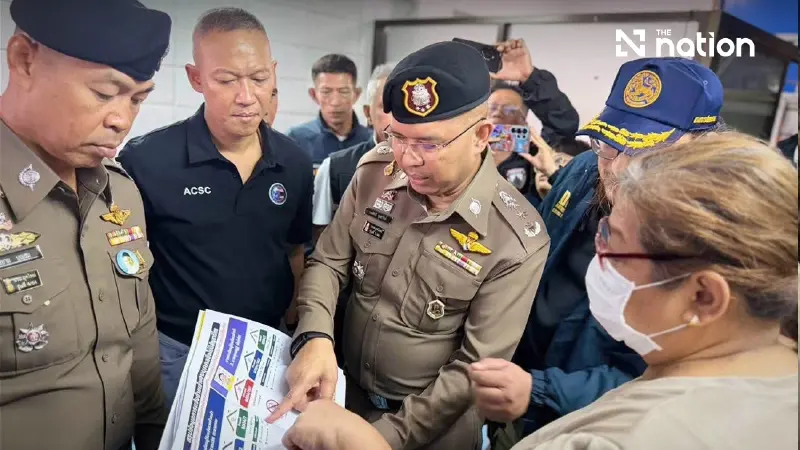


Police are reviewing household registration records after finding 1,366 foreign nationals listed at the Din Daeng flats, including 64 in one room.
- Thai police have expanded a nationwide investigation into the fraudulent use of "pink cards," where foreign nationals allegedly pay brokers to be illegally added to household registers to gain access to state benefits.
- The probe, which also covers false paternity registrations and illegal business nominees, is now being extended to review civil registration records from the past five years, with plans to go back as far as 10 years.
- A recent case in Din Daeng, Bangkok, uncovered significant corruption, with one small apartment having 64 people registered, leading to the arrest of state officials and brokers.
- In response, the Bangkok governor has ordered all 50 district offices to check for unusually high numbers of pink-card holders, and the Department of Provincial Administration has directed a nationwide review of potential corruption.
Thai police are expanding nationwide investigations into 3 alleged forms of misconduct: manipulation of civil-registration records involving pink identity cards, false paternity registrations used to obtain Thai nationality, and Thai nominees holding businesses and land for foreign nationals.
In the pink-card cases, foreign nationals allegedly used brokers to have their names added to household registers, enabling access to some state benefits.
Pol Lt Gen Noppasin Poolsawat, a commissioner attached to the Royal Thai Police, said false paternity posed a long-term national-security risk, while nominee arrangements threatened economic security.
He cited a NIDA Poll dated Sunday (July 19, 2026) that ranked investment in illegal businesses or “grey” money laundering as the greatest concern, followed by nominee landholding and the registration of Thai men as fathers of foreign children to obtain Thai nationality.
The Royal Thai Police is working with the Department of Provincial Administration (DOPA) and other enforcement agencies on the 3 areas.
Nominee investigations have proceeded through 7 phases on Koh Pha-Ngan and Koh Samui and in Phuket, Krabi, Phang Nga, Chon Buri, Chiang Mai and Hua Hin.

All 7 phases involved Thai nominees holding land for foreign nationals.
Authorities have seized 309 plots covering 34.72 hectares, valued at THB4.339 billion, and initiated legal proceedings.
False-paternity inquiries have proceeded through 2 phases.
The first, involving a hospital in the Thon Buri area, resulted in 33 arrests.
The second, involving a hospital in the Rama IX area, led to 6 arrest warrants and 2 arrests, with proceedings against the others continuing.
The wider inquiry covers 1,494 suspected instances identified across 8 hospitals.
Four phases of operations have examined G-prefix student identifiers, zero-prefix cards and pink cards.
Cases involving G-prefix identifiers and zero-prefix cards allegedly included Chinese and Myanmar nationals reusing student codes to enter household registers before obtaining identity cards for people without civil-registration status.
Related operations were conducted in Chiang Rai, Don Sak district in Surat Thani, where cases involved Rohingya, and Mae Sot district in Tak, where cases involved Myanmar nationals.
The pink-card investigation was conducted separately in Din Daeng.
The Din Daeng investigation developed from an operation in Wang Noi district, Phra Nakhon Si Ayutthaya, on Monday (March 30, 2026).

Investigators found that 44 of the Din Daeng flats’ 5,726 rooms across 63 buildings had 16 or more registered occupants, with 1,366 foreign nationals listed in total.
One room measuring 30 to 35 square metres had 64 people registered.
Records showed that 26 names were added on Thursday (June 6, 2024) and 38 on Friday (June 7, 2024).
Noppasin questioned why the registrations had been approved and said the recorded occupancy did not meet Ministry of Public Health safety criteria.
Police obtained arrest warrants for 7 people comprising 3 state officials, 3 registered householders and 1 person accused of providing false testimony.
According to Noppasin, all 7 were arrested and confessed.
He described the acceptance of documents signed in advance by brokers, approvals under false names and registrations made without householders appearing in person as “corruption by officials”.
Financial tracing also identified a woman believed to be a broker.
She allegedly made 8 transfers totalling about THB133,000 to second-tier brokers who were registered householders at the Din Daeng flats.
The same woman allegedly made 17 transfers totalling THB936,120 to staff at Din Daeng District Office.
The Bangkok governor has ordered all 50 district offices to check for unusually high numbers of pink-card holders in household registers.
DOPA has separately directed officials nationwide to review possible civil-registration corruption involving G-prefix student identifiers, zero-prefix cards, 7-prefix cards and pink-card records.
The 7-prefix cards were described as cards issued to children of ethnic minority groups.
A separate complaint in Phaya Thai found that 111 people had been registered at one address without the householder’s knowledge.
Pink-card records are being reviewed over the previous 5 years, with checks expected to extend as far back as 10 years. Nominee investigations will continue in other parts of the country, including the Northeast and the Central region.
Police have also sought information from the public, referring to the protection of informants’ identities and action against anyone found to have solicited benefits.
False paternity remains the most difficult area to investigate because DNA testing is required.
Police cannot collect samples when the foreign mother and child are outside Thailand, while state funding for the tests has yet to be allocated.
Police are coordinating with the Interior Ministry, and the DOPA director-general has undertaken to propose the use of central budget funding to purchase the testing reagents requested by police.
