
PM Anutin orders rapid Nan flood relief and early downstream warnings
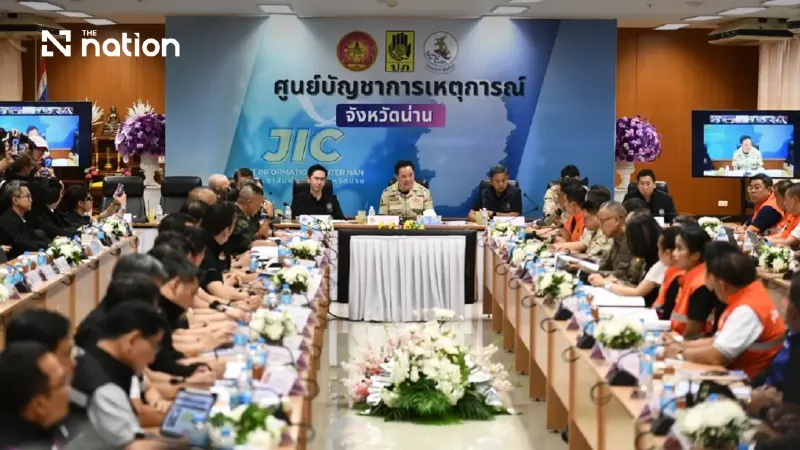


Anutin Charnvirakul told agencies to accelerate recovery, monitor rain and water flows, and prepare vulnerable communities after flooding affected seven districts.
- Prime Minister Anutin ordered disaster agencies to provide immediate assistance, compensation, and recovery support to flood-affected residents in Nan province.
- He mandated the issuance of early warnings to downstream provinces as soon as floodwaters are known to be approaching, allowing residents time to prepare and evacuate.
- Directives were issued for continuous monitoring of weather and water levels, the rapid restoration of infrastructure like roads and bridges, and keeping response teams and equipment on standby.
- Anutin also instructed relevant agencies to prepare a long-term plan for systematic and sustainable flood solutions in the Nan region.
Prime Minister Anutin Charnvirakul chaired a meeting to review flooding in northern and northeastern Thailand at 11am on August 23.
The meeting was held in the Phrachao Suriyaphong Pharitdet Meeting Room on the third floor of Nan Provincial Hall in Mueang Nan district, Nan province.
Those attending included Deputy Prime Minister and Minister of Higher Education, Science, Research and Innovation Yodchanan Wongsawat; Agriculture and Cooperatives Minister Suriya Jungrungreangkit; Defence Minister Lt Gen Adul Boonthamcharoen; Nan Governor Chainarong Wongyai; administrators; civil servants; and other relevant officials.
Relevant local agencies also joined online.
Government spokeswoman Rachada Dhanadirek said Anutin had travelled to Nan to review the flooding.
He expressed condolences to the families and relatives of those who had died and instructed all agencies to provide full assistance, compensation and recovery support without delay.
He also thanked the deputy prime minister, ministers, the Nan governor, government agencies, officials and organisations across all sectors for their full efforts to help residents.
Although the overall situation was beginning to ease, close monitoring was still required for heavy rain, rapid run-off and mudslides.
Anutin issued the following directives:

Assistance, compensation and recovery
The Department of Disaster Prevention and Mitigation (DDPM) and provincial authorities were told to assess damage and assist residents without delay.
They were also instructed to deploy water pumps in Pua, Mueang Nan and Wiang Sa districts and low-lying areas, and to accelerate the restoration of homes, roads, bridges, electricity and water supplies, and farmland where floodwaters had receded.
Weather monitoring and forecasting
The Thai Meteorological Department (TMD), Hydro-Informatics Institute (HII) and Geo-Informatics and Space Technology Development Agency (GISTDA) were instructed to monitor rainfall in Nan and upstream areas, analyse areas at risk of heavy to very heavy rain, and provide information to provincial authorities and relevant agencies so they could prepare.
Water monitoring and forecasting
The Office of the National Water Resources (ONWR), Royal Irrigation Department (RID) and HII were told to assess the volume and movement of floodwaters continuously, particularly in Mueang Nan district and downstream areas.
If floodwaters were known to be heading towards a particular area, an immediate warning should be issued rather than waiting for them to arrive.
This would give residents time to prepare, raise belongings, relocate vehicles, and move older people, bedridden patients and vulnerable groups.
All agencies were also instructed to have personnel, machinery, boats, water pumps, evacuation routes and safe areas ready so they could assist residents immediately if conditions changed.

Monitoring rapid run-off and landslide risks
The Department of Mineral Resources (DMR), Department of Water Resources (DWR) and relevant agencies were told to monitor risk areas continuously and coordinate with local networks to issue warnings and prepare timely evacuations.
Restoring transport routes and infrastructure
The Ministry of Transport was instructed to assess affected routes, bridges and infrastructure.
Where mud or other obstructions were found, machinery was to be deployed to reopen routes quickly, while the public was to be informed which routes were passable and which should be avoided.
Longer-term measures
The ONWR and relevant agencies were instructed to prepare a plan to address flooding in Nan and submit it to the relevant working group, to advance systematic and sustainable solutions.
Anutin also told Sukhothai and provinces further downstream in the path of the floodwaters to prepare early, particularly communities along the Yom River, low-lying areas and places that had repeatedly flooded.
Flood-prevention and drainage systems, water pumps, machinery, boats, personnel, shelters and evacuation routes were to be made ready rather than waiting for damage to occur before taking action.
Anutin reiterated that recovery should be accelerated in areas where floodwaters had receded, while areas still at risk should remain under close watch and receive warnings.
Downstream areas in the path of the floodwaters should begin preparations immediately.
He instructed all agencies to work in an integrated and unified manner, with public safety as the priority.
Any action that could be taken should begin at once, while obstacles or needs beyond local capacity should be reported so the government could provide full support.
Anutin placed particular emphasis on compensation, saying it should be accelerated and that registration must be prompt.
Technology should be used to reduce paperwork.
He also instructed authorities to ensure that food was of good quality, supplied in appropriate quantities and represented the best provisions available for residents.
All provincial governors were told to remain ready to act at all times.
The government would also accelerate infrastructure development to address the problem sustainably over the long term.
On the flood situation, Rachada said Nan experienced heavy to very heavy rain from August 18-21.
Phu Kha subdistrict in Pua district recorded up to 367 millimetres of accumulated rainfall in 24 hours, causing severe rapid run-off, flash flooding, rivers to overflow their banks and landslides.
Floodwaters from upstream areas flowed into the Nan River, affecting communities and economic areas from Pua through Tha Wang Pha, Mueang Nan and Phu Phiang to Wiang Sa.
In total, 7 districts, 42 subdistricts and 356 villages or communities were affected, encompassing 23,827 households and 67,129 people.
Three people died.
Damage affected transport, public utilities, education, public health and agriculture.
Rachada said Nan was managing the situation under a Single Command system, with the provincial incident command centre serving as the hub for coordination across all sectors.
Assistance and relief were being prioritised in areas that remained critical, while recovery was to begin immediately where floodwaters had receded so personnel and resources could be rotated to areas that remained affected.
The province was moving quickly to declare areas eligible for emergency disaster assistance so budget mechanisms could be used to help residents without delay.
Local administrative organisations were initially instructed to provide livelihood assistance for kitchenware, clothing and bedding totalling 6,700 baht.
Damage to housing and occupational equipment would be addressed later.
Damage surveys and meetings of district-level disaster assistance committees were to be completed by August 26, with compensation payments completed by September 1.
