
Thai JIC challenges Cambodian account of border dispute
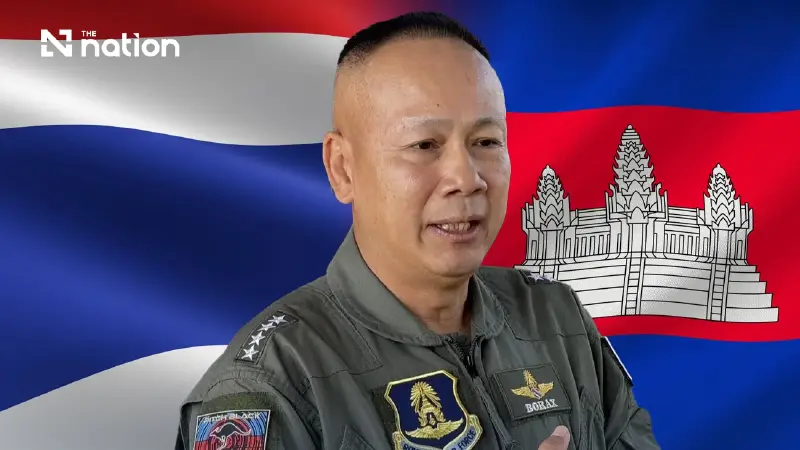


ACM Prapas Sonjaidee says colonial-era treaties and ICJ rulings must be read within their legal scope, urging a full chronology and talks
- Thailand's Joint Information Centre (JIC) has challenged a media report, supported by Cambodia, that portrays Thailand as the aggressor in the border conflict.
- The JIC argues that the narrative should examine the complete chronology of events, including who initiated force, rather than selectively starting from historical treaties or Thailand's response.
- Thailand contends that historical agreements and court rulings cited by Cambodia have a limited scope and should not be broadly applied to settle the entire border dispute.
- The JIC refutes claims that Thailand is altering conditions on the ground, stating it is observing a joint agreement for troops to maintain their positions, and calls for a return to bilateral talks.
Thailand’s Joint Information Centre on the Thailand-Cambodia Situation (JIC) has challenged a French media account republished in Cambodia that described Thailand as the aggressor in the border conflict.
ACM Prapas Sonjaidee, Assistant Commander-in-Chief of the Royal Thai Air Force and JIC director, said on Sunday (August 30, 2026) that Thailand respected press freedom but distinguished between a journalist’s article, claims made by either party and facts established through evidence.
The article reportedly accused Thailand of using its military advantage to create new facts on the ground and alter conditions along the border.
Cambodia’s information minister described the article as valuable because it drew on historical and legal documents rather than emotion.
Prapas said an article published in France or any other country did not amount to a legal determination of a boundary. He argued that any account of the clashes should examine who first used force and what happened before Thailand responded.
“Do not begin the history in 1904, but begin the account of the clashes only when Thailand responded,” he said, calling for the entire sequence of events to be examined.

Treaties and court rulings
Cambodia has cited the Franco-Siamese agreements of 1904 and 1907, together with International Court of Justice rulings from 1962 and 2013, in support of its sovereignty claims.
Prapas said historical documents should be considered in full and court judgments applied only to the questions and areas they addressed.
A ruling concerning one matter should not, he argued, be extended into a determination of every disputed section of the border.
He also pointed to the colonial context in which the 1904 and 1907 agreements were concluded.
“We are now in the 21st century. We should learn from history, not use the legacy of the colonial era to create another conflict for the people of Thailand and Cambodia,” he said.
Troops should remain in agreed positions
Responding to the allegation that Thailand had changed conditions on the ground, ACM Prapas referred to the joint statement agreed by the two countries.
He said its central principle required forces on both sides to remain in their existing positions and refrain from moving troops to create a new situation.
“Put simply, stay where you are: do not advance, provoke or create new facts,” he said, maintaining that Thailand was observing this principle.
He argued that disagreements over the first use of force, troop locations and the sequence of events should be tested against evidence rather than public narratives.
Questions should therefore focus on which side was complying with the agreement and whether either party had tried to change conditions after it was reached, ACM Prapas said.
Call for full chronology and bilateral talks
Prapas said a journalist visiting Cambodia had the right to report what they saw and heard, but viewing the disputed area and receiving information from one side did not settle a disagreement between two countries.
Fair reporting should include Thailand’s position, examine the complete chronology and establish how the incident began, he argued.
“A good investigation should not begin with a conclusion and then select evidence to support it,” he said.
Prapas called on both countries to consider whether they wanted to win the contest over competing narratives or resolve the conflict peacefully.
Thailand and Cambodia would remain neighbours, he said, making dialogue unavoidable.
He urged an end to unilateral assertions, distorted chronologies and language that encouraged hostility between Thai and Cambodian citizens.
Both sides should return to their current agreements, verifiable facts, bilateral mechanisms and negotiations, he added.
“One article may generate attention for a few days, but if an incomplete narrative causes renewed provocation or misunderstanding, those who suffer will not be its writer or those sharing it. They will be the Thai and Cambodian people living along the border,” ACM Prapas said.
“Thailand chooses peace, but peace must rest on facts, agreements and sincerity on both sides. Do not lie to each other, provoke each other or make the people of our two countries the stake.”
