
Thai poll finds doubts over government disaster response
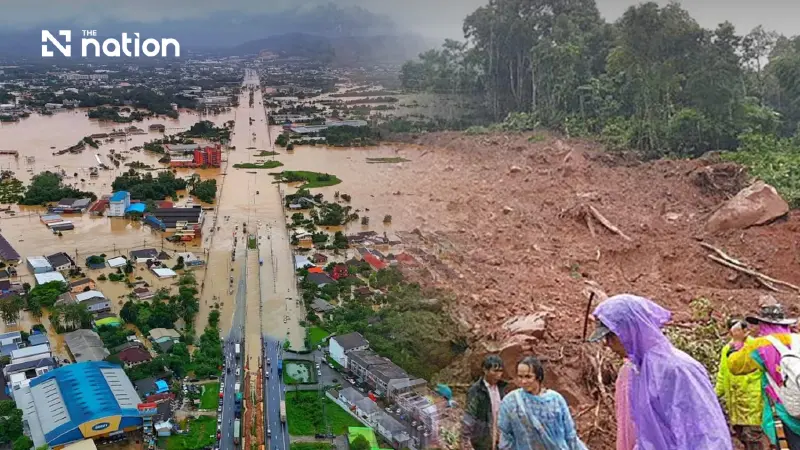


Suan Dusit Poll finds 53.19% are not very confident in the government’s disaster response, with environmental action the top priority.
Floods, flash floods and landslides topped disaster concerns in a nationwide Suan Dusit Poll, with 84.29% of respondents selecting them. The survey also found low confidence in the government’s ability to handle disasters.
Suan Dusit University surveyed 1,241 people nationwide online and through fieldwork from September 1 to 4, 2026. The findings were released on Sunday (September 6).
Respondents most often identified climate change and global warming as reasons for increasingly frequent and severe disasters. Addressing environmental problems and reducing factors that worsen disasters ranked first among their priorities for government action.
Disaster concerns and personal preparedness

1. Which types of disaster concern respondents most?
- Floods, flash floods and landslides — 84.29%
- Storms, typhoons, monsoons and heavy rain — 63.74%
- Earthquakes and building collapses — 58.50%
- Drought, wildfires and extreme heat — 47.22%
- Tsunamis — 29.73%
2. What do respondents believe are the main causes of increasingly frequent and severe disasters?
- Climate change and global warming — 69.70%
- Human behaviour affecting the environment — 66.00%
- Destruction of forests and natural resources — 65.43%
3. How are respondents preparing for disasters?
- Regularly following news and disaster warnings — 64.46%
- Taking greater care in everyday life — 51.17%
- Learning how to respond when a disaster occurs — 48.27%
Confidence in government and priorities for action

4. How confident are respondents that the government can handle disasters that may occur in Thailand?
- Not very confident — 53.19%
- Fairly confident — 25.02%
- Not confident — 19.94%
- Very confident — 1.85%
5. What should the government do most urgently to improve Thailand’s disaster preparedness?
- Address environmental problems and reduce factors that make disasters more severe — 68.65%
- Prepare evacuation plans, safe areas and emergency assistance — 61.08%
- Allocate dedicated budgets for disaster prevention and response — 52.70%
- Improve forecasting and warning systems to make them faster and more accurate — 52.05%
- Improve protective systems and infrastructure in high-risk areas — 49.88%
For questions allowing multiple answers, percentages were calculated separately for each response.
Calls for prevention and public preparedness

Dr Pornpan Buathong, president of Suan Dusit Poll, said people feared disasters affecting them directly and saw climate change as partly responsible. Despite making their own preparations, they had limited confidence in government. She urged stronger preparedness, warning systems, emergency assistance and post-disaster relief to improve safety and public confidence.
Dr Montol Suwanprapha, chair of the Environmental Health and Disasters programme in Suan Dusit University’s Faculty of Science and Technology, said flooding had been a major national crisis over the past decade and a longstanding part of Thai life. Repeated floods could lead people to accept losses that were preventable, he warned.
He said the findings suggested growing awareness of human activity’s role in disasters, with global warming making their effects more severe and complex. People still expected government action despite their doubts.
Montol urged a shift from reacting after disasters to prevention and practical action on underlying risks, alongside knowledge and skills enabling people to prepare and respond independently. Effective disaster management required cooperation from the public, communities and every sector of society, rather than government alone, he said.
