
Thailand shows observers alleged O’Smach scam and military sites
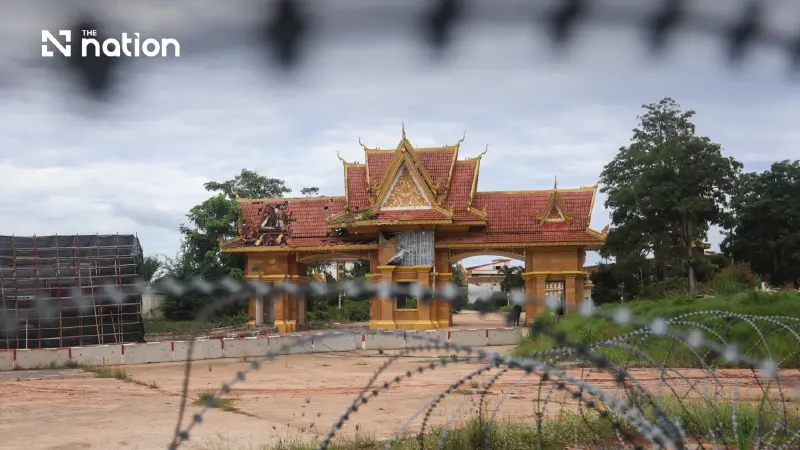


Thai officials show ASEAN observers an O’Smach compound with fake police stations and raise organ-harvesting suspicions, while denying territorial ambitions.
- Thai officials led international journalists and an ASEAN Observer Team on a tour of an 80-hectare compound in O'Smach, Cambodia, which is now under Thai military control following border clashes.
- The tour showcased facilities allegedly used for scam operations, including mock police stations and a hospital where Thai authorities suspect organ harvesting from victims occurred.
- Observers were also shown six seized Cambodian military bases and weapons within the compound, which Thailand claims were used to launch attacks against its forces.
- A Thai official stated the military action was a defensive response to Cambodian aggression and not a pretext to seize territory, framing the scam operations as an unacceptable global threat.
ACM Prapas Sornchaidee, director of the Joint Information Centre on the Thailand-Cambodia Situation (JIC), led Thai and international journalists and the ASEAN Observer Team (AOT) on a visit to an alleged scam compound in O’Smach, Cambodia, on Monday (September 7, 2026).
The delegation travelled through the Chong Chom permanent border crossing in Kap Choeng district, Surin, to inspect an area covering more than 80 hectares that Thai troops took control of following the second round of border clashes.
The site contained 157 buildings, including 29 used for scam operations. Thai troops had also seized six Cambodian military bases. Thai officials said the grounds and buildings had been used to store weapons and explosives and as positions for snipers and drone attacks against Thai forces.

Hospital raises suspicions of organ harvesting
The inspection covered Zones A to E. Among the facilities identified was a newly built hospital named Zhong Nan Hospital, described as the compound’s only hospital and a facility used to treat Chinese nationals holding senior positions in the scam operations.
An operating theatre inside the hospital raised suspicions, based on information attributed to the Royal Thai Police, that it might have been used to remove organs, including kidneys or hearts, from scam workers who failed to meet targets and had been beaten or tortured until close to death. The organs were suspected of being sold to generate additional revenue.

The delegation also inspected mock police stations designed to impersonate law-enforcement agencies in several countries, including China, Indonesia, Brazil, Australia, Singapore and Vietnam.
The facilities contained scam scripts, police uniforms from different countries, replica interrogation rooms and photographs depicting arrests, all intended to make the settings resemble genuine police premises. Rooms used to test and assess scam workers, along with training materials, were also found.
Tuesday (September 8) would mark nine months since Thai troops took control of the area. Buildings damaged during the fighting had deteriorated substantially, with standing water in some structures and furnishings and equipment beginning to break down.

Prapas denies scams are a pretext for territorial control
Prapas said the visit was conducted on behalf of the government, the Defence Ministry and the Foreign Ministry to explain Thailand’s position.
Thailand did not intend to seize Cambodian territory on the grounds of combating scams, he said. Rather, Cambodian forces had used the area to attack Thai troops.
He described scam operations as an unacceptable threat requiring countries to work together. He called for a task force to investigate, with cooperation from the host country, to prevent Cambodia from continuing to host such operations and acquiring the label “Scambodia”.
“These are not simply allegations. Several agencies have already gathered information to support further action, including asset seizures, disruption of financial channels and preventing investment,” Prapas said.
“The evidence can be used by countries in Europe, Asia and elsewhere to expand their investigations and take further action.”

Claims of attempts to enter Thai-controlled area
Prapas said reports from personnel on the ground indicated that Cambodian forces had attempted to enter the area, cutting through barbed-wire fencing at two or three locations.
He said Thai troops had captured people who presented themselves as civilians but were Cambodian soldiers. Such incidents had occurred on two or three occasions, he added.
Thai troops had to act in accordance with their rules of engagement, he said, arguing that failure to respond could allow Cambodian soldiers to establish positions in the area.
Prapas said the Royal Thai Air Force was also ready to provide support. He questioned whether Cambodian troops attacking Thai positions, cutting through fences and assaulting Thai personnel would amount to the opening of hostilities.
“If they open hostilities, we must respond in full. Ground forces, air power and artillery are fully prepared,” he said.
He acknowledged that further incidents were possible because the opposing forces were positioned close to each other. The best way forward, he said, was to reduce provocations, build trust and hold bilateral discussions.
Meanwhile, the Foreign Ministry was working internationally to explain the facts and chronology of events that he accused Cambodia of distorting.

Defensive positions and weapons cited
Prapas said his delegation had also inspected more than 10 kilometres of surrounding terrain, including vulnerable locations.
“The public can be confident that Thai troops have established effective defences. Cambodian tanks cannot enter because we have prepared defensive trenches,” he said.
He said Thai forces had regained control of an area known as Chong Pling using a single battalion. The location had been used to store explosives and ammunition, particularly rocket-propelled grenades, he said.
Prapas said the explosives and ammunition had been destroyed, while a truckload of Cambodian weapons had been taken away as evidence.
“This shows that the Cambodian side had intentions and had made preparations to do something,” he said.

Military deployment ‘not border demarcation’
Prapas said the current deployment of Thai troops was not intended to establish a new boundary.
Thailand was not invading Cambodia to claim its territory, he said, but was operating under the Chakrabongse Bhuvanath Plan for national defence, with coordination among the three armed services.
He stressed that the plan was not designed to seize Cambodian territory.
“Taking Cambodian territory would mean fighting across the country and would become a substantial war, requiring a united effort if they did not stop,” he said.
Prapas also claimed that Cambodia had many “ghost soldiers” and that its actual troop numbers did not match reported figures, adding that some personnel were fearful.
“I want the public to be confident that we are not standing idle. We have strong defensive positions and the equipment needed to defend the country,” he said.
Border scam operations described as a global threat
Responding to Cambodian leaders’ allegations that Thailand was using the scam issue to justify occupying territory, Prapas said scam networks posed a threat to the entire world.
He claimed that even international organisations had used the term “Scambodia”, and accused Cambodian leaders of raising the issue to attack Thailand.
Prapas cited what he described as scam operations and casinos operating as entertainment complexes along the border, including in Poipet opposite Sa Kaeo, Pailin opposite Chanthaburi, and Thma Da opposite Trat.
“We are not using this issue to try to control Cambodian territory, because we did not previously know there were scam operations at this particular site,” he said.
He maintained that Thailand had needed to take control because the Cambodian side used the area as a military base for attacks against Thai forces.
Further discussions could take place through bilateral channels when conditions were conducive, he said, adding that no other country could dictate what Thailand must do.
The situation involved national interests and economic considerations, he said, but those involved also needed to recognise its substantial impact on Thailand and other countries.
Questions over Cambodian authorities’ awareness
Asked whether the Cambodian government was sustaining scam operations, Prapas replied: “You have said it yourself.”
He questioned how Cambodian state agencies could have been unaware of activities on a site covering more than 80 hectares and containing what he described as hundreds of buildings.
He suggested that the investors behind the operations probably came from elsewhere.
Prapas said the AOT delegation had been brought to observe the area under Thai control, not to draw a boundary. He stressed that the team’s role was limited to observation.
“They are soldiers. If they do not enter the area, it suggests that they are concerned about something,” he said.
Battalion commander reassures border communities
Lt Col Khunakon Chotiphanat, commander of the 25th Infantry Battalion, said people living near the Chong Chom border crossing could remain confident that Thai soldiers were ready to defend national sovereignty at all times.
Personnel maintained excellent morale and their equipment was combat-ready, he said. Commanders at every level regularly inspected the units, and any shortages were met with full support.
He also said the opposing side continued to fire shots in what he described as provocations along the stretch of border under his unit’s responsibility.
Source: NationTV
