
Fossil footprints span 12 Thai provinces with a 120-million-year-old trail in Udon Thani
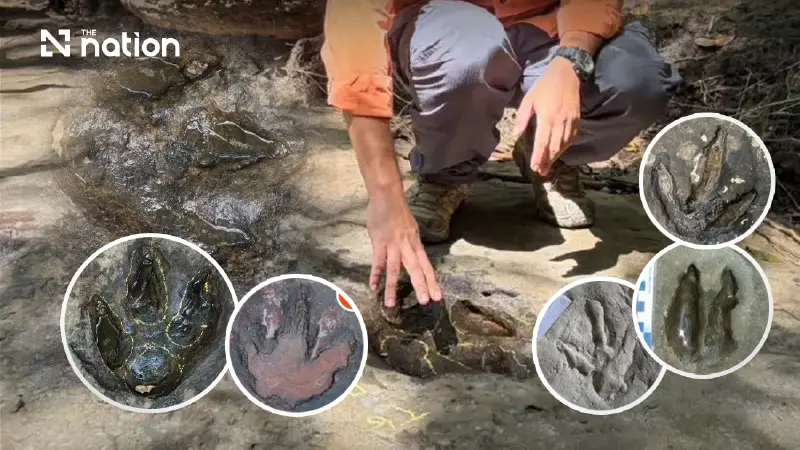


Six dinosaur footprints in Udon Thani date back about 120 million years and offer fresh evidence of Thailand’s prehistoric wildlife.
- A 120-million-year-old dinosaur trackway, the first for the province, has been confirmed in Udon Thani, Thailand.
- The six footprints were left by a two-legged, carnivorous theropod dinosaur during the Early Cretaceous period.
- This discovery in Udon Thani brings the total number of Thai provinces with confirmed fossil footprints to 12.
Thailand’s Department of Mineral Resources confirmed Udon Thani’s first dinosaur footprints on October 20, 2026, identifying six prints left by a meat-eating dinosaur about 120 million years ago. The Udon Thani footprints form a single trackway in sandstone belonging to the Phu Phan Formation, which dates to the Early Cretaceous period. Researchers attributed the impressions to a theropod dinosaur that moved on its two hind legs.
The discovery adds to a wider record of prehistoric animal activity in Thailand. Phu Wiang Dinosaur Museum, part of the Department of Mineral Resources, has outlined footprint discoveries covering 12 provinces.
Fossil footprints offer evidence that complements skeletal remains. While bones help researchers reconstruct an animal’s anatomy, tracks preserve traces of its activity, including how it moved through an ancient landscape.

Trackways preserve evidence of dinosaur movement
A fossil footprint belongs to a category known as trace fossils: evidence of an organism’s activity rather than part of its body. A sequence of footprints left by the same animal is called a trackway.
The spacing and arrangement of dinosaur footprints can help researchers estimate stride length and speed, distinguish different ways of moving and investigate possible group behaviour. The surrounding sediment also provides clues to the environment in which the animal lived.

Researchers examine several features when interpreting dinosaur tracks:
- Body size and weight: Footprint dimensions and stride length can support estimates of an animal’s size. Depth requires particular care because it reflects ground conditions as well as the force applied by the foot, rather than providing a direct measurement of body weight.
- Dinosaur group: Three-toed impressions with pointed claw marks can indicate theropods, while large, rounded footprints can be associated with long-necked, plant-eating sauropods. Footprint shape generally identifies a broad group more reliably than an exact species.
- Movement and behaviour: Trackway patterns can help distinguish walking from running and may suggest that several animals travelled together. Claims about migration, hunting or escape require further evidence.
Parallel tracks, for example, may support an interpretation of herd behaviour, but footprints beside one another were not necessarily made at the same time. The Natural History Museum in London notes that apparent predator-and-prey tracks could have been left hours or even weeks apart.
Sediment preserves footprints long after the animal has gone
A footprint survives only if the ground records the impression and subsequent conditions protect it from destruction. River margins and floodplains can provide suitable soft sediment, although the consistency of the surface affects how much detail remains.

The preservation process involves several stages:
- An impression forms: A dinosaur steps onto moist sediment capable of retaining the shape of its foot. Ground that is too firm may record little detail, while very soft material may collapse around the impression.
- The impression is protected: Drying can firm up the surface before later sediment covers it. Burial must preserve the footprint without washing away or distorting its features.
- The sediment becomes rock: Further layers accumulate, and compaction and cementation turn the deposits into sedimentary rock, including sandstone or shale. Later uplift and erosion can expose the preserved surface.
The Department of Mineral Resources’ educational guidance describes footprints drying and retaining their shape before being gently covered by further sediment. Preservation therefore depends on suitable conditions throughout the process, rather than rapid burial alone.
Thailand’s fossil footprint record covers 12 provinces
The overview described by Phu Wiang Dinosaur Museum includes tracks of dinosaurs and other animals that lived alongside them. Discoveries are concentrated particularly in northeastern Thailand, with the reported provinces comprising:
- Khon Kaen
- Kalasin
- Prachin Buri
- Nakhon Phanom
- Loei
- Nong Bua Lamphu
- Mukdahan
- Chaiyaphum
- Sakon Nakhon
- Phetchabun
- Phitsanulok
- Udon Thani
Thailand’s dinosaur research history includes the discovery of the country’s first dinosaur bone at Phu Wiang in Khon Kaen in 1976, in the area now associated with Phu Wiang National Park.
Thailand’s first dinosaur footprints were discovered eight years later, in 1984, at Phu Luang Wildlife Sanctuary in Loei. Those impressions opened another route to studying prehistoric animals, allowing researchers to examine evidence of their movements even where skeletal remains were absent.
The Udon Thani trackway extends that record with six successive impressions preserved in Early Cretaceous sandstone, documenting the passage of a two-legged carnivore through the area about 120 million years ago.

