
Anutin orders Prachin Buri e-waste closures and corruption inquiry, plans ban on mining chemical exports
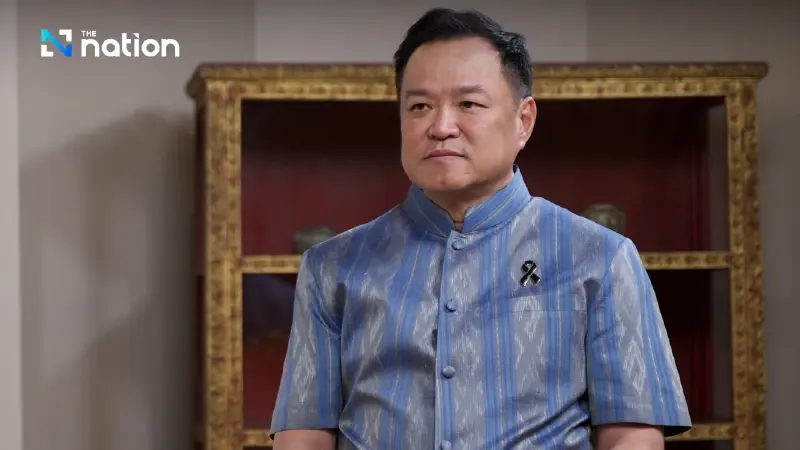


Only two of seven Prachin Buri factories had licences, says Anutin, who expects to announce curbs on mining chemical exports around 30 November.
- Prime Minister Anutin Charnvirakul ordered the closure of illegal e-waste plants in Prachin Buri after finding they were mixing ground-up waste with soil and distributing it to villagers as fertilizer.
- Anutin has initiated an inquiry by the Department of Special Investigation (DSI) to determine if public officials were corruptly involved in the licensing and operation of the illegal e-waste businesses.
- The government plans to announce a ban on the export of chemicals used for ore processing in Myanmar to address cross-border contamination of the Kok, Sai, and Ruak rivers.
Prime Minister Anutin Charnvirakul said on 28 November that he had ordered illegal electronic waste plants in Prachin Buri to close after finding conditions “worse than I expected”. He said operators had mixed ground-up waste with soil and given it to villagers as fertiliser. He asked the Department of Special Investigation (DSI) to examine whether public officials had helped the businesses operate.

Speaking on Talk with PM Anutin, the prime minister also said he expected the government to announce a ban around 30 November on exports of chemicals used to process ore in Myanmar. The proposed measure is part of Thailand’s response to contamination in the Kok, Sai and Ruak rivers.
Only two of seven factories had licences
Anutin, who is also interior minister, said only two of the seven factories in the area he visited on 24 November had licences. Residents’ complaints had prompted inspections. He called for a review of who issued the permits, who was responsible for inspections and how unlicensed operators had remained in business.
Operators recovered valuable metals such as copper and aluminium, Anutin said, but failed to dispose of the residue properly. Some of it was dried, ground up and mixed with soil. “They handed the danger on to the villagers and told them they could use it as fertiliser,” he said.
Waste operators are responsible for material from the point they receive it through to final disposal, Anutin said. Sending unusable residue to landfill or to an authorised incinerator costs more than offloading it on the community.
Investigators to examine possible official involvement
Thailand prohibits e-waste imports, but Anutin said some businesses used legitimate operations as cover to bring in falsely declared shipments. Waste arrived by the container load, sometimes compressed into bales so large that he questioned how they could have escaped notice.
Anutin called for the prosecution of anyone responsible, including owners, shareholders, directors and operators. The DSI had already opened a special case on 9 November into suspected smuggling of prohibited hazardous materials in Prachin Buri and other provinces. Anutin wants investigators to follow the evidence into possible corruption in licensing and enforcement.
Foreign nationals found to have committed serious offences would be considered for deportation, he said. He discussed changes to ministerial rules to allow the interior minister to act more quickly. Cases involving people who had acquired Thai citizenship would have to be considered under the relevant nationality laws.
Proposed chemical export ban targets upstream pollution
Anutin linked contamination in the Kok, Sai and Ruak rivers to mining in Myanmar and sediment carried downstream into Thailand. He said he had asked Myanmar to take responsibility for the cross-border effects. During a visit to China, a destination for some of the processed minerals, he also raised the issue with Chinese leaders. According to Anutin, they told him China did not support industries that harmed public health.
The National Security Council secretary-general said the proposed export ban, initially covering two chemicals, was due before the Defence Council on 30 November and the Cabinet on 1 December. Thailand and Myanmar have also agreed to establish six water-quality monitoring stations, four on the Kok and two on the Sai.
Anutin acknowledged that some readings had exceeded standards on some days. He said agencies had not concluded that residents generally needed to change their daily routines. The Department of Disease Control has issued more specific advice for five Mae Sai subdistricts, urging residents to avoid drinking or cooking with untreated Sai River water and eating aquatic animals caught there.
Deputy Prime Minister Yodchanan Wongsawat is coordinating the northern response with researchers, health and environment officials, and local authorities. Anutin said the Provincial Waterworks Authority was expanding reserve water sources and treatment capacity under plans that predated the contamination reports.
Cross-border haze and the Bangchak fire
On smoke from agricultural burning in neighbouring countries, Anutin said Thailand had stopped buying produce from sources where burning caused pollution to drift across the border. He left open the possibility of further trade measures alongside talks with neighbouring governments.
Anutin also addressed the 26 November fire at Bangchak’s Phra Khanong refinery on Sukhumvit Road in Bangkok. He said he had been told at the time of the interview that the flames were out, although smoke remained. Government teams had joined the refinery’s emergency crews to contain the fire and protect nearby residents. Bangchak said it shut down all production units after the fire.
Anutin said transparent enforcement, public scrutiny and action against corruption were standards Thailand needed to uphold as it pursued membership of the Organisation for Economic Co-operation and Development.
